
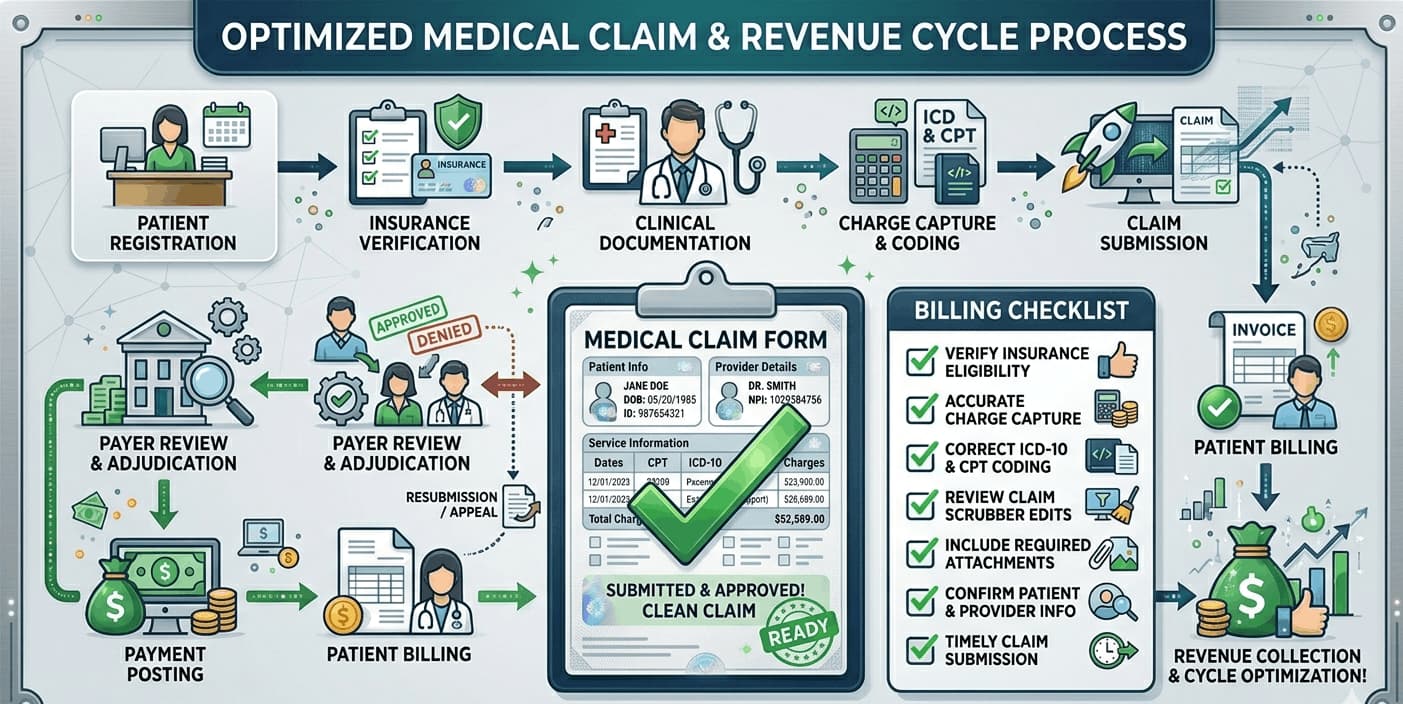


Medical billing does not forgive small mistakes. One wrong digit. One missing code. One expired authorization number. And a claim gets rejected — costing your practice time, money, and staff energy that no one can afford to waste.
That’s why clean claims matter more than most billing teams realize.
Practices that consistently submit clean claims spend less time correcting and resubmitting work that should have gone through the first time. When claim quality slips, the cost is spread across rejections, resubmissions, denials and delayed payments — which is exactly why it is easy to miss.
This guide explains what “clean claim” means in each context where the term is used, what goes into one, and how to measure your own clean claim rate, first-pass acceptance and denial rate with the calculator below — using definitions that are stated, sourced and kept separate.
⚡ TL;DR — Quick Reference Summary
| Topic | Key Takeaway |
|---|---|
| What is a clean claim? | A claim the payer can process without having to obtain more information. The formal wording differs across Medicaid, Original Medicare and Medicare Advantage. |
| Payment timeline | Program-specific. Medicaid agencies must pay 90% of practitioners’ clean claims within 30 days of receipt; Original Medicare pays interest on clean claims not paid within 30 days. Commercial timing depends on the contract and applicable state law. |
| Clean claim rate | A pre-submission measure (HFMA MAP Key CL-1): claims that pass your edits with no manual intervention. It is not a payer acceptance rate or a payment rate. |
| Rejection vs. Denial | Rejection = returned before the payer processes the claim; correct and resubmit. Denial = a negative determination after processing; appeal, reopening or corrected-claim rules apply. |
| Common causes of rejections and denials | Outdated insurance info, missing prior auth, mismatched CPT/ICD-10 codes, wrong POS code. |
| Best prevention tools | Claim scrubbing software, real-time eligibility verification, annual coder training. |
| Timely filing | Original Medicare: within 1 calendar year after the date of service (42 CFR 424.44). Medicaid, Medicare Advantage and commercial limits are set by the state program, plan or contract. A claim filed late can be denied no matter how clean it is. |
What Exactly Is a Clean Claim in Medical Billing?
In everyday billing use, a clean claim contains all required information, is free from errors, and can be processed by a payer without any additional information or correction. That working description is useful, but the formal definitions come from specific programs — and they are not identical.
Three Different Things Called a “Clean Claim”
The phrase appears in federal Medicaid rules, in CMS’s instructions for processing Original Medicare claims, in Medicare Advantage regulations and on revenue cycle dashboards. Each use answers a different question, so the definitions are not interchangeable.
Medicaid: 42 CFR 447.45
For state Medicaid agencies, a clean claim is one that can be processed without obtaining additional information from the provider or from a third party. The regulation uses that definition to set payment timeliness: the agency must pay 90 percent of clean claims from practitioners in individual or group practice or shared health facilities within 30 days of receipt, and 99 percent within 90 days. It also requires providers to submit claims no later than 12 months from the date of service.
Original Medicare: CMS Claims Processing Manual
In the Medicare Claims Processing Manual, Chapter 1, §80.2, a clean claim is one the Medicare contractor does not need to investigate or develop outside its Medicare operation before payment. Clean claims wait out a payment floor before they can be paid — CMS tells providers to wait at least 14 days for electronic claims and 29 days for paper claims before checking payment status — and Medicare pays interest on clean claims that are not paid within 30 days of receipt.
Medicare Advantage: 42 CFR 422.500 and 422.520
Medicare Advantage regulations define a clean claim as one with no defect, impropriety, missing required substantiating documentation or special circumstance that prevents timely payment, and that otherwise meets Original Medicare’s clean-claim requirements. Under 42 CFR 422.520, an MA organization must pay 95 percent of clean claims within 30 days of receipt when the claim is for an enrollee of an MA private fee-for-service plan or for services not furnished under a written agreement with the provider. Contracted providers are paid under the prompt payment terms of their contract.
None of these is a performance metric. They describe how a program treats an individual claim and when it must pay. The rates practices track — clean claim rate, first-pass acceptance and denial rate — are operational measures with their own definitions, which is why each formula in the calculator below names its source.
Why Does a Clean Claim Rate Matter for Revenue Cycle Performance?
Your clean claim rate shows how many claims clear your own edits without anyone having to touch them. A falling rate usually means more manual work before claims go out, and every claim that needs rework reaches the payer later — one of the upstream drivers of the losses estimated by the revenue leakage analyzer.
Clean claim rate is only one view. Once claims leave your system, first-pass acceptance shows how many got past the payer’s front-end edits, and denial rate shows how many were denied after the payer processed them. The three can move independently, which is why this guide does not collapse them into a single number.
What Are the Required Components of a Clean Claim?
Think of a clean claim like a complete application — every single field has a job to do. A single missing or incorrect entry — even a typographic error — triggers a rejection. Here’s what every clean claim needs:
Patient Demographics
These four fields are the first thing any payer checks. They must match exactly what the payer has on file.
Provider Information
Your NPI is your billing identity — get this wrong and nothing else matters. Every provider must be currently enrolled with the payer.
Payer Information
Payer IDs change more often than most billing teams track. Outdated payer IDs are a common — and avoidable — source of rejection.
Diagnosis Codes (ICD-10-CM)
Specificity is non-negotiable with ICD-10. Unspecified codes get flagged. To confirm a code was valid and billable for the date of service, use the ICD-10-CM code validity checker.
Procedure Codes (CPT/HCPCS)
Get the modifier wrong and you’ll never know why it rejected. Modifier errors are a common cause of clean claim failure.
Date of Service
One wrong date and the entire claim falls apart. Even a one-day discrepancy triggers a rejection.
Place of Service (POS) Code
Telehealth billing made this field more critical than ever. Claims submitted with the wrong POS code can be rejected or denied.
Prior Authorization Number
Missing or invalid authorization information is a preventable cause of both rejections and denials.
Referring Provider Details
Skip this on a specialty claim and the rejection is automatic.
None of these fields is optional — and payers know it. Payers run electronic edits against every submission in seconds. There’s no margin for guesswork.
What Is the Difference Between a Claim Rejection and a Claim Denial?
Most billing teams use these two words interchangeably — and that’s exactly where the confusion starts. A claim rejection means the claim was turned away due to errors in format, missing data, or eligibility issues. A denial occurs after adjudication — the payer received and reviewed the claim but decided not to pay it.
The distinction is more than vocabulary. For Original Medicare, CMS states that a claim returned as unprocessable because of incomplete or invalid information is not treated as a claim, is not denied and has no appeal rights, and that a rejected claim is not considered received until it is resubmitted as a corrected, complete claim (Claims Processing Manual, Chapter 1, §80.2.1 and §80.3.1). A denial is different: the payer processed the claim and made a determination, and the next step is an appeal, reopening or corrected claim under that payer’s rules.
Keeping them apart also keeps your numbers honest. The calculator below never counts rejections as denials: rejections belong in first-pass acceptance, and denials belong in denial rate. Working the denials themselves is covered in claim denial management.
How Do You Calculate Clean Claim Rate, First-Pass Acceptance and Denial Rate?
“Clean claim rate” is often used loosely for four different measures. They answer different questions and use different denominators, so the same month of claims can produce four very different percentages. The calculator keeps them separate and shows the formula behind each result.
Denial Rate Calculator
Whichever rate you track, keep the claim population and the measurement period consistent from month to month, and break results down by payer and provider. Comparing against your own prior periods is more reliable than comparing against a published figure that may rest on a different definition.
Aggregate numbers hide the real story. Breaking it down by provider reveals coding gaps. The granularity tells you exactly where your process is failing — and that’s where the fix needs to happen.
Partial Denials and Gross Charges
A partial denial still counts. If a $1,000 claim has one $300 line denied and the rest paid, it counts as a denied claim in HFMA’s remittance denial rate. In the dollar-based initial denial rate, the claim-level method counts the claim’s full $1,000 in gross charges, while the line-level method counts only the $300 line. Gross charges are billed charges — not the allowed amount, the paid amount, contractual adjustments or patient responsibility — so neither dollar rate measures lost revenue.
Which Denial Rate Answers Your Question?
HFMA publishes more than one denial measure, and each counts different claims against a different denominator. Choose the one that matches your question, then keep using the same one.
- Of the claims payers answered this month, how many came back with a denial? Use the remittance denial rate (HFMA MAP Key AR-5): claims remitted with a denial code ÷ all claims remitted in the month.
- How often are newly submitted claims denied the first time? Use the initial denial rate by volume (HFMA Claim Integrity Task Force): claims with a first denial this month ÷ average monthly claims submitted in the prior three months.
- How much of what you bill is tied to first denials? Use the initial denial rate by gross charges (HFMA Claim Integrity Task Force): gross charges on those first denials ÷ average monthly gross charges submitted in the prior three months. It is a charge-weighted measure of denial exposure. This is not lost revenue.
- How much net revenue was written off to denials? That is a different, financial measure: denial write-offs as a percentage of net patient service revenue (HFMA MAP Key AR-6), or net denial write-offs after recoveries ÷ average monthly net patient service revenue. It is not a denial rate, and the calculator does not compute it.
The details matter. AR-5 counts zero-pay and partial-pay remittances that carry a denial, and denials on appeal, after HFMA’s listed exclusions. The two initial denial rates count each claim once, at its first denial in the reporting month, and leave rebills out. For the dollar version, the claim level uses the full claim charge and the line level uses only the denied lines, which the task force describes as best practice.
Same Claims, Four Results
Illustrative example. These numbers are invented to show the arithmetic. They are not a benchmark, a typical result or data from any practice.
- Claims submitted in the three months before the reporting month: 1,020, 980 and 1,000, an average of 1,000.
- Gross charges submitted in those months: $204,000, $196,000 and $200,000, an average of $200,000. The claim lines add up to the same totals.
- In the reporting month, 60 claims received their first denial, and 25 of them were partial denials. The full charges on those 60 claims total $18,000; the denied lines alone total $9,600. No rebills are included.
- Also in the reporting month, payers remitted 1,150 claims. After the AR-5 exclusions, 72 of those remittances carried a denial code: the 60 first denials plus 12 denials on appeal of claims first denied earlier.
| Measure | Calculation and result |
|---|---|
| Remittance denial rate (AR-5) | 72 ÷ 1,150 = 6.3% |
| Initial denial rate by volume | 60 ÷ 1,000 = 6.0% |
| Initial denial rate by gross charges, claim level | $18,000 ÷ $200,000 = 9.0% |
| Initial denial rate by gross charges, line level | $9,600 ÷ $200,000 = 4.8% |
The same claims produce four different percentages, and each is correct for its own definition. The remittance rate uses a different denominator and includes the 12 appeal denials. The claim-level dollar rate is higher than the volume rate because, in this example, the denied claims carry more charges than the average claim and the 25 partial denials count at their full claim charge. The line-level rate counts only the denied lines. Enter these figures in the calculator above to reproduce each result.
Why Your Numbers Differ
A denial rate from your billing system and one from a payer report, clearinghouse or outside review can both be calculated correctly and still disagree. Before comparing them, check how each handles these points:
- Denominator. Claims remitted in the month (AR-5) and the average number of claims submitted in the prior three months (initial denial rate) are different populations.
- Time period. A remittance-based rate follows when payers responded. The initial denial rate compares this month’s first denials with earlier submission volume.
- First or all denials. The initial denial rate counts each claim once, at its first denial. AR-5 also counts later denials on appeal.
- Rebills and corrected claims. The initial denial rate leaves rebills out. AR-5’s listed exclusions do not mention rebills, so reports built on it may treat them differently.
- Partial denials. AR-5 counts a partial-payment remittance with a denial as a denied claim. In the dollar rate, the claim level counts the whole claim’s charge and the line level counts only the denied lines.
- Exclusions. AR-5 leaves out non-covered-service denials assigned to patient responsibility (group code PR), other patient-responsibility denials, RAC recoupments, duplicate-claim denials, and shadow or encounter claims. A report that keeps any of them will show a different rate.
- Count or charges. A few high-charge denials move a dollar rate more than a count rate.
- Rejections. A claim rejected before the payer accepted it was never adjudicated, so it belongs in first-pass acceptance rather than a denial rate. For Original Medicare, a rejected claim is not considered received until it is resubmitted as a corrected, complete claim (Claims Processing Manual, Chapter 1, §80.2.1).
- Medicare returns on the remittance. Medicare can report a rejected or returned claim on the remittance, and the Claims Processing Manual describes returning unprocessable claims through the remittance process. A claim returned as unprocessable is not denied and has no appeal rights (Chapter 1, §80.3.1), so counting it as a denial adds a claim that is not a denial. This is a Medicare rule; check how other payers classify returned claims.
- Which acknowledgment counts as final. For first-pass acceptance, Medicare issues a 999 acknowledgment for each file and a 277CA acknowledgment for individual claims. A report that treats a different acknowledgment as final will count acceptances differently.
When two figures disagree, compare their definitions before comparing the percentages.
Why This Guide Shows No Benchmark
You will not find a target clean claim rate or an “average” denial rate here. There is no universal benchmark for these measures because results depend on the definition, payer mix, claim population, workflow and measurement period, and a figure built on one definition cannot be compared with a result calculated on another. The most reliable comparison is your own trend, measured the same way each period.
What Are the Most Common Errors That Prevent a Clean Claim?
These errors are common, preventable causes of rejections and denials:
- Outdated insurance information — patients change coverage without notifying the provider
- Missing prior authorization — procedures performed without payer approval
- Mismatched diagnosis and procedure codes — the CPT doesn’t support the ICD-10
- Duplicate claim submissions — common when tracking systems aren’t synchronized
- Wrong place of service code — especially frequent with telehealth billing
- Invalid or unenrolled NPI — particularly for newly credentialed providers
- Incorrect claim form — CMS-1500 used where UB-04 is required, or vice versa
- Unbundling CPT codes — billing separately for procedures that should be combined
Every one of these is preventable. That’s the point.
How Can You Actively Improve Your Practice’s Clean Claim Rate?
There’s no single tweak that fixes a broken billing process. It’s not a single fix. It’s a system.
Start with Claim Scrubbing Software
Most billing teams have this tool sitting inside their practice management system — underused or misconfigured. They catch errors that human review consistently misses at scale. Most practice management platforms include this functionality — but many practices underuse it or skip configuration entirely.
Verify Eligibility in Real Time
Checking eligibility before or on the day of service catches coverage changes before the claim is built. Outdated coverage information is a preventable cause of rejection.
Invest in Annual Coder Training
October and January are the two most important dates on any medical coder’s calendar. Coders who don’t keep current produce outdated claims. The cost of training is a fraction of the cost of rework.
Build a Denial Management Feedback Loop
Reworking denied claims without fixing what caused them is billing whack-a-mole. Don’t just rework individual claims — close the gap that created them.
A feedback loop only works if denials are tracked by reason, payer and provider, so the same root cause can be found and fixed before the next batch of claims goes out.
How Do Payer-Specific Rules Affect What Makes a Claim Clean?
Not every payer defines a clean claim the same way. Medicare, Medicaid, and commercial insurers each operate on their own set of edits, modifier requirements, and documentation standards. What clears one payer’s scrubber fails another’s — and that’s a trap many practices walk straight into.
This is where payer-specific rule libraries in your claim scrubbing software earn their value. A generic scrubber catches common errors. A payer-calibrated scrubber catches the errors that specific insurance contracts create.
For Original Medicare, the filing deadline comes from 42 CFR §424.44: claims must be filed within one calendar year after the date of service. That regulation sets the filing limit only. Medicare’s clean-claim and payment-timing terms come from CMS’s claims processing instructions, described earlier in this guide.
Medicaid adds another layer entirely. Each state runs its own program with its own rules, timely filing limits, and prior authorization requirements — the most common Texas TMHP rejection codes show how specific those state-level edits get. A multi-state practice needs payer-specific workflows, not a one-size-fits-all submission process.
Commercial payers are the most unpredictable of the three. Their rules shift with contract renewals and policy updates. The practices that stay ahead of this track payer portal announcements, update their scrubbing rules quarterly, and designate a billing team member to monitor policy changes by payer.
How Does Timely Filing Affect a Clean Claim?
A claim filed after the applicable deadline can be denied for timely filing, no matter how clean it is. Filing limits vary by program, plan and contract.
Original Medicare requires claims to be filed within one calendar year after the date of service. Federal Medicaid rules require state agencies to have providers submit claims no later than 12 months from the date of service, and each state program publishes its own filing rules. Medicare Advantage plans and commercial payers set limits by plan or contract, so check the payer’s provider manual or your agreement rather than relying on a general range.
Pro Tip: Set internal submission targets at least 30 days ahead of any payer’s filing deadline. One documentation delay shouldn’t cost you the entire claim.
Timely filing windows are part of clean claim strategy — not an afterthought. Track deadlines by payer, flag aging claims in your AR before they become uncollectable write-offs, and train your team to treat the filing window as a hard boundary, not a suggestion.
Resubmissions need the same care. Whether a corrected claim or an appeal is judged against the original filing date depends on the payer and the program. In Original Medicare, a rejected claim is not considered received until it is resubmitted as a corrected, complete claim, so keep proof of every submission and acknowledgment.
What Is the Real Cost of a Low Clean Claim Rate to Your Practice?
The cost of a low clean claim rate is not only the staff time spent on rework.
Extended AR days mean delayed cash flow — which affects payroll, supply purchasing, and operational stability for small and mid-size practices. Denied claims that don’t get appealed become write-offs. Write-offs that accumulate go unnoticed until a revenue cycle audit surfaces them, often months later when the damage is already done.
Payer relationships suffer too. Chronic claim quality issues can trigger a pre-payment review — a process where the insurer holds payments pending additional documentation. That is a cash flow crisis that is entirely avoidable with upstream process discipline.
Lasting improvement comes from treating claim quality as an operations problem, not only a billing problem: fix the workflow that produced the errors, not just the individual claims.
Is a Clean Claim Guaranteed to Result in Full Payment?
Not automatically, no. A clean claim is processed without obstruction — but payers may still apply contractual adjustments, patient cost-sharing amounts, or coordination of benefits rules. The claim gets reviewed and decided quickly. Full payment depends on the patient’s benefit structure and the provider’s payer contract.
What you’re actually aiming for is speed and certainty of decision — not just payment. The goal is to eliminate preventable delays and rework. Submit clean. Get a decision fast. Follow up on anything that isn’t paid correctly.
What Role Does Claim Scrubbing Play Before Submission?
Before a claim ever reaches the payer, it should pass through one more checkpoint. Claim scrubbing checks code combinations, payer coverage rules, missing required fields, and formatting requirements — all before the claim is transmitted.
Think of it as a preflight checklist for billing. It doesn’t replace human expertise. But it catches what human eyes miss when processing hundreds of claims per week. Combined with eligibility verification and trained coders, claim scrubbing is one of the highest-leverage tools available in revenue cycle management.
Leave a Reply