
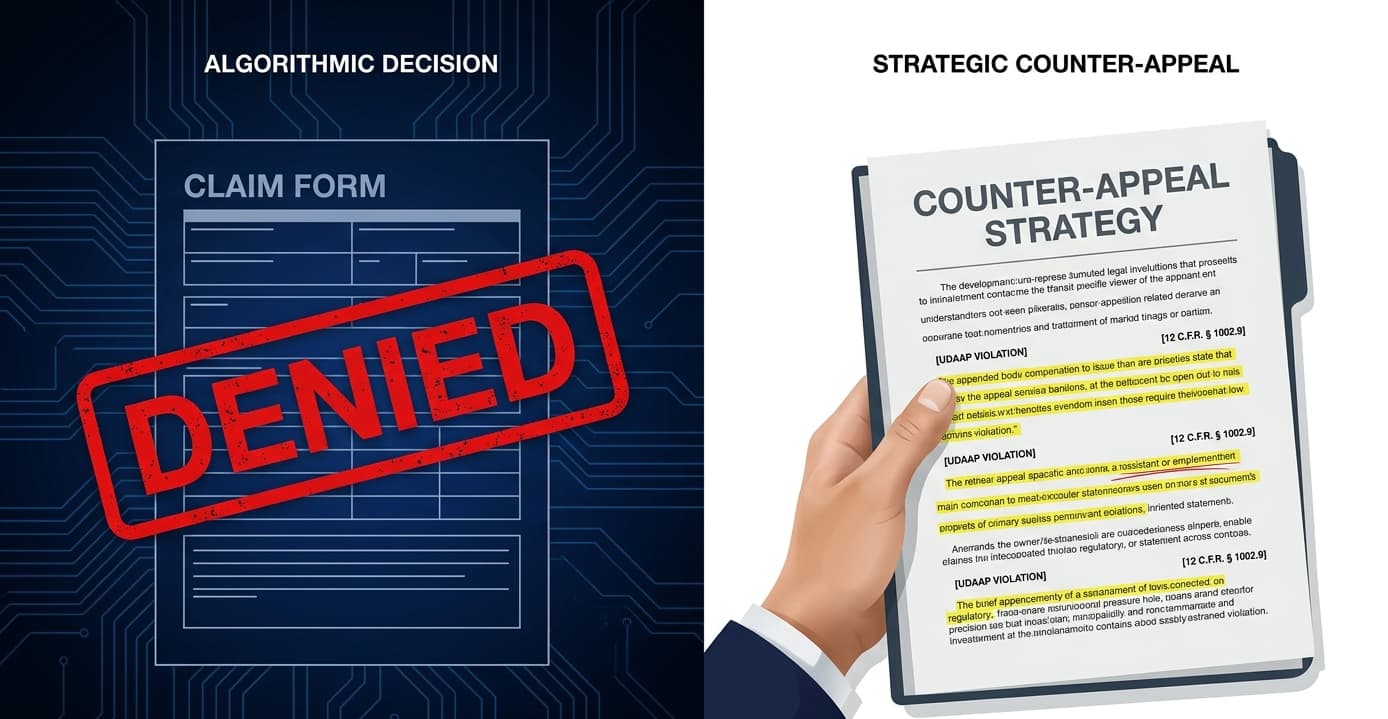

What exactly is an automated payer algorithmic denial, and why is the traditional appeal process failing against it?
An automated payer algorithmic denial occurs when a health plan’s decision-support system — not a licensed physician — flags a claim or prior authorization request for rejection based on pattern-matching against aggregate population data, cost thresholds, or proprietary clinical criteria. These systems generate decisions at machine speed, often within minutes of submission, making them structurally distinct from human utilization management and requiring a fundamentally different appeal architecture.
The traditional appeal process was built to dispute a physician reviewer’s clinical judgment. It fails against algorithmic denials because it argues medicine when the real vulnerability is process. When nH Predict — UnitedHealthcare’s naviHealth-developed AI tool — reportedly denied post-acute care claims at a rate where 90% of appealed decisions were reversed, the evidence wasn’t that the care was medically unnecessary. The evidence was that a statistical model was substituting for individualized review in direct conflict with <a href=”https://www.cms.gov” target=”_blank”>CMS</a> requirements under 42 CFR § 422.101.
That distinction is the foundation of every effective appeal strategy in 2025 and beyond.
How does the regulatory landscape now actively arm providers against algorithmic denials?
Under OIG‘s February 2026 Medicare Advantage Industry Compliance Program Guidance (ICPG), algorithm-based coverage decisions that fail to account for individual patient medical history, provider recommendations, or clinical notes constitute a defined compliance risk. CMS’s February 2024 HPMS memo had already clarified that AI tools cannot solely dictate coverage decisions. Providers now have two sequential regulatory weapons: the CMS prohibition on sole-algorithm determinations and the OIG’s directive that MA organizations must validate AI tools for inappropriate auto-denial bias.
This regulatory architecture transforms the appeal. Instead of proving medical necessity in isolation, a well-constructed appeal now simultaneously argues clinical merit and process deficiency. <a href=”https://oig.hhs.gov” target=”_blank”>OIG’s 2022 and 2023 reports</a> on MA denials, cited directly in the ICPG, documented “widespread and persistent problems related to inappropriate denials.” Citing those findings in an appeal letter reframes the dispute from a clinical disagreement into a documented systemic pattern — a categorically harder position for a payer’s appeals team to dismiss.
The US Senate Permanent Subcommittee on Investigations’ October 2024 “Refusal of Recovery” report added another layer. It documented that UnitedHealth’s post-acute denial rate more than doubled after deploying nH Predict. Reference that report number in appeals for skilled nursing or home health denials. Payer appeals reviewers know it exists. Invoking it signals that the provider understands the legal terrain.
What does an operationally effective appeal strategy for algorithmic denials actually look like?
An effective appeal strategy for automated payer algorithmic denials requires three sequential phases: denial fingerprinting, documentation weaponization, and escalation architecture. Each phase must be executed with forensic precision before a single appeal letter is drafted.
Denial Fingerprinting. Every algorithmic denial leaves a behavioral signature. Document denial velocity — claims rejected within 24 hours of submission are almost never subject to individualized physician review and are therefore immediately arguable on process grounds. Track denial patterns by CPT code cluster, place of service, and MA plan. Kodiak Solutions’ 2025 analysis found that Medicare Advantage plans had initial and final denial rates more than double those of traditional Medicare, with denials and uncompensated care representing more than $48 billion in revenue losses across 2,300 hospitals. That pattern data is your first argument: this denial is not an isolated clinical disagreement; it is part of a documented, plan-specific pattern. Healthcare Finance News
Build a payer intelligence dossier for each major commercial and MA plan in your payer mix. Log denial reason codes (CO-4, CO-50, CO-97, N115), match them to the payer’s publicly filed coverage determination policies, and identify where their internal criteria diverge from CMS Local Coverage Determinations (LCDs) or National Coverage Determinations (NCDs). That divergence is legally exploitable.
Documentation Weaponization. According to the Optum 2024 Revenue Cycle Denials Index, national denial rates hold at approximately 12%, with 84% of claims denied in 2023 classified as potentially avoidable. Most of those avoidable denials trace back to documentation that gives the algorithm an easy rejection pathway. Algorithmic systems screen for the presence or absence of specific clinical language using NLP. They do not read. They match. IKS Health
The operational correction is to template clinical documentation by denial type rather than by specialty. For medical necessity denials, ensure attending physician notes explicitly name the patient’s functional deficits using language that maps directly to the payer’s own coverage criteria — not just the treating physician’s narrative. For post-acute care specifically, document cognitive status, ADL dependency scores, and anticipated recovery trajectory in quantified terms. nH Predict inputs include mobility scores and living situation assessments. Mirror that data in the medical record before submission.
Which specific appeal pathways deliver the highest overturn rates against algorithm-generated denials?
The highest-yield appeal pathway is the physician-to-physician peer-to-peer review, initiated immediately upon denial — before the formal written appeal clock runs. Algorithmic systems generate denials that no human physician at the payer has reviewed. A peer-to-peer request forces a licensed physician onto the record. That physician cannot rely on the algorithm’s output as their sole basis for upholding the denial without incurring the exact compliance risk OIG’s 2026 ICPG identifies.
Research from Kaiser Family Foundation found that approximately 40% of internal appeals result in overturned denials, while Medicare Advantage appeals see overturn rates around 75% according to government data. The gap between those figures is the peer-to-peer leverage window. Most denials that reach formal appeals were never subject to peer-to-peer. Correcting that sequencing alone shifts overturn probability significantly. Counterforce Health
For denials that survive peer-to-peer, escalate immediately to the Independent Review Organization (IRO) pathway for MA plans, or external appeal under ERISA for commercial plans. IROs are structurally insulated from payer financial incentive pressure and are required by CMS to apply Medicare coverage rules — not the MA plan’s internal algorithmic criteria. This is where the regulatory mismatch between payer AI output and legal coverage standards becomes dispositive.
For high-dollar denials, file a complaint simultaneously with the state insurance commissioner. State regulators in Wisconsin, Montana, and several other jurisdictions now actively monitor algorithmic denial rates and have statutory authority to require payer-level reporting. A study published in JAMA Health Forum found that states with stricter regulations on algorithmic denials saw 23% higher success rates for patient appeals. That correlation gives the commissioner complaint added strategic weight as a parallel pressure mechanism. Counterforce Health
How should revenue cycle teams prioritize appeals when denial volumes are overwhelming staff capacity?
Revenue cycle teams should prioritize algorithmic denial appeals using a three-variable triage model: financial value, appeal success probability, and timely filing deadline proximity. These three variables, scored and weighted within your practice management system, prevent the most common failure mode: teams spending equal effort on a $180 lab denial and a $14,000 surgical facility denial.
Providers spent nearly $20 billion in 2022 pursuing delayed payments and denials, more than half of which were eventually overturned. That number reflects the cost of undifferentiated effort. The $19.7 billion annual administrative cost figure, at approximately $118 per claim to manage denials, means every appeal that fails on a claim worth less than $118 in net recoverable revenue is net negative. Build that floor into your triage logic explicitly. Ensemblehp
Timely filing is the single largest unforced error in algorithmic denial management. Payers that use automated denial systems tend to batch-send EOBs on compressed timelines. Map each commercial and MA plan’s appeal deadline to your clearinghouse’s ERA delivery lag, and build a standing 15-day buffer into your workflow calendar. A technically valid appeal filed one day past deadline is a permanent write-off regardless of clinical merit.
What financial and compliance risks make ignoring algorithmic denials more dangerous than the cost of appeals?
Unchallenged algorithmic denials create three compounding financial risks beyond the initial revenue loss: write-off accumulation, under-coded pattern reinforcement, and False Claims Act exposure from the opposite direction.
Write-offs from uncontested denials distort your clean claim rate and trigger payer contract renegotiation leverage against you. When your data shows a 14% denial rate, your contract renewal position weakens regardless of the clinical legitimacy of those denials.
More critically: if your billing team, under pressure to close AR, begins pre-emptively under-coding or avoiding certain procedure codes because “the payer always denies them,” you have created an internal pattern that erodes compliant revenue capture. That pattern, if audited, looks like systematic under-documentation — which creates its own OIG risk profile.
The False Claims Act exposure runs both directions. Payers face it for patterns of wrongful denial. Providers face it for improper appeals that misrepresent clinical facts to overturn valid denials. The discipline required to build a forensically accurate appeal — grounded in actual clinical documentation, actual coverage criteria, and actual regulatory citations — is the same discipline that insulates the practice from both risk vectors simultaneously.
What is the single most important operational change a provider can make today to improve algorithmic denial appeal outcomes?
The single highest-impact operational change is assigning a dedicated payer algorithm analyst — a biller or coder with cross-trained clinical abstraction skills — whose exclusive function is to maintain payer-specific denial intelligence and construct the first 72 hours of every appeal response. This role does not exist in most practices. It should. The asymmetry between a payer deploying a multi-million-dollar AI adjudication system against a billing team using generic appeal letter templates is the core structural problem. Closing that gap requires a dedicated human intelligence function on the provider side — one who reads OIG reports, tracks payer policy updates, monitors litigation developments like the Lokken v. UnitedHealth Group case, and translates that intelligence into appeal language before the deadline arrives.
The regulatory window to exploit algorithmic denial vulnerabilities has never been wider. OIG’s 2026 ICPG is explicit. CMS’s 2024 guidance is on record. The litigation infrastructure is building. Providers who treat appeals as administrative chores will continue hemorrhaging recoverable revenue. Those who treat them as a forensic discipline — grounded in regulatory intelligence, clinical precision, and payer-specific behavioral analysis — will systematically outperform the algorithm.
The information in this article reflects regulatory guidance current as of May 2026 and is intended for healthcare executives, revenue cycle professionals, and compliance officers. It does not constitute legal advice. Consult qualified legal counsel for case-specific compliance determinations.
Leave a Reply