

What Exactly Changed in Skin Substitute Reimbursement on January 1, 2026?
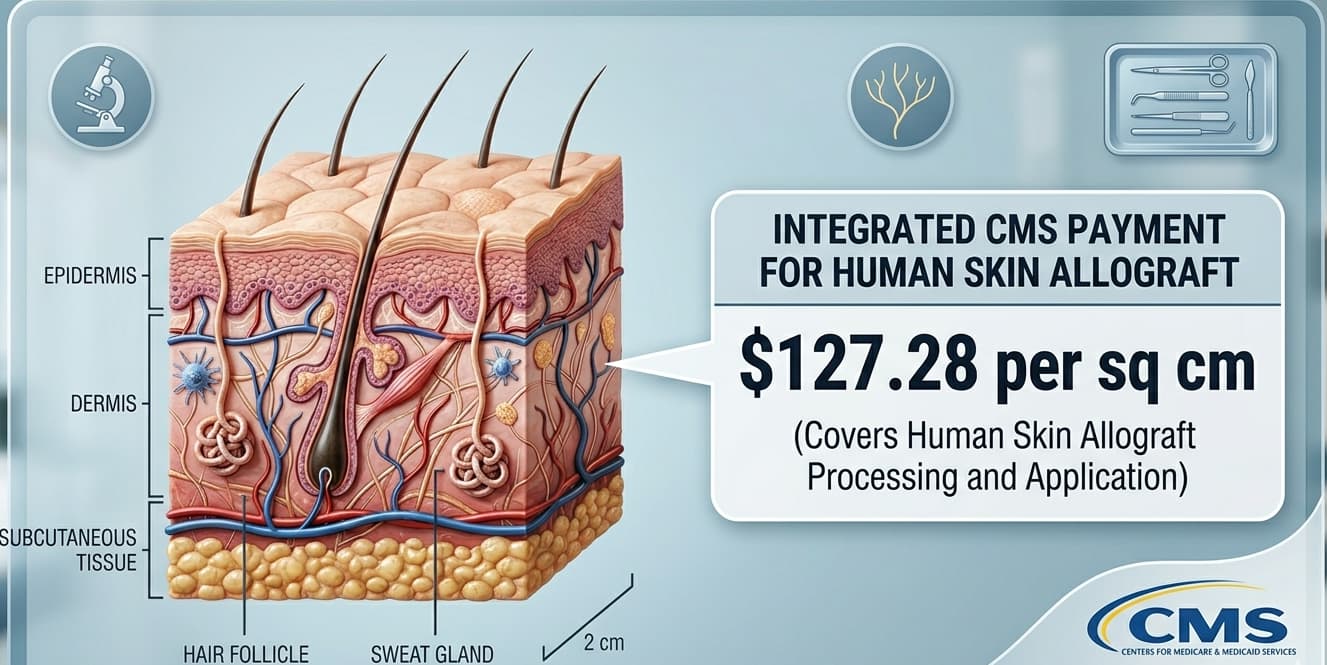
Effective January 1, 2026, CMS finalized a fundamental restructuring of Medicare skin substitute payments under the Physician Fee Schedule. The agency reclassified nearly all skin substitutes from separately billable biologicals to incident-to supplies, replacing the ASP+6% payment model with a single national flat rate of $127.14 per square centimeter. The coding framework shifted to CPT codes 15271–15278 exclusively across all clinical settings, while HCPCS codes C5271–C5278 were permanently deleted.
That structural pivot is the most consequential reimbursement change to hit wound care since the 2019 MAC LCD consolidations. Before the rule, Medicare Part B spending on skin substitutes had exploded from $252 million in 2019 to over $10 billion in 2024—a nearly 40-fold increase in five years, driven in part by “gaming of the spread,” multiple claims submitted on the same date to stay below automated denial thresholds, and discrepancies between manufacturer-reported sales volumes and units billed to Medicare. Applied Policy
CMS drew the line. The 2026 rule is a direct financial and regulatory response, one that compresses margins for most practices and concentrates enforcement risk for any clinic that hasn’t updated its documentation and coding workflows from the ground up.
Which Skin Substitute Products Still Qualify for ASP+6% Reimbursement?
Only products licensed under Section 351 of the Public Health Service Act as full Biologics License Application (BLA) products retain the ASP+6% payment methodology in 2026. All other skin substitutes—including 361 HCT/P products, FDA 510(k)-cleared wound devices, and PMA-approved materials—are reimbursed at the $127.14 flat rate regardless of acquisition cost, brand, or clinical indication.
This FDA-classification-first coding logic is where most billing errors now originate. The HCPCS code you report must align with the product’s actual FDA regulatory pathway, not its marketing category or clinical name. CMS now categorizes skin substitutes by their FDA regulatory pathway—not by brand name or clinical indication—meaning any mismatch between the product’s classification and the billed code increases audit risk immediately. 247medicalbillingservices
A practice that stocks twenty skin substitute products likely has items spanning three or four distinct FDA categories. Map each one. Lock the formulary to the correct code. Then run margin analysis against the $127.14 ceiling before purchasing a single unit. Products with acquisition costs above $127.14 per square centimeter are margin-negative under Medicare by definition—a structural cash-flow risk that compounding denials will only worsen.
What Happened to the HCPCS C-Code Series for Skin Substitutes?
CMS deleted HCPCS codes C5271 through C5278 effective January 1, 2026. These codes previously covered low-cost skin substitute applications in hospital outpatient settings. Any claim filed with a deleted C-code after that date is automatically rejected at adjudication—not denied, but rejected—meaning it does not trigger timely filing protections and cannot be appealed through standard channels without correction.
Going forward, all skin substitute graft applications are billed using CPT codes 15271 through 15278 regardless of clinical setting, and any claims submitted with deleted C-codes will be rejected. Humanmedicalbilling
Hospital outpatient departments and ASCs that maintained separate code-to-setting mappings in their chargemasters must update those configurations immediately. This is a workflow issue, not merely a coding one. Billing teams should audit chargemaster line items against the current CPT 15271–15278 framework and retire any legacy C-code crosswalk tables from use.
How Must Providers Document Wound Care for Skin Substitute Claims in 2026?
For a skin substitute claim to survive audit in 2026, documentation must capture the wound type, precise surface area measurement, treatment duration, the conservative care provided and its failure, the specific product applied, and the exact application area—since reimbursement is now limited strictly to the area actually treated. Photographs are required by most MACs and must be dated, oriented, and accompanied by a measurement scale. Prior authorization tracking data must be retained in the record as well.
RAC auditors examine whether CPT codes billed are consistent with appropriate ICD-10 diagnosis codes, whether the quantity billed exceeds the number permitted under the LCD, and whether the correct Place of Service code was used—with payment methodology and coverage rules varying significantly by setting. Liles Parker PLLC
The operational problem most practices face is not intent—it is workflow. EHR templates built before 2026 typically capture a wound description and a CPT code. They do not capture the exact square centimeters applied versus ordered, the JW or JZ modifier rationale, the conservative care failure narrative, or the prior authorization UTN. Every one of those elements is now a denial trigger if absent. Rebuild your documentation templates around audit criteria, not around clinical convenience.
What Are the JW, JZ, and KX Modifiers, and When Are They Required?
The JW modifier reports discarded or unused skin substitute material from a single-dose vial or packaging. The JZ modifier attests that zero waste occurred—that the entire product was applied to the patient. The KX modifier signals that the provider is applying the skin substitute beyond four applications in a 12-week period, affirming in the claim itself that documentation supporting medical necessity for continued treatment exists in the record.
Reimbursement is limited strictly to the portion of the product actually applied to the patient, and discarded or unused skin substitute material is no longer separately billable to Medicare under the 2026 rules. Humanmedicalbilling
This wastage restriction is the most underestimated revenue risk in the post-January landscape. A practice that consistently opens large-format skin substitute sheets and applies partial areas without tracking the discarded square centimeters has no defensible claim for those wasted units. The JW and JZ modifiers are now the audit trail for every single application encounter, not optional administrative housekeeping.
What Is the WISeR Model and Which Providers Must Comply Right Now?
The Wasteful and Inappropriate Service Reduction (WISeR) Model is a six-year CMS Innovation Center prior authorization pilot that launched January 15, 2026, in Arizona, New Jersey, Ohio, Oklahoma, Texas, and Washington. It mandates prior authorization or pre-payment review for skin substitutes and thirteen other high-risk service categories in Traditional Medicare. Standard prior authorization decisions under WISeR take three business days, and the model uses AI and machine learning tools alongside human clinical review to make coverage determinations. Muni
For providers operating inside WISeR states, every skin substitute application requires a MAC-issued Unique Tracking Number (UTN) before or immediately after the service. UTNs are valid for 120 days from issuance; if a planned service is delayed beyond that window, a new prior authorization request must be submitted and a new UTN obtained before the claim can be filed. Claims submitted without a valid UTN are held for pre-payment review and face denial if authorization cannot be verified. HMS USA
The WISeR model also introduces a gold-card pathway: providers with consistent authorization compliance records may ultimately qualify for exemption from routine prior authorization requirements. CMS has signaled that gold-card criteria details will be released later in 2026. Practices should treat every denial and every authorization response today as institutional record-building for that exemption process.
What Is the Real False Claims Act Exposure for Skin Substitute Billing Errors?
False Claims Act exposure in skin substitute billing arises from billing for non-covered products, misclassifying FDA categories, applying skin substitutes without documented conservative care failure, exceeding application frequency limits, or structuring claims to stay below automated denial thresholds. The DOJ actively pursues FCA cases independently of whistleblowers, and OIG has added skin substitute billing to its formal oversight work plan.
The OIG has added skin substitute billing to its oversight work plan, and Medicare contractors—including Unified Program Integrity Contractors (UPICs) and Recovery Audit Contractors (RACs)—are actively targeting high-cost products and outlier billing patterns. These audits typically begin with records requests, but can quickly escalate to suspension of Medicare payments, recoupment demands, and referrals for fraud investigation. Insidethefalseclaimsact
In March 2025, CMS issued controversial LCDs for skin substitute grafts targeting diabetic foot ulcers and venous leg ulcers; though ultimately withdrawn in December 2025, heightened scrutiny by OIG and CMS has caused wound care providers to face increased Medicare audits, overpayment demands, and recoupment actions. The $3.2M ALJ ruling against a Florida wound care clinic and the $1.2 billion Arizona FCA fraud conviction make clear that enforcement is not theoretical. Many wound care providers assume that because Medicare paid a claim, it was compliant—that assumption is dangerous, because payers routinely conduct post-payment audits and DOJ regularly pursues FCA cases years after reimbursement. Foley & Lardner LLPHealthlawalliance
Internal audits, conducted quarterly at minimum, are no longer optional. Practices generating significant revenue from skin substitute applications should conduct prospective claim reviews before submission, not retrospective ones after a RAC or UPIC letter arrives.
The Strategic Operational Takeaway
The 2026 skin substitute reforms collapse four distinct risks into one billing encounter: coding accuracy, documentation completeness, prior authorization compliance, and product-margin viability. No single fix resolves all four.
Practices that survive this environment will do three things. First, they will rebuild their documentation templates around the MAC audit checklist, not around clinical workflow. Second, they will run product-level margin analysis monthly, removing formulary items whose acquisition costs exceed the $127.14 reimbursement ceiling. Third, they will treat the WISeR UTN as a prerequisite to scheduling, not to billing—catching authorization failures before the patient is on the table, not after the claim is rejected.
For authoritative guidance on coding updates, reference the CMS Physician Fee Schedule Final Rule directly at cms.gov/medicare/physician-fee-schedule and the OIG’s September 2025 skin substitute fraud, waste, and abuse report at oig.hhs.gov. Both documents should be required reading for every RCM director managing wound care revenue lines in 2026.
Leave a Reply