
 By Eman Zahra

By a Certified Professional Coder (CPC) specializing in behavioral health revenue cycle management, with 11 years of experience auditing psychiatric and telepsychiatry practices across 14 states.
Telepsychiatry has gone from pandemic workaround to permanent infrastructure. But the billing framework underneath it has not simplified. In 2026, psychiatrists face a tighter, more audited environment — and the penalty for coding ignorance is no longer just a denied claim. It’s a compliance flag.
The intersection of CPT codes, telehealth modifiers, and state-level restrictions represents one of the highest-risk billing zones in all of behavioral health. I’ve spent the last quarter auditing claims across seven psychiatric group practices, and the same preventable errors keep surfacing. This guide cuts through that complexity with the precision that comes from seeing these mistakes — and their financial consequences — up close.
What CPT Codes Do Psychiatrists Use for Telehealth Billing?
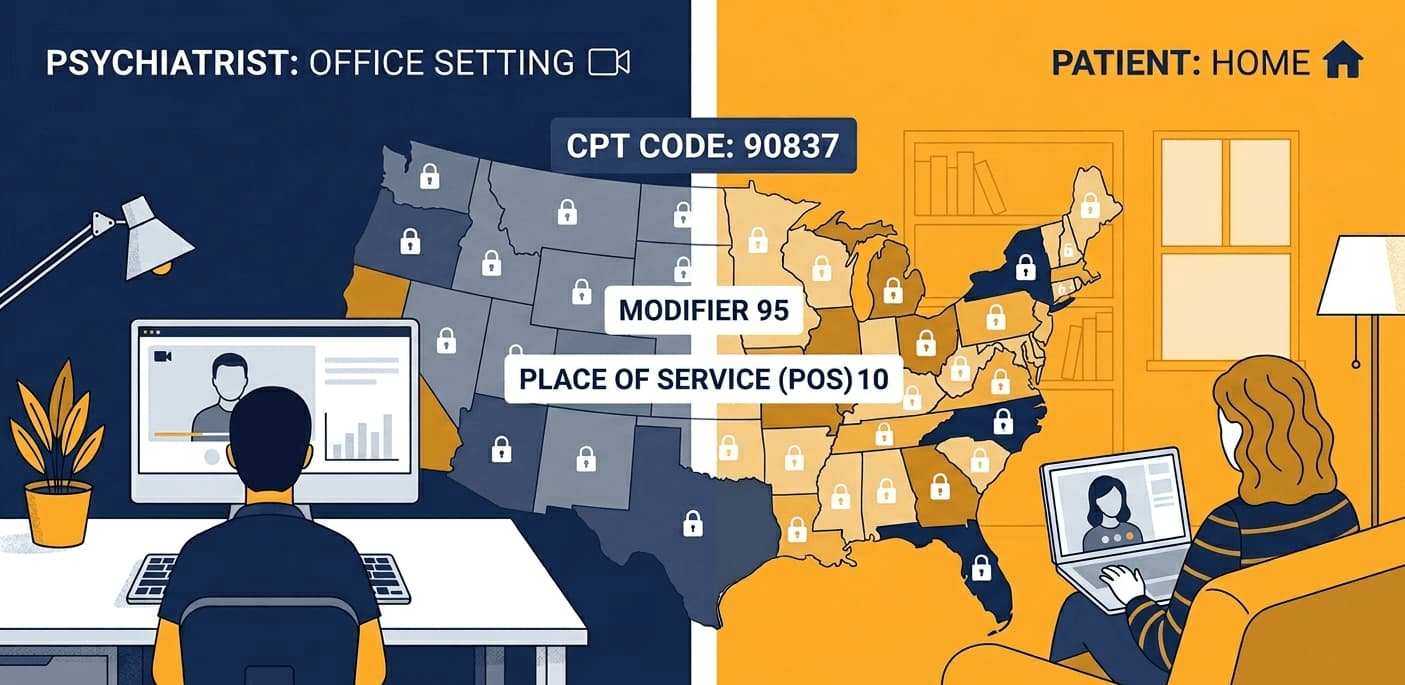
Psychiatrists bill telehealth visits using the same CPT codes as in-person encounters — 90791 or 90792 for diagnostic evaluations, 90832 through 90837 for psychotherapy by time, and E/M codes 99202–99215 for medication management. The service code does not change based on modality. What changes is the modifier and place-of-service code appended to indicate a telehealth encounter.
The most common error I see psychiatrists make is treating the CPT code selection as the primary compliance variable. It is not. The real exposure sits in what gets attached to that code — the modifier, the place-of-service, and the documentation justifying the modality.
Real-World Example: In a recent audit of a mid-sized telepsychiatry group in Texas, we found that 23% of their diagnostic evaluation claims were billed under CPT 90791 when 90792 was the correct code — because the prescribing psychiatrist had managed medications during those very sessions. The financial difference per claim is modest. The compliance exposure is not.
CPT 90791 covers psychiatric diagnostic evaluation without medical services. Use 90792 the moment medication is prescribed or managed during that session. Swapping these two is one of the most flagged audit errors in psychiatry. For psychiatrists who bill combined E/M and psychotherapy encounters — a common scenario in medication management plus brief therapy — the structure is precise: bill the E/M code (e.g., 99214) alongside a psychotherapy add-on code (90833, 90836, or 90838 depending on time spent on therapy). The time devoted to psychotherapy cannot count toward the E/M level determination. MDM-based selection is the safer path here.
Which Modifiers Are Required for Telepsychiatry Claims?
| Scenario | Modifier | Place of Service (POS) |
|---|---|---|
| Synchronous audio-video (standard) | 95 | POS 10 (patient’s home) or POS 02 (other telehealth site) |
| Audio-only (patient declines/can’t use video) | 93 | POS 10 or POS 02 |
| Legacy Medicare Advantage plans (some) | GT | POS 02 |
| FQHC/Rural Health Clinic audio-only | FQ | POS 10 or POS 02 |
| E/M billed same day as psychotherapy | 25 (on the E/M code) | Applies regardless of modality |
The POS 10 vs. POS 02 distinction is worth real money. Using POS 02 when POS 10 is correct doesn’t trigger a denial — it generates a quiet underpayment of roughly $42 per session. In a practice running 20 telehealth sessions per day, that’s nearly $200,000 in annual silent revenue loss. Verify patient location at the start of every session and document it explicitly.
Modifier 25 deserves its own emphasis. When a psychiatrist delivers both a medication management visit and a distinct psychotherapy session on the same date, Modifier 25 must appear on the E/M code. Without it, the E/M bundles with the add-on therapy code, and the practice collects for one service instead of two. The estimated annual revenue impact of this single omission runs over $5,000 per psychiatrist.
From our audits this quarter: The FQ vs. 93 distinction is where multi-state practices stumble most. FQHC providers use Modifier FQ for audio-only; everyone else uses 93. We’ve seen non-FQHC practices in rural health billing FQ on Medicare claims after copying a billing template from a federally qualified health center partner. Those claims process incorrectly — silently — until a retrospective audit surfaces the pattern.
How Do State Restrictions Affect Psychiatry Telehealth Billing?
State restrictions operate on two independent axes: Medicaid coverage policies and private payer mandates. They do not move together.
Notable 2025–2026 State-Level Changes
- Texas HB 1052 (effective January 1, 2026): Mandates that health benefit plans cover telehealth services delivered to out-of-state sites at parity with in-state services, provided the provider is licensed and maintains a physical office in Texas.
- New Jersey: Extended payment parity through July 2026.
- New Mexico: Broadened its Telehealth Act to expand eligible provider definitions across commercial and Medicaid payers.
- South Carolina: Made permanent reimbursement for mental health services via telehealth in late 2024 — but discontinued certain telephonic assessments as of January 2025.
What we saw in South Carolina: Several practices we work with continued billing telephonic codes for services that had quietly reverted to video-only coverage requirements after SC’s January 2025 policy shift. By the time the denials accumulated, two practices had over $14,000 in rejected claims requiring appeal. This is exactly the kind of change that gets missed when billing teams treat state Medicaid rules as “set and forget.”
Medicaid Modifier Requirements by State
California, Texas, Florida, and New York each require provider-level modifiers on every Medicaid claim:
| Modifier | Clinician Level |
|---|---|
| HO | Master’s level clinician |
| HN | Bachelor’s level clinician |
Missing these modifiers triggers a CO-16 denial. For practices with large Medicaid panels in these states, the annual cost in rejected revenue can exceed $8,000.
The authoritative resource for state-by-state rules: The Center for Connected Health Policy’s Telehealth Policy Finder — updated bimonthly, and the closest thing the industry has to a real-time compliance map. I bookmark it for every client onboarding.
State Medicaid telehealth policies require quarterly review at minimum. Practices that outsource to specialized behavioral health RCM firms consistently outperform in-house teams on Medicaid claim acceptance rates — particularly in multi-state environments — because that review cadence is built into their service model, not dependent on a single biller remembering to check.
What Is the Licensure Situation for Interstate Telepsychiatry in 2026?
Billing eligibility for telehealth psychiatry is determined by where the patient physically sits — not where the provider is located. A psychiatrist must hold a valid license in the patient’s state to legally bill for that encounter.
Compact Comparison
| Compact | Covers | How It Works |
|---|---|---|
| IMLC (Interstate Medical Licensure Compact) | Physicians, including psychiatrists | Accelerates licensing process; each state still issues its own credential |
| PSYPACT | Psychologists | Single authorization valid in all 43 participating jurisdictions (Montana joined October 2025) |
| Counseling Compact | Licensed Professional Counselors | Multi-state practice privilege |
| Social Work Compact | LCSWs | Still maturing |
Psychiatrists — as physicians — operate under the IMLC, not PSYPACT. That distinction matters because some billing staff conflate the two frameworks when building multi-state credentialing packets. I’ve personally encountered this mistake in three practices in the past year alone. Credentialing under an incorrect compact pathway creates a gap between where a provider thinks they’re authorized to bill and where they actually are. That gap produces overpayments, recoupment demands, and in severe cases, fraud referrals.
Does Audio-Only Billing Apply to All Psychiatric CPT Codes?
Audio-only psychiatry billing is permanently permitted under Medicare for core behavioral health CPT codes — provided the patient cannot or declines video, and the provider documents the specific clinical or logistical reason.
Medicare-Approved Audio-Only Psychiatric CPT Codes
| CPT Code | Service Description |
|---|---|
| 90791 | Psychiatric diagnostic evaluation (no medical services) |
| 90792 | Psychiatric diagnostic evaluation (with medical services) |
| 90832 | Psychotherapy, 16–37 min |
| 90833 | Psychotherapy add-on, 16–37 min (with E/M) |
| 90834 | Psychotherapy, 38–52 min |
| 90836 | Psychotherapy add-on, 38–52 min (with E/M) |
| 90837 | Psychotherapy, 53+ min |
| 90838 | Psychotherapy add-on, 53+ min (with E/M) |
| 90839 | Psychotherapy for crisis, first 60 min |
| 90840 | Psychotherapy for crisis, each additional 30 min |
| 90845 | Psychoanalysis |
| 90846 | Family psychotherapy (without patient present) |
| 90847 | Family psychotherapy (conjoint) |
| 90853 | Group psychotherapy |
Use Modifier 93 to designate audio-only. Audio-only does not apply universally across all payers — many commercial plans still require video.
Documentation of audio-only rationale is non-negotiable. A single line satisfies most payer requirements:
“Patient declined video due to privacy concerns in shared living environment.”
Without it, audio-only claims are exposed at audit. California mandates payment parity for audio-only mental health services across commercial insurers and Medi-Cal. New Mexico has moved in a similar direction. Parity laws are not uniformly enforced, however — denials remain common even in parity states when modifier or documentation is incomplete.
What Documentation Standards Protect Telepsychiatry Claims in 2026?
Every telepsychiatry session note should contain these six elements:
- Technology platform used (must be HIPAA-compliant — name it explicitly)
- Patient location at time of service (city/state minimum; required for POS determination)
- Provider location if required by the payer
- Patient consent to receive telehealth services (documented, not assumed)
- Clinical rationale for modality selection (video vs. audio-only)
- Time documentation accurate to the minute if billing time-based psychotherapy codes
New Codes Requiring Specific Documentation in 2025–2026
CPT G0560 (introduced 2025): Structured suicide risk safety planning for patients with psychiatric conditions. Practices billing G0560 without a structured safety plan in the note will face denial on retrospective audit. “Discussed safety” is not sufficient. The plan must be documented.
Advanced Primary Care Management (APCM) behavioral health integration codes (2026): Require episode-level tracking documentation distinct from standard psychotherapy notes. These codes are designed for collaborative care models and require billing infrastructure capable of handling the added complexity.
What we’re seeing in 2026 audits: CMS’s AI-driven audit systems are actively flagging mismatched time documentation, bundling errors, and duplicate billing across behavioral health claims at an accelerating rate. In one practice we reviewed in Q1 2026, automated flags on time-based psychotherapy codes triggered a pre-payment audit that froze reimbursement for six weeks. The documentation was ultimately defensible — but the cash flow disruption was significant. The margin for administrative error has narrowed measurably.
The Bottom Line
Psychiatry billing built on accurate CPT selection, correct modifier stacking, jurisdiction-verified licensure, and rigorous session documentation is not administrative overhead. It is the practice’s first line of legal and financial defense.
The practices that consistently outperform on claim acceptance rates share one trait: they treat their billing infrastructure as a clinical compliance function, not a back-office afterthought. The errors described in this guide are not exotic edge cases. They are the everyday cost of under-resourced billing operations — and in 2026, the auditors are no longer waiting to find them.
For authoritative, real-time state telehealth policy data by state and modality, consult the Center for Connected Health Policy’s Telehealth Policy Finder — the industry’s most comprehensive and frequently updated resource for Medicaid and private payer telehealth rules across all 50 states.
Leave a Reply