
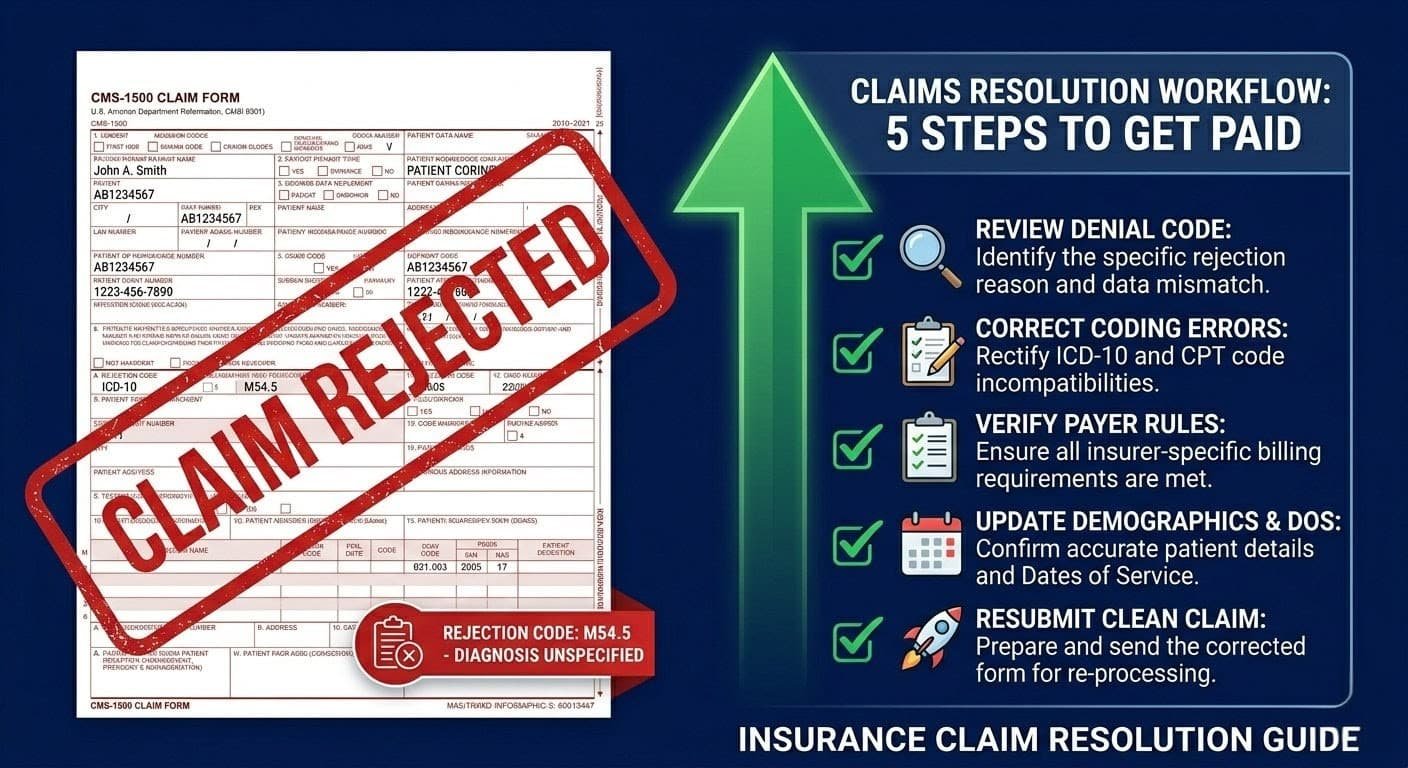


This page is a reference for Texas Medicaid providers who have a claim back from the Texas Medicaid & Healthcare Partnership (TMHP) with a rejection or an explanation of benefits (EOB) code. It covers three questions: what kind of outcome you have, which claim channel the code belongs to, and what to check next. Statements marked TMHP says summarize the TMHP documents listed at the end of this page. Statements marked CureAdvantage suggests are our own practical checklist, not TMHP instructions. The code explanations below are written in our own words; use the linked TMHP documents for TMHP’s exact wording.
Rejected, Denied, Resubmitted or Appealed?
These four terms describe different steps in TMHP’s processes. Other payers and managed care organizations can use them differently, so read them in the TMHP context only.
- Rejected claim: the claim was not accepted for payment processing. For electronic claims under the Texas Medicaid Provider Procedures Manual (TMPPM), only claims accepted on the Claim Response (27S) report move forward, and rejected claims need to be corrected and sent again (TMPPM Vol. 1, Section 6.2.2). TMHP’s Long-Term Care FAQ describes a rejected claim as one that failed the initial system edits and never received an internal control number (ICN).
- Denied claim: the claim was processed and dispositioned, but payment was not allowed. The Long-Term Care FAQ notes that a denied claim has an ICN and appears on the Remittance and Status (R&S) Report.
- Resubmission: a corrected claim sent back through the applicable electronic claim process after a rejection.
- Appeal: TMHP describes an appeal as a request to reconsider a claim that has already been dispositioned (TMPPM Vol. 1, Section 7.1). Appeals follow the applicable appeal process and its own timeframes.
Which Claim Channel Are You In?
Codes, reports and rules differ by channel. CureAdvantage suggests identifying the channel first and looking a code up only in that channel’s TMHP document.
- Fee-for-service and carve-out claims covered by the TMPPM (TexMedConnect or an EDI vendor). Results appear in the 277CA claim response file, the 27S Claim Response report with its REJ and ACC batch files, and the R&S Report. TMHP lists its EDI Help Desk, 888-863-3638, for electronic submission questions. Claims for Medicaid managed care clients go to the client’s managed care organization (MCO) or dental plan instead, except for carved-out services (TMPPM Section 6.1.1).
- Long-Term Care claims (TexMedConnect Long-Term Care). Claim status appears in TexMedConnect, and EOB codes such as F0077 are listed in TMHP’s Long-Term Care EOB code table. The TexMedConnect Long-Term Care User Guide lists the TMHP LTC Help Desk, 800-626-4117, option 1 then option 3, for claims questions.
- Claims forwarded to an MCO (for example, nursing facility claims for people who have moved to managed care). TexMedConnect shows the claim as Forwarded, Accepted or Rejected with a 28-character EDI transaction number. The Long-Term Care User Guide says providers must work with the MCO on forwarded claims and that TMHP cannot answer questions about claims an MCO rejects.
- Electronic Visit Verification (EVV) services. TMHP says EVV claims must be submitted electronically to TMHP, the EVV aggregator performs the claims match, and TMHP forwards the claim with an EVV match code to the payer that adjudicates it (TMPPM Sections 6.1.1 and 6.2.6). TMHP’s Long-Term Care EOB code table includes EVV match codes numbered EVV01 through EVV08.
Long-Term Care Scope
The six Long-Term Care codes on this page come from TMHP’s Long-Term Care EOB code table (form D00372) and TMHP’s TexMedConnect claim processing FAQ. The filing, resubmission and appeal rules later on this page come from TMPPM Sections 6 and 7, which describe fee-for-service and carve-out claims handled through TMHP. Those sections do not state that their timeframes apply to Long-Term Care claims, so this page does not present them as Long-Term Care deadlines. For Long-Term Care filing and appeal timeframes, check the current program-specific TMHP and HHSC Long-Term Care instructions, or ask the TMHP LTC Help Desk.
Long-Term Care EOB Codes: F0077, F0147, F0155, F0138, F0165, F0307
Each explanation below is CureAdvantage’s plain-language summary, not TMHP’s text. For the exact descriptions, see TMHP’s Long-Term Care EOB code table (form D00372). The recommended checks summarize TMHP’s TexMedConnect claim processing FAQ, which was posted November 2, 2020; its guidance may have changed, so confirm it against current TMHP instructions.
F0077: Billing Code Missing or Not Recognized
- FAQ grouping: rejection.
- What it means: TMHP could not identify a billing code for the service, either because none was sent or because the one sent could not be matched.
- TMHP’s FAQ recommends: looking first at service authorization and level of service, since those cause most of these rejections, including billing dates that have no authorization or level on file or that cross a gap between authorizations. Compare the dates, service group, service code and procedure code on the claim with the Medicaid Eligibility and Service Authorization Verification (MESAV), including any Resource Utilization Group (RUG) level that applies. TMHP’s FAQ directs providers to the most recent LTC Bill Code Crosswalk. If the MESAV and the claim both look correct, contact the TMHP LTC Help Desk.
F0147: Level of Service Does Not Fit the Billed Service
- FAQ grouping: rejection.
- What it means: the level-of-service type or level on file for the person does not line up with the service group and billing code on the claim.
- TMHP’s FAQ recommends: confirming on the MESAV that a valid level covers every billed date. If the claim matches and the edit keeps appearing, contact the TMHP LTC Help Desk.
F0155: Funding Source Could Not Be Assigned
- FAQ grouping: rejection.
- What it means: TMHP could not work out which fund pays for the billed service, and TMHP’s description tells providers to verify Medicaid eligibility.
- TMHP’s FAQ recommends: checking the MESAV to confirm the person’s Medicaid eligibility covers all billed dates with no gap, and checking that the service code and service group are a valid pair, which the FAQ says can also cause this code. If the person has no eligibility for the service, the FAQ points to the Medicaid eligibility worker; otherwise contact the TMHP LTC Help Desk.
F0138: No Valid Service Authorization for the Dates Billed
- FAQ grouping: denial.
- What it means: TMHP found no service authorization that covers this person, this service and the dates on the claim.
- TMHP’s FAQ recommends: confirming on the MESAV that an authorization covers each billed date, and billing separate authorization periods on separate lines. For nursing facilities and hospices whose submitted forms have not reached the MESAV, the FAQ refers providers to HHSC Provider Claims Services. If the MESAV and the claim both look correct, contact the TMHP LTC Help Desk.
F0165: Service Already Paid
- FAQ grouping: inconsistent in the source. TMHP’s LTC FAQ groups F0165 under denials, while its action guidance says the claim will be rejected. Treat the status wording as a source-level inconsistency and verify the current response before correcting the claim.
- What it means: a payment has already been made for the same service, so TMHP treats the new claim as a duplicate.
- TMHP’s FAQ recommends: using Claim Status Inquiry to find any paid or approved-to-pay claim that covers one or more of the same dates, and correcting the dates before billing again.
F0307: Other Insurance Missing From the Claim
- FAQ grouping: denial.
- What it means: the person has other insurance that was not reported on the claim, and that coverage has to be billed before Medicaid.
- TMHP’s FAQ recommends: comparing the other-insurance details on the claim with the MESAV, including the carrier’s name and address and the policy or subscriber number, so they match exactly before the claim is sent again.
Common Electronic Rejection Reasons — TMPPM §6.2.3
This section summarizes TMPPM Vol. 1, Section 6.2.3, which gives TMHP’s most common reasons for rejecting electronic professional claims and electronic hospital UB-04 CMS-1450 claims under the TMPPM. It is not a Long-Term Care list. The manual does not rank the reasons by volume.
Professional Claims
- Client information does not match. The name, date of birth, sex and nine-digit Medicaid number on the claim must match TMHP’s eligibility record exactly. The manual suggests an interactive eligibility request in TexMedConnect, or checking through the TMHP website or the Automated Inquiry System (AIS).
- Referring or ordering physician field blank or invalid. The referring physician’s NPI is required when billing consultations, laboratory or radiology.
- Performing physician ID blank or invalid. When the billing NPI belongs to a group practice, the NPI of the physician who performed the service is required.
- Facility provider field blank or invalid. When the place of service is not the home or office, the facility’s NPI is required, or its name and address if the NPI is unknown.
- Invalid type of service, or an invalid type of service and procedure code combination. Some procedure codes need a modifier to show the type of service (TMPPM Section 6.2.5).
Hospital UB-04 CMS-1450 Claims
- Admit hour outside the allowable range, for example 24 hours.
- Billed amount left blank.
- Health coverage ID blank or invalid. It must be the client’s valid nine-digit Medicaid number. The manual lists a number with fewer than nine digits, PENDING, 999999999 and Unknown as incorrect entries. A separate TMPPM instruction applies when a client is not yet eligible for Medicaid; see Section 6.
- Referring physician information blank on an outpatient claim when laboratory or radiology services are ordered or a surgical procedure is performed. The manual requires the referring physician’s NPI in Fields 78–79.
Provider Details on TMPPM Claims
TMHP says claims under the TMPPM need the provider’s complete name, physical address with the ZIP+4 code, NPI, taxonomy code and benefit code (if applicable) to avoid unnecessary delays in processing and payment. Billing providers not associated with a group must include a taxonomy code on all electronic claims, and claims without one may be rejected. The manual also notes that Medicare does not require a taxonomy code for Part B claims, so some Medicare crossover claims sent to TMHP may arrive without the taxonomy code TMHP needs (TMPPM Sections 6.2 and 6.2.1).
Ordering and Referring Provider NPIs (TMPPM §6.4.2.4)
TMHP says Texas Medicaid claims for services that require a physician order or referral must include the ordering or referring provider’s NPI. If that provider is not enrolled in Texas Medicaid as a billing or performing provider, they must enroll as an ordering or referring-only provider. The billing provider is responsible for confirming that enrollment, and claims without the NPI, or with the NPI of a provider not enrolled in Texas Medicaid, may be reviewed retrospectively and denied.
CureAdvantage suggests confirming the ordering or referring provider’s NPI with our free NPI lookup or NPPES, then confirming their Texas Medicaid enrollment through TMHP before submitting the claim.
TMPPM Filing, Resubmission and Appeal Rules (Fee-for-Service and Carve-Out Claims)
The rules in this section come from TMPPM Vol. 1, Sections 6 and 7. Section 7 covers appeals of Medicaid fee-for-service and carve-out service claims to TMHP. Neither section states that these timeframes apply to Long-Term Care claims, so do not use them as Long-Term Care deadlines.
Filing Deadlines (TMPPM §6)
- Unless the manual states otherwise, TMHP must receive claims within 95 days of each date of service. Inpatient claims filed by a hospital must be received within 95 days of the discharge date or the last date of service on the claim.
- The manual states that, in accordance with federal regulations, all claims must be initially filed with TMHP within 365 days of the date of service, regardless of provider enrollment status or retroactive eligibility.
- Claims from newly enrolled providers must be received within 95 days of the date enrollment is complete and within 365 days of the date of service. TMHP rejects these claims until enrollment is complete, and the manual says providers can use the TMHP rejection report as proof of meeting the 365-day deadline and submit an appeal.
- A 95-day or 120-day deadline that falls on a weekend or holiday moves to the next business day.
Other deadlines apply to Medicare crossovers, other insurance, out-of-state providers and retroactive eligibility; see TMPPM Section 6.
Resubmitting After a 277CA Rejection (TMPPM §7.1.2)
- For claims covered by TMPPM Section 7.1.2, a provider whose claim is rejected on the 277CA claim response file may resubmit an electronic claim within 95 days of the date of service.
- The provider may also submit a paper appeal with a copy of the 277CA response within 120 days of the 277CA rejection to meet the filing deadline.
- Each corrected claim submitted on paper must be accompanied by a copy of the electronic response file rejection that includes the batch ID. The manual notes that the batch ID is in the file name of the returned 277CA response, not inside the file, and that handwritten batch IDs are not accepted.
Appealing a Denied Claim (TMPPM §7)
- For Medicaid fee-for-service and carve-out service claims handled through TMHP, TMHP must receive appeals of denied claims and requests for adjustments on paid claims within 120 days of the disposition date on the R&S Report.
- Appeals can be submitted electronically (TexMedConnect or the TMHP EDI Gateway), through the Automated Inquiry System (AIS), or on paper. AIS accepts certain corrections, such as the patient control number, date of birth, place of service, quantity billed and prior authorization number, but not procedure codes, modifiers or diagnosis codes.
- Paper appeals include a copy of the R&S Report page showing the claim, with any supporting documentation on separate pages. The manual recommends keeping a copy and sending paper appeals by certified mail with a return receipt requested.
- After the TMHP appeal process is exhausted, a second-level appeal to HHSC must be received within 120 days of the disposition by TMHP or the claims processing entity. For that appeal, proof of timely filing for electronic claims is an electronic claims report showing the TMHP-assigned batch ID and the claim being appealed; office notes and personal screen prints are not accepted as proof.
CureAdvantage suggests using our claim filing deadline checker to keep track of dates, then confirming each date against the TMPPM, or against the current Long-Term Care instructions for Long-Term Care claims.
CureAdvantage Suggests: A Quick Checklist
- Decide whether the claim was rejected or denied before changing anything, using the definitions at the top of this page.
- Confirm the channel (TMPPM fee-for-service or carve-out, Long-Term Care, forwarded to an MCO, or EVV) before looking up a code.
- Keep 277CA, 27S, REJ and ACC response files with their original file names, because the TMPPM requires the batch ID for certain appeals and paper resubmissions.
- Check the deadline that applies to your channel before correcting the claim, and do not assume a TMPPM timeframe applies to Long-Term Care claims.
Sources, Scope and Limitations
This page was reviewed against these TMHP documents on September 17, 2026:
- Texas Medicaid Provider Procedures Manual, Vol. 1, Section 6: Claims Filing (online edition, file last modified August 31, 2026)
- Texas Medicaid Provider Procedures Manual, Vol. 1, Section 7: Appeals (online edition, file last modified August 31, 2026)
- TexMedConnect: Claim Processing, Denials, and Rejections FAQ (Long-Term Care; posted November 2, 2020)
- Long-Term Care Explanation of Benefits (EOB) Codes, form D00372 (no date printed on the document)
- TexMedConnect Long-Term Care (LTC) User Guide, v2026_0305
Scope and limitations: the code explanations and checklists on this page are CureAdvantage’s own wording, not TMHP text, so use the linked documents for TMHP’s exact descriptions and current instructions. TMPPM rules are labelled as TMPPM rules and are not presented as Long-Term Care rules. MCO and dental plan workflows, edits and appeal rules can differ; follow the plan’s own instructions for managed care claims. TMHP codes, reports and manual sections change over time. This page is an independent reference, not TMHP guidance, and it does not guarantee that a corrected claim will be paid.
Leave a Reply