


The Most Commonly Miscoded Change in the FY 2027 Update
M72.2 was deleted on October 1, 2026, and the obvious reading is that it gained laterality: one code becomes three, right and left and unspecified, exactly as several other FY 2027 deletions did. That reading is wrong, and it is wrong in a way that quietly codes a different disease.
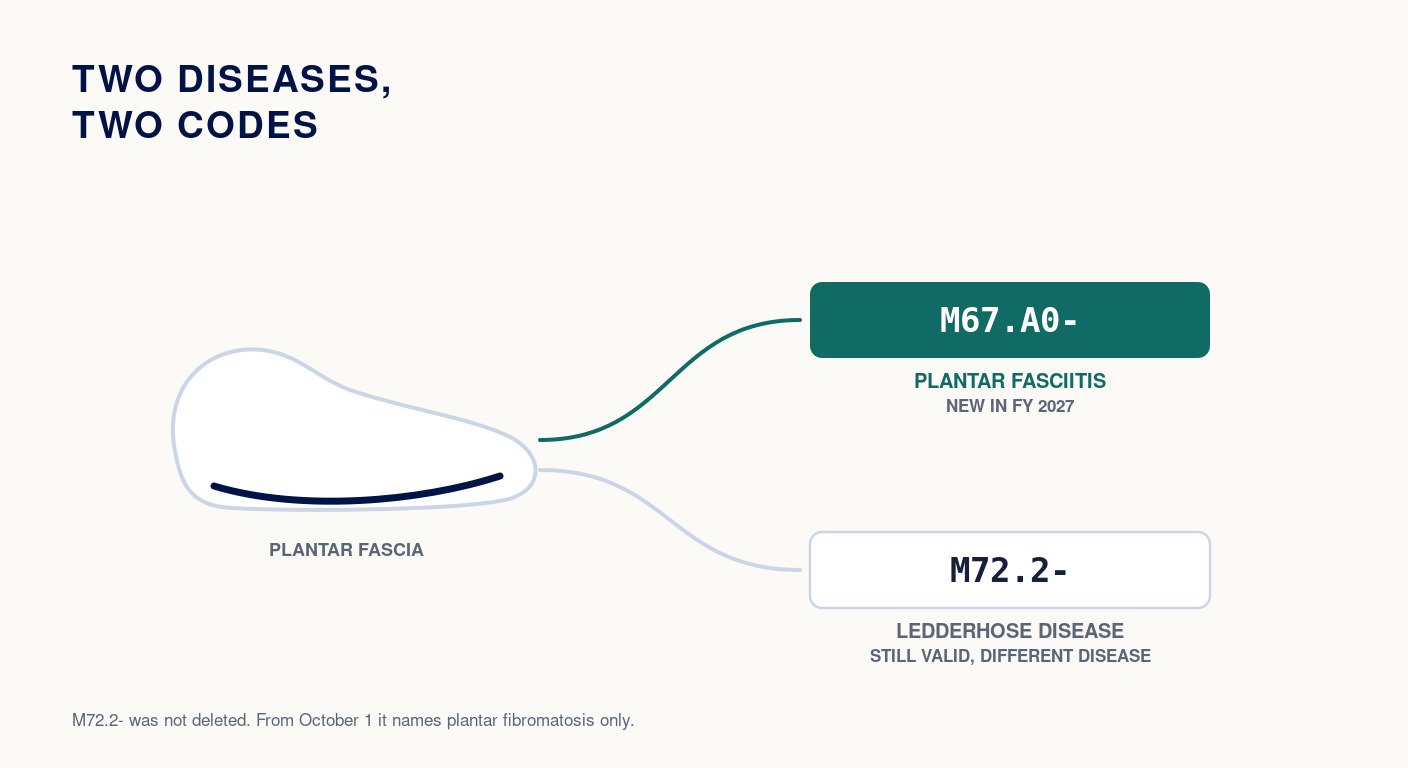
What actually happened is that plantar fasciitis was separated out of plantar fascial fibromatosis and given its own category. From October 1 the two conditions live in different chapters of the musculoskeletal codes, and the one most practices report every week is not in M72 at all.
What Replaced What
| Condition | Code from October 1, 2026 |
|---|---|
| Plantar fasciitis New category M67.A | M67.A01 Plantar fasciitis, right foot |
| M67.A02 Plantar fasciitis, left foot | |
| M67.A09 Plantar fasciitis, unspecified foot | |
| Plantar fascial fibromatosis M72.2, which the tabular also calls Ledderhose disease | M72.20 Plantar fascial fibromatosis, unspecified foot |
| M72.21 Plantar fascial fibromatosis, right foot | |
| M72.22 Plantar fascial fibromatosis, left foot |
The official crosswalk is technically correct and practically unhelpful. It maps the single deleted code to all six successors, because both conditions used to share it. Only the descriptors tell you which branch a given patient belongs on.
The tabular list settles it. M67.A09 carries the inclusion term plantar fasciitis NOS, so an undocumented-laterality plantar fasciitis has an explicit home. And M72.2 carries the inclusion term Ledderhose disease, which is the giveaway: Ledderhose is the fibromatosis, a benign nodular proliferation of the plantar fascia. It is not the same thing as plantar fasciitis and never was.
Why This One Will Actually Bite
Most FY 2027 deletions affect codes a practice reports a handful of times a year. This one does not. Plantar fasciitis is among the most common presentations in podiatry, and it turns up steadily in orthopaedics, sports medicine, physical therapy referrals and primary care.
Three specific ways it goes wrong:
- Autocomplete. A favourites list or problem list that held M72.2 for plantar fasciitis will suggest M72.20, M72.21 or M72.22, because those are the codes that inherited the number. Every one of them is now the wrong disease.
- Crosswalk tools. Anything that maps a deleted code to its successors will offer all six, and the fibromatosis codes sort first numerically.
- The new category is easy to miss. M67.A is a new category with a letter in the fourth character. Systems and lists that updated their M72 family may have no M67.A entry at all.
None of these produces a rejection. M72.21 is a perfectly valid code. The claim goes out, it is payable, and the record says the patient has Ledderhose disease.
Laterality Is Now Required for Both
Separately from the split, both families now carry laterality where the old single code did not. M72.2 was one code for either foot. Its successors, and the new M67.A0 codes, distinguish right, left and unspecified.
Unspecified is available on both sides, so nothing is unbillable if the note is silent. But plantar fasciitis is frequently bilateral and frequently documented as such, and a template that was written when laterality did not exist for this diagnosis will not prompt for it. If the record supports both feet, both codes can be reported.
How to Tell Them Apart in the Note
This is a documentation question before it is a coding question, and the distinction is usually clear once somebody looks for it.
| If the note describes | Family |
|---|---|
| Heel pain, pain on first steps in the morning, tenderness at the calcaneal insertion, an inflammatory or degenerative process of the plantar fascia | M67.A0- plantar fasciitis |
| A palpable nodule or mass in the plantar fascia, a fibrous proliferation, or the term Ledderhose disease | M72.2- plantar fascial fibromatosis |
| Plantar fasciitis with no side stated | M67.A09, which the tabular lists as plantar fasciitis NOS |
What to Check Before You Bill
- Search your favourites and problem lists for M72.2. Anywhere it was saved against the words plantar fasciitis needs repointing to M67.A0-.
- Confirm M67.A loaded at all. It is a new category. If your encoder returns nothing for M67.A01, the October update has not fully applied.
- Check the date of service. M72.2 is correct for a date of service on or before September 30, 2026 and invalid after it, whatever date you submit.
- Add a laterality prompt. This diagnosis did not have one before October 1.
- Audit a fortnight of October claims. Any M72.2- on a patient whose note says heel pain is the error this change produces, and nothing will flag it for you.
Common Questions
What is the ICD-10 code for plantar fasciitis in 2027?
M67.A01 right foot, M67.A02 left foot, or M67.A09 unspecified foot, for dates of service on or after October 1, 2026.
Is M72.2 deleted?
The single code M72.2 is no longer billable. Its children M72.20, M72.21 and M72.22 are billable, but they describe plantar fascial fibromatosis, not plantar fasciitis.
Can I still use M72.2- for plantar fasciitis?
No. From October 1 those codes name a different condition, and the tabular identifies it as Ledderhose disease.
What if the note does not say which foot?
M67.A09, plantar fasciitis, unspecified foot, which the tabular lists as plantar fasciitis NOS.
What about bilateral plantar fasciitis?
There is no single bilateral code. Report the right and left codes where the documentation supports both.
Why does the crosswalk list six replacements?
Because the deleted code covered both conditions, so NCHS maps it to every code that now carries part of what it used to hold. The crosswalk cannot choose between them for you.
Sources and Methodology
Code descriptors and inclusion terms, including plantar fasciitis NOS at M67.A09 and Ledderhose disease at M72.2, were read from the FY 2027 ICD-10-CM Tabular List and code descriptions file published by CMS and the CDC National Center for Health Statistics. The six successors to the deleted M72.2 are as listed in the NCHS ICD-10-CM Conversion Table FY 2027. The FY 2026 code descriptions file was used to confirm that M72.2 was previously a single code without laterality. All files are free and none is licence gated. The full FY 2027 deletion list is in our replacement guide for all 30 deleted codes.
Leave a Reply