


What Happened to ICD-10 Code I42.0?
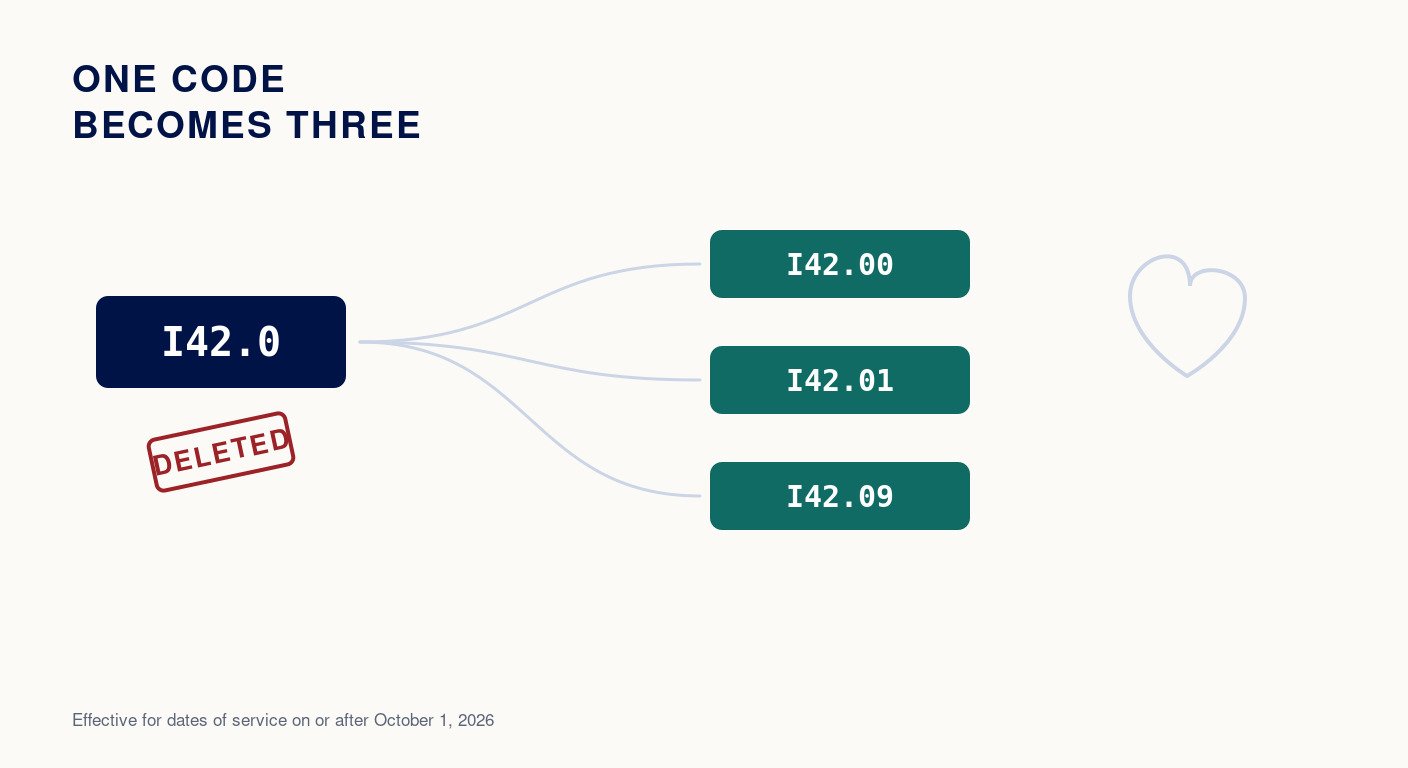
If a dilated cardiomyopathy claim for a date of service on or after October 1, 2026 comes back denied, the diagnosis is not the problem. The code is. Effective that date, the FY 2027 ICD-10-CM update deletes I42.0 Dilated cardiomyopathy as a billable code and replaces it with three more specific children. I42.0 becomes a category header. A header cannot be reported on a claim, so a line submitted with it will be rejected or denied for an invalid diagnosis code.
This is not a coverage change or a payer policy. It is the annual code set update that CMS and the CDC’s National Center for Health Statistics publish together, and it applies to every payer that uses ICD-10-CM, which in practice means all of them.
I42.0 was billable for the whole of FY 2026. That is precisely why it is a problem: it is in charge masters, favourites lists, EHR pick lists and superbills across the country, and none of those update themselves.
The Three Codes That Replace I42.0
These are the official FY 2027 descriptors, taken from the CMS code descriptions file:
| Code | Official descriptor | When it applies |
|---|---|---|
| I42.00 | Dilated cardiomyopathy, unspecified | The documentation says dilated cardiomyopathy and does not establish a familial or genetic cause, or any other specified cause. |
| I42.01 | Familial-genetic dilated cardiomyopathy | The record establishes a familial or genetic basis, for example a documented family history or a confirmed genetic finding. |
| I42.09 | Other dilated cardiomyopathy | A cause is documented and specified, but it is not familial or genetic. |
The choice is driven by what the note actually establishes, not by what is likely. If the cardiologist documents dilated cardiomyopathy with nothing said about cause or family history, that is I42.00. Coding I42.01 because a familial cause seems plausible is not supported, and an auditor will read it the same way.
Practices working under risk-adjusted contracts should also check how their own model maps the new subcodes before October, rather than assuming the mapping carries over unchanged from I42.0.
I42.8 Was Deleted in the Same Update
The cardiomyopathy category lost a second billable code in the same cycle, and it is getting far less attention than I42.0. I42.8 Other cardiomyopathies is also deleted and replaced:
| Code | Official descriptor |
|---|---|
| I42.81 | Arrhythmogenic cardiomyopathy |
| I42.89 | Other cardiomyopathies not elsewhere classified |
If your practice uses I42.8 as a catch-all, every one of those lines needs re-mapping too. The rest of the I42 category is untouched: I42.1 through I42.7 and I42.9 remain billable exactly as they were.
The Date That Decides Which Code You Use
This is the part that generates avoidable denials in October and November, and it is worth being precise about.
ICD-10-CM code selection follows the date of service, not the date you submit the claim. For inpatient admissions it follows the date of discharge. So:
- A visit on 28 September 2026, billed in November, is still coded I42.0. Replacing it with I42.00 will deny, because I42.00 did not exist on that date of service.
- A visit on 1 October 2026 or later must use I42.00, I42.01 or I42.09, whenever it is submitted.
- A corrected claim or an appeal on an older date of service keeps the code that was valid on that date of service.
For a few weeks either side of the cutover your billing team will legitimately be using both the old and the new codes on the same day, for different dates of service. That is correct, and staff should be told so explicitly, otherwise someone will helpfully update the old claims and create denials that did not need to happen.
What to Check Before You Bill
- Search your EHR favourites, pick lists, superbills and charge master for I42.0 and I42.8, and retire them from selection for dates of service from October 1.
- Pull your last twelve months of claims carrying I42.0 to see the real volume and which providers generate it. That is the size of your exposure.
- Tell the cardiologists what now changes the code: whether the note establishes a familial or genetic cause. Without that, everything defaults to unspecified.
- Confirm your clearinghouse and practice management system have loaded the FY 2027 code set. A system still validating against FY 2026 will reject the new codes as invalid.
- Watch October remittances for invalid-diagnosis denials and check the date of service before assuming the code was wrong.
The Other 28 Codes That Stopped Being Billable
The FY 2027 addendum adds 190 codes, deletes 30 and revises 8. Every one of those 30 deleted codes was billable in FY 2026, so every one of them can produce the same denial. Most published summaries give the totals without saying what to use instead, so here is the full map, taken from the CMS addendum file:
| Deleted | What it was | Use instead |
|---|---|---|
| D69.1 | Qualitative platelet defects | D69.11 Glanzmann thrombasthenia; D69.19 other qualitative platelet defects |
| I42.0 | Dilated cardiomyopathy | I42.00 unspecified; I42.01 familial-genetic; I42.09 other |
| I42.8 | Other cardiomyopathies | I42.81 arrhythmogenic; I42.89 other not elsewhere classified |
| I49.8 | Other specified cardiac arrhythmias | I49.81 Brugada syndrome; I49.82 ventricular bigeminy; I49.89 other not elsewhere classified |
| M72.2 | Plantar fascial fibromatosis | M67.A01 right foot; M67.A02 left; M67.A09 unspecified — plantar fasciitis moves to a new M67.A0- family. M72.20 / M72.21 / M72.22 remain, but only for plantar fascial fibromatosis (Ledderhose disease) |
| M86.8X1 – M86.8X8 | Other osteomyelitis, eight sites | M86.8X1 to M86.8X7 each gain right, left and unspecified, for example M86.8X11 right shoulder, M86.8X12 left, M86.8X19 unspecified. M86.8X8 is the exception: it splits by site rather than side — M86.8X80 skull, M86.8X81 face and sinuses, M86.8X89 other site |
| S23.420A / D / S | Sprain of sternoclavicular joint | No direct replacement. The sternoclavicular code is gone; S23.421 chondrosternal, S23.428 other sprain of sternum and S23.429 unspecified remain |
| T52.8X1 – T52.8X4 | Toxic effect of other organic solvents | T52.811 – T52.894, split by specific solvent as well as intent: T52.81- alkenes, T52.82- cycloparaffins, T52.89- other organic solvents |
| Z68.1 | BMI 19.9 or less, adult | Z68.18 BMI 18.4 or less; Z68.19 BMI 18.5–19.9 |
| Z87.890 | Personal history of sex reassignment | Z87.8901 social; Z87.8902 medical; Z87.8903 surgical; Z87.8904 intersex surgery; Z87.8909 unspecified. Z87.893 personal history of gender detransition is also new for FY 2027, but NCHS does not list it as a successor to Z87.890 |
Three of these deserve attention beyond cardiology. M72.2 carried plantar fasciitis, which is high volume in podiatry, orthopaedics and primary care. From October 1 plantar fasciitis has its own family, M67.A01, M67.A02 and M67.A09, and M72.2- is left to plantar fascial fibromatosis. Reporting plantar fasciitis under M72.2- after that date names a different disease. Z68.1 is a BMI code attached routinely and often automatically to wellness and chronic care visits. S23.420 is the one with no direct successor at all: a sternoclavicular sprain now has to be reported as another or unspecified sprain of the sternum, which is a real loss of specificity rather than a renumbering.
One change in the same release works the other way round. FY 2027 adds five codes for inherited cancer predisposition syndromes, including Lynch syndrome and BRCA, but deletes nothing: QA17 is added alongside Z15.09 rather than in place of it, and the tabular list asks for both codes on the same claim. The release also names a substance that had no code of its own until now: medetomidine moves out of T65.891 into T65.85-, a year after xylazine made the same move.
You can confirm any code against the date of service with our ICD-10-CM code validity checker, which is built on the same CMS files referenced here.
FAQs
Is I42.0 deleted or just non-billable?
The FY 2027 addendum lists it as a deletion. In practice it survives as a category header for I42.00, I42.01 and I42.09, and a header can never be reported on a claim. Either way, it cannot be billed for a date of service from October 1, 2026.
Which code replaces I42.0 if the note says nothing about cause?
I42.00, dilated cardiomyopathy, unspecified. Do not reach for I42.01 unless the record establishes a familial or genetic basis.
A September claim denied for an invalid diagnosis code. Should I change it to I42.00?
No. Check the date of service first. If the service was before October 1, 2026, I42.0 is the correct code and the denial has another cause. Switching to a code that did not exist on that date of service will produce a second denial.
Does this affect Medicare Advantage differently from Original Medicare?
The code set itself is the same for every payer. What can differ is how a risk-adjustment model maps the new subcodes, so practices in those contracts should confirm the mapping rather than assume it transfers from I42.0.
Where can I verify this myself?
The FY 2027 code descriptions and addendum files are published free by CMS on its ICD-10 Codes page. The addendum lists every addition, deletion and revision for the year. The successors in the table above were then checked line by line against the NCHS ICD-10-CM Conversion Table FY 2027, which names the previously assigned code equivalent for each new code.
Leave a Reply