


Fifteen Drug Codes End on September 30, 2026
The October 2026 quarterly update to HCPCS Level II terminates fifteen codes with a termination date of 20260930. September 30 is the last valid date of service for all of them.
Most quarterly updates are routine. This one is not, because ten of the fifteen are replaced by codes that describe a different billing unit. The drug is the same, the dose is the same, and the number of units on the claim line changes by a factor of two, ten, twenty or fifty. Two of the affected drugs are fluorouracil and leucovorin, which are given together in FOLFOX and FOLFIRI, so a colorectal infusion practice has two unit conversions landing on the same claim on the same day.
The whole October 2026 update, counted from the CMS transaction report, is 45 additions, 15 discontinuations, 11 long description changes, 5 payment changes and 1 administrative field change.
It is also not the only code set turning over on that date. The annual ICD-10 update lands the same day, which means a single infusion claim can carry a new diagnosis code, a new procedure code and a new drug unit at once. The diagnosis side is covered in the FY 2027 deletions and the inpatient procedure side in the 38 expiring ICD-10-PCS codes.
The Ten Codes Where the Unit Changes
| Ends Sep 30 | Valid from Oct 1 | Units for the same dose |
|---|---|---|
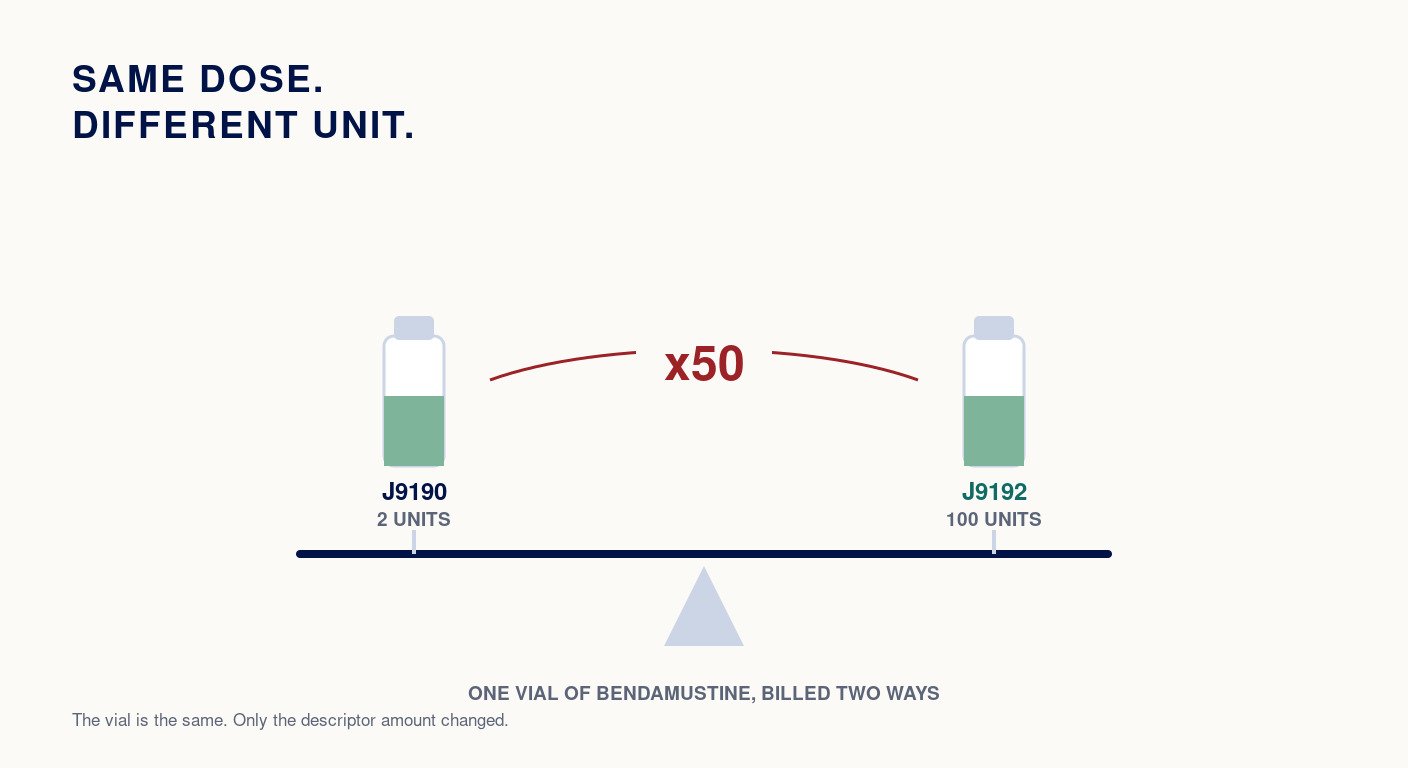
| J9190 Injection, fluorouracil, 500 mg | J9192 Injection, fluorouracil, 10 mg | 50 times more |
| J0640 Injection, leucovorin calcium, per 50 mg | J0643 Injection, leucovorin calcium, not otherwise specified, 1 mg | 50 times more |
| J7517 Mycophenolate mofetil, oral, 250 mg | J7524 Mycophenolate mofetil, oral, 5 mg | 50 times more |
| J7528 Mycophenolate mofetil, for suspension, oral, 100 mg | J7529 Mycophenolate mofetil, for suspension, oral, 5 mg | 20 times more |
| J7514 Mycophenolate mofetil (myhibbin), oral suspension, 100 mg | J7530 Mycophenolate mofetil (myhibbin), oral suspension, 5 mg | 20 times more |
| J1941 Injection, furosemide (furoscix), 20 mg | J1947 Injection, furosemide (furoscix), 1 mg | 20 times more |
| J9181 Injection, etoposide, 10 mg | J9187 Injection, etoposide, 1 mg | 10 times more |
| J9352 Injection, trabectedin, 0.1 mg | J9362 Injection, trabectedin, 0.01 mg | 10 times more |
| J7519 Injection, mycophenolate mofetil, 10 mg | J7526 Injection, mycophenolate mofetil, 5 mg | 2 times more |
| J1953 Injection, levetiracetam, 10 mg | J1957 Injection, levetiracetam, 5 mg | 2 times more |
What This Looks Like on a Real Claim
Take a 1,000 mg dose of fluorouracil, which is an ordinary adult dose.
- Through September 30: J9190, 2 units. The code descriptor is 500 mg, so 1,000 divided by 500 is 2.
- From October 1: J9192, 100 units. The descriptor is 10 mg, so 1,000 divided by 10 is 100.
A practice that swaps the code but keeps the old unit count reports 2 units of a 10 mg descriptor, which is 20 mg of a 1,000 mg dose. That is a claim for two per cent of what was given. Nothing rejects it, because 2 units of J9192 is a perfectly valid line. It simply pays almost nothing, and it does so quietly on every 5-FU claim until someone notices.
The reverse error is louder. Keeping the unit count from a smaller descriptor and applying it to a larger one, or converting twice, produces an inflated unit count that is likely to hit a medically unlikely edit or, if it pays, become an overpayment. Practices should confirm current unit limits for the new codes against their payer and the published edit files rather than assuming the limit carried over from the retired code.
Leucovorin is the same arithmetic. J0640 was per 50 mg. J0643 is per 1 mg. A 500 mg dose was 10 units and becomes 500.
Three Codes Move From C to J at the Same Unit
These are simpler. The descriptor and the unit are unchanged and only the code number moves out of the temporary C series into the permanent J series.
| Ends Sep 30 | Valid from Oct 1 | Descriptor |
|---|---|---|
| C9046 | J0014 | Cocaine hydrochloride nasal solution (goprelto), 1 mg |
| C9310 | J0644 | Injection, leucovorin calcium (avyxa), 1 mg |
| C9462 | J3268 | Injection, delafloxacin, 1 mg |
The Two With No Like for Like Successor
L8696, antenna (external) for use with implantable diaphragmatic or phrenic nerve stimulation device, replacement, ends on September 30. The October additions include L8697, external accessory for use with implantable phrenic nerve stimulation device, replacement, each. The new descriptor is broader, covering an accessory rather than specifically an antenna, and it drops the word diaphragmatic. It is the obvious destination, but it is not a word for word replacement.
C8010, percutaneous placement of permanent common carotid embolic protection device including all system components, ends on September 30 and nothing in the 45 October additions describes that procedure. If you report it, confirm with the payer what they expect in its place before the next case rather than after it.
CMS Publishes No Crosswalk for Any of This
This is the part worth being careful about, and it is the reason the pairings above are presented as a reading rather than as an official mapping.
The HCPCS master file carries five cross reference fields, XREF1 through XREF5, whose purpose is exactly to point a retired code at its successor. On all fifteen discontinued codes in this update, every one of those fields is empty. There is no published crosswalk. The pairings are inferred from the drug name, the dose form and the unit in the descriptors, which is the same reading any coder would have to make.
That matters because ICD-10-CM does publish an official conversion table each year, so it is easy to assume HCPCS does the same. It does not. Where a payer has its own guidance for these ten drugs, that guidance outranks any descriptor based reading, including this one.
A Second Choice You Now Have to Make
Several of the October additions are brand specific codes that sit alongside the generic ones. For four of these drugs there is now a generic code and an Avyxa branded code at the same unit:
- Fluorouracil: J9192 generic, J9191 Avyxa, both 10 mg
- Leucovorin calcium: J0643 not otherwise specified, J0644 Avyxa, both 1 mg
- Etoposide: J9187 generic, J9186 Avyxa, both 1 mg
- Bendamustine: J9033 not otherwise specified, J9066 Avyxa, both 1 mg
Two more new codes say so in the descriptor itself. C9312 is trabectedin (apotex), not therapeutically equivalent to j9362, and J0871 is daptomycin (endo), not therapeutically equivalent to j0878. When a descriptor names a manufacturer and states non-equivalence, the product actually dispensed decides the code, which means the purchasing record has to reach the biller.
Also Changed, Quietly
Eleven codes keep their number and get a new long description, which is the kind of change that never triggers a system update because nothing was added or deleted. Among them are J9033 bendamustine, now explicitly not otherwise specified; J3300 triamcinolone acetonide (triesence); A9595 piflufolastat F 18 (pylarify), which now sits beside a new A9613 for pylarify truvu; and three breast prosthesis codes, L8030, L8031 and L8035. Five codes have payment changes, all skin substitute add-on products in the A2040 to A2045 range.
What to Do Before October 1
- Find every place the old unit is stored. The code change is the easy part. The unit multiplier usually lives in the charge master, the infusion order set, the drug library and the claim scrubber, and those are four separate updates.
- Recalculate, do not translate. Work from milligrams given divided by the new descriptor amount. Converting from the old unit count is where the double conversions happen.
- Check the date of service, not the date of the claim. A September 29 infusion billed in October still uses J9190. A claim for a September service submitted with J9192 will be denied for a code that was not valid on that date.
- Confirm unit limits separately. A fifty fold change in units per dose does not automatically mean the published edit limits scaled with it.
- Decide the generic or brand question once. Write it down for pharmacy and billing together rather than leaving it to whoever builds the claim.
- Audit the first two weeks of October. An underbilled unit count does not reject. Comparing paid amount per dose against September is the fastest way to catch it.
FAQs
What replaces J9190 for fluorouracil?
J9192, injection, fluorouracil, 10 mg, valid for dates of service from October 1, 2026. The unit is 10 mg rather than 500 mg, so the same dose needs fifty times as many units. J9191 is the Avyxa branded equivalent at the same unit.
What replaces J0640 for leucovorin?
J0643, injection, leucovorin calcium, not otherwise specified, 1 mg. The unit is 1 mg rather than 50 mg. J0644 is the Avyxa branded code and replaces C9310.
Can I still bill J9190 in October for a September infusion?
Yes. The code is valid through a date of service of September 30, 2026, whatever date you submit on. The date of service governs.
Did CMS publish an official crosswalk?
No. The XREF fields in the HCPCS file are empty for all fifteen discontinued codes.
How many codes changed in the October 2026 update overall?
45 additions, 15 discontinuations, 11 long description changes, 5 payment changes and 1 administrative field change.
Does any of this affect CPT codes?
No. This is HCPCS Level II only. The administration codes you report alongside these drugs are unaffected by this update.
Sources
Every code, descriptor, termination date and effective date above was read from the October 2026 alpha-numeric HCPCS file published by CMS, together with its transaction report, and compared against the July 2026 file. HCPCS Level II is published by CMS and is not licence gated. Counts come from the transaction report worksheet titled Changes by Action Code. The empty cross reference fields were read from the XREF1 to XREF5 columns of the October master file.
Leave a Reply