
 By Eman Zahra

What Changed on October 1, 2026
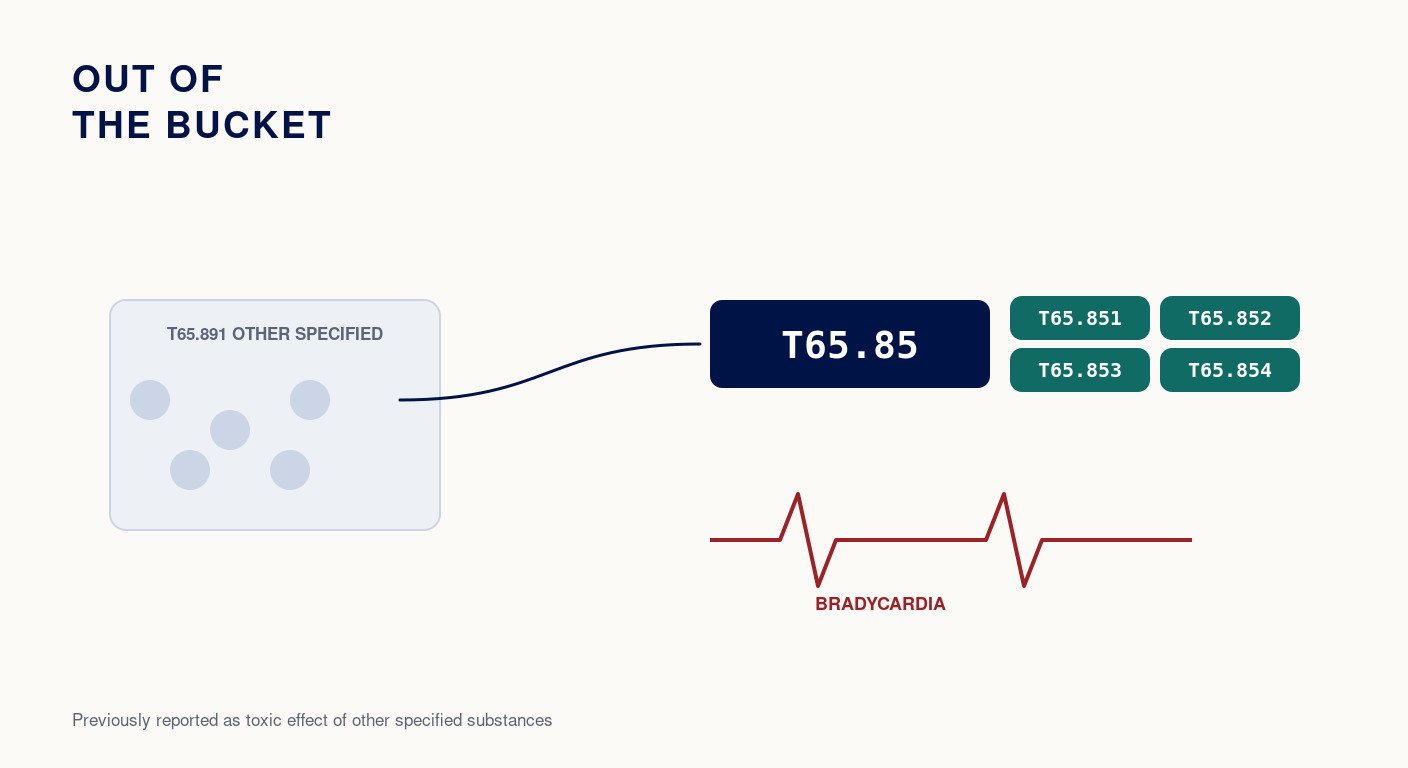
Medetomidine has been turning up in the illegal opioid supply since 2022, and until this month there was no ICD-10-CM code that named it. Every case went into a generic bucket. Effective for dates of service on or after October 1, 2026, the FY 2027 ICD-10-CM update adds twelve codes under subcategory T65.85, Toxic effect of medetomidine.
This is the second year running that the code set has done this for a veterinary sedative found in street drugs. Xylazine got the identical treatment one year earlier, at T65.84. The two subcategories now sit next to each other in the tabular list, and as you will see below, they carry very different instructions about what else to report.
The Four Codes and Their Seventh Characters
Like every code in category T65, these are combination codes: the substance and the intent are both built into the code, and a seventh character records the encounter. That produces twelve billable codes from four base codes.
| Base code | Intent | Billable as |
|---|---|---|
| T65.851 | Accidental (unintentional). Also the default: the tabular lists Toxic effect of medetomidine NOS here | T65.851A, T65.851D, T65.851S |
| T65.852 | Intentional self-harm | T65.852A, T65.852D, T65.852S |
| T65.853 | Assault | T65.853A, T65.853D, T65.853S |
| T65.854 | Undetermined | T65.854A, T65.854D, T65.854S |
Where Medetomidine Was Coded Before
The NCHS Conversion Table names the previously assigned equivalent for every new code. For medetomidine it is the other specified substances bucket, intent for intent:
| New code | Previous code assignment | Xylazine, one year earlier |
|---|---|---|
| T65.851 | T65.891 | T65.841 ← T65.891 |
| T65.852 | T65.892 | T65.842 ← T65.892 |
| T65.853 | T65.893 | T65.843 ← T65.893 |
| T65.854 | T65.894 | T65.844 ← T65.894 |
T65.891 is not deleted. It stays in the code set for substances that genuinely have no more specific code. What changes is that medetomidine is no longer one of them, so continuing to report T65.891 for a documented medetomidine exposure understates the record from October 1 onward.
Fentanyl Belongs on the Same Claim
This is the part that will decide whether these codes produce a usable record. CDC Health Advisory CDCHAN-00527, issued April 2, 2026, reports that among medetomidine-positive drug products tested, 98% had fentanyl co-detected. Medetomidine is very rarely found on its own.
The FY 2027 Official Guidelines, Section I.C.19.e, are explicit about how to handle that:
If two or more drugs, medicinal or biological substances are taken, code each individually unless a combination code is listed in the Table of Drugs and Chemicals.
There is no combination code. So a fentanyl overdose with medetomidine involvement carries both, and they come from different chapters of the T section: fentanyl is a poisoning at T40.411 to T40.414, while medetomidine is a toxic effect at T65.85-. The guideline distinction is that poisoning applies to drugs, medicaments and biological substances, and toxic effect applies when a harmful substance is ingested or comes into contact with a person.
What the Tabular Tells You to Code Alongside
Both new subcategories carry a use additional code note, and the two notes point in completely different clinical directions. This is the detail most worth carrying into a query template.
| Subcategory | Use additional code, per the FY 2027 Tabular List |
|---|---|
| T65.85 Medetomidine | Code to identify associated manifestations, such as: bradycardia NOS (R00.1); somnolence, stupor and coma (R40.-) |
| T65.84 Xylazine | Code(s) for all associated manifestations, such as: cellulitis and acute lymphangitis (L03.-); cutaneous abscess, furuncle and carbuncle (L02.-); non-pressure chronic ulcer of lower limb, not elsewhere classified (L97.-); non-pressure chronic ulcer of skin, not elsewhere classified (L98.4-) |
Xylazine sends you to the skin. Medetomidine sends you to the heart rate and the level of consciousness. That tracks the clinical picture in the CDC advisory, which describes marked bradycardia with heart rates as low as 32 beats per minute, hypotension, and profound and often prolonged sedation, and notes that naloxone restores breathing but does not reverse the medetomidine sedation.
Sequencing follows the general rule in Section I.C.19.e: assign the toxic effect code first, followed by codes for all associated manifestations.
There Is Still No Code for Medetomidine Withdrawal
The CDC advisory devotes much of its length to a severe withdrawal syndrome, described as similar to clonidine withdrawal, featuring tachycardia, severe hypertension, fluctuating alertness, tremor, chest pain and intractable nausea and vomiting, peaking 18 to 36 hours after last use and often requiring intensive care.
No ICD-10-CM code names it. Searching the complete FY 2027 code descriptions file returns medetomidine in exactly twelve codes, all of them in T65.85, and xylazine in twelve codes, all of them in T65.84. Neither substance appears anywhere in categories F10 to F19. There is no medetomidine dependence code, no medetomidine withdrawal code, and no inclusion term naming either substance in the substance use chapter.
That is a genuine gap rather than something a coder can resolve by picking harder. It is worth knowing before an inpatient stay driven mostly by withdrawal management gets coded, because the toxic effect code describes the exposure, not the syndrome that follows it.
Medetomidine Is Not Dexmedetomidine
These two are one letter apart and they are not interchangeable in the code set.
In the FY 2027 Table of Drugs and Chemicals, the Medetomidine row lists T65.851, T65.852, T65.853 and T65.854 across the four poisoning columns, and both the Adverse effect and Underdosing columns are marked with dashes. There is no adverse-effect pathway, because medetomidine is not approved for human use, so it can never be the correctly prescribed and properly administered drug that an adverse effect code describes.
Dexmedetomidine, the sedative used in critical care, has no named entry anywhere in the FY 2027 code descriptions file or the Table of Drugs and Chemicals. If you are coding a reaction to clinically administered dexmedetomidine, look it up by drug class in the Table of Drugs and work back through the tabular list. Do not reach for T65.851, which names a different substance and carries no adverse-effect column at all. For contrast, clonidine does have a full row including an adverse effect code at T46.5X5, which is what a human therapeutic agent looks like in that table.
Two Lookup Traps
Medetomidine is not in the Alphabetic Index. Searching the FY 2027 Alphabetic Index for medetomidine returns nothing, and the same is true of xylazine. Both live only in the Table of Drugs and Chemicals. A coder who searches the Index and finds nothing may conclude no code exists.
But you cannot code from that table either. Section I.C.19.e opens with the instruction not to code directly from the Table of Drugs and Chemicals, and to always refer back to the tabular list. The table gives you T65.851. Only the tabular gives you the seventh character and the manifestation note.
Present on Admission
On the FY 2027 POA exempt list, the subsequent encounter and sequela codes are exempt and the initial encounter codes are not. So T65.851D, T65.851S and their siblings across all four intents require no POA indicator, while T65.851A, T65.852A, T65.853A and T65.854A do. That is the standard pattern for injury and poisoning codes, and it is the opposite of the assumption that a whole new family arrives exempt.
What to Check Before You Bill
- Check the date of service, not the date of the claim. T65.85- codes are invalid for a date of service on or before September 30, 2026. T65.891- remains correct for those encounters, and switching a denied September claim to the new code will produce a second denial.
- Look for the co-involved substance. Fentanyl was present in nearly every medetomidine-positive sample the CDC reported. Code each substance individually.
- Check whether the substance was actually identified. The CDC advisory notes that medetomidine is not typically included in hospital rapid drug screens and recommends comprehensive drug screening including medetomidine in blood. If the chart records a clinical suspicion rather than a confirmed finding, the documentation has to support the code.
- Capture the manifestations. Bradycardia and the level of consciousness are what the tabular note asks for, and they are frequently the whole reason for the admission.
- Update problem lists and favourites. Anything that autofills T65.891 for these cases will keep doing so until someone changes it.
- Do not assume a withdrawal code exists. None names medetomidine.
Why the Code Set Moved Now
New codes are created when the existing ones stop describing what clinicians are seeing. CDCHAN-00527 reports National Forensic Laboratory Information System identifications rising from 247 in 2023 to 2,616 in 2024, and to 8,233 in 2025, concentrated in the Northeast and Midwest. A substance at that volume cannot stay inside other specified substances without making the national data unusable.
That is also the practical argument for coding it accurately from the start rather than when a payer asks. Surveillance data is built from claims, and the first year of a new code is the year that decides whether anyone can see the problem in the numbers.
Medetomidine is one of 190 billable codes added for FY 2027. The release also removes 30, and those are the ones that stop claims outright: see the full FY 2027 deletion list with replacements, which includes the T52.8X solvent codes from the same T section.
FAQs
What is the ICD-10 code for medetomidine toxicity?
T65.851 for accidental or unspecified, T65.852 for intentional self-harm, T65.853 for assault and T65.854 for undetermined intent, each with a seventh character of A, D or S. The codes are valid for dates of service on or after October 1, 2026.
Is T65.891 deleted?
No. T65.891 through T65.894, toxic effect of other specified substances, remain valid. They are simply no longer the right place for a documented medetomidine exposure.
Do I need an external cause code as well?
No. The FY 2027 Official Guidelines state that codes in categories T36 to T65 are combination codes that include both the substance and the intent, and that no additional external cause code is required.
Can I report medetomidine and xylazine together?
Yes. They are separate substances with separate subcategories and there is no combination code, so the guideline to code each substance individually applies.
Which code covers medetomidine withdrawal?
None. No ICD-10-CM code names medetomidine dependence or withdrawal, and the substance does not appear in categories F10 to F19.
Is there an adverse effect code for medetomidine?
No. The Adverse effect and Underdosing columns are blank in the Table of Drugs and Chemicals, because medetomidine is not approved for human use.
Sources
Codes, instructional notes, seventh characters and crosswalks were taken from the primary FY 2027 files published by CMS and the CDC National Center for Health Statistics: the ICD-10-CM FY 2027 code descriptions and addendum, the FY 2027 Tabular List, Alphabetic Index and Table of Drugs and Chemicals, the NCHS ICD-10-CM Conversion Table FY 2027, the FY 2027 POA exempt code files, and the ICD-10-CM Official Guidelines for Coding and Reporting FY 2027. All are free to download and none is licence gated. The FY 2026 equivalents were used for the before and after comparisons. The epidemiology and clinical description come from CDC Health Advisory CDCHAN-00527, issued April 2, 2026.
Leave a Reply