
 By Eman Zahra

A BMI Code Nobody Thinks About Just Split in Two
Z68.1 is one of the most quietly ubiquitous codes in the set. It attaches to wellness visits, chronic care management, nutrition referrals and inpatient records, often added automatically by an EHR from a recorded height and weight without anybody choosing it.
On October 1, 2026 it stopped being billable. In its place:
| Until Sep 30, 2026 | From Oct 1, 2026 |
|---|---|
| Z68.1 Body mass index [BMI] 19.9 or less, adult | Z68.18 Body mass index [BMI] 18.4 or less, adult |
| Z68.19 Body mass index [BMI] 18.5-19.9, adult |
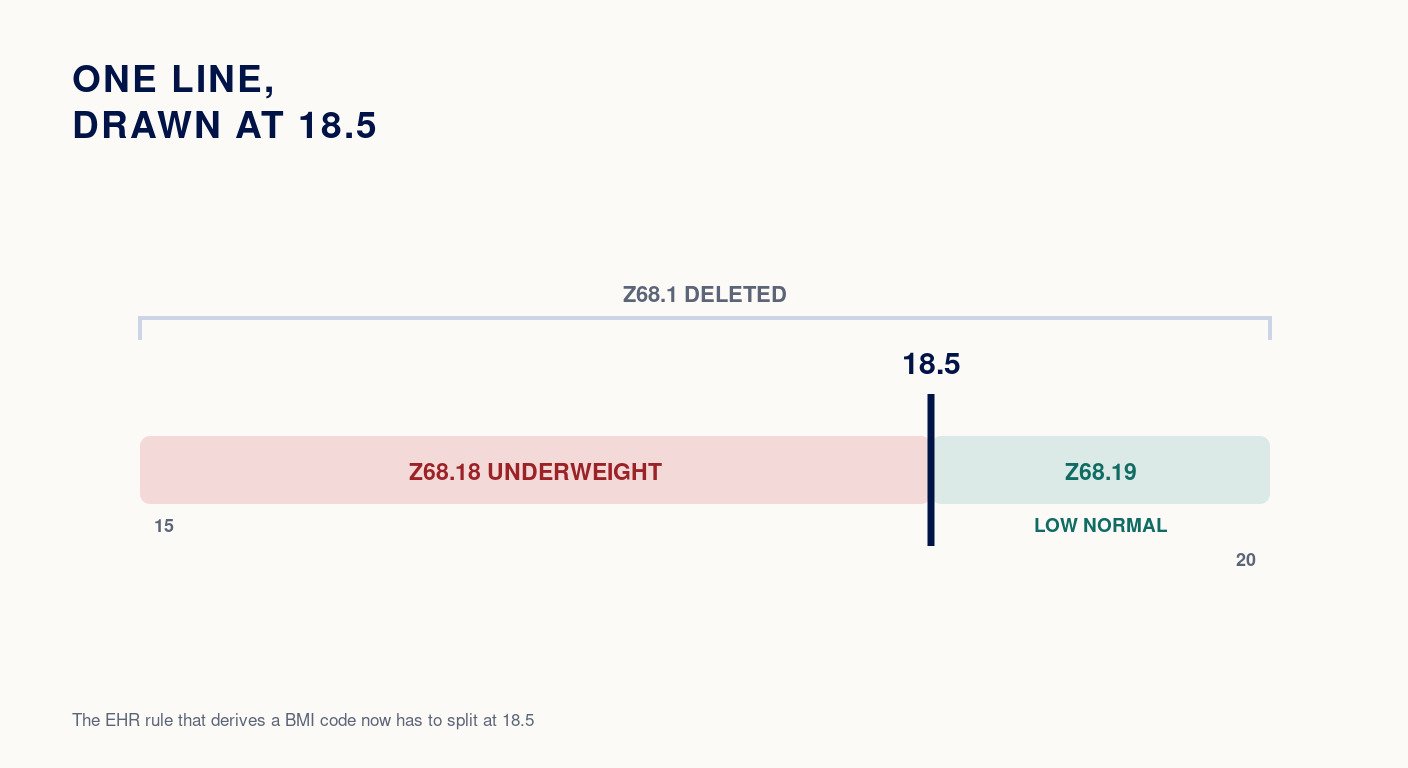
The split is not arbitrary and it is not cosmetic. It separates two groups that the old code had been reporting as one, and the dividing line is placed where it is for a reason.
Why 18.5 Is the Line
A BMI of 18.5 is the conventional lower boundary of the normal adult range. Below it is underweight. Above it, up to roughly 25, is normal.
The old Z68.1 straddled that boundary. A patient with a BMI of 19.6, which is unremarkable, and a patient with a BMI of 15, which is a serious clinical finding, carried the same code. Anyone querying claims data for underweight adults got both, and anyone trying to exclude the normal group could not.
From October 1 the two are distinguishable. Z68.18 is the underweight code. Z68.19 is the low-normal code. That is the whole change, and it is more useful than it looks.
Where This Actually Matters
Malnutrition documentation. BMI codes do not establish malnutrition on their own; the malnutrition diagnosis is a clinical determination the provider documents. But the BMI code sits alongside it on the record, and a Z68.18 supports that picture in a way Z68.1 never could, because Z68.1 was equally consistent with a perfectly healthy patient.
Anything that reads BMI from claims. Quality measures, population health reporting, internal dashboards and risk models that used Z68.1 as a proxy for low body weight were, until now, capturing a mixed group. From October 1 they can capture the right one, and any logic that still looks for Z68.1 captures nothing at all.
Automated posting. This is the practical risk. An EHR that derives a BMI code from vitals has a rule somewhere mapping a calculated value to a code. If that rule maps everything at or below 19.9 to Z68.1, it is now producing an invalid code on every affected encounter, and it will keep doing so silently until someone updates the mapping to split at 18.5.
The Rest of the Z68 Family Is Unchanged
Only the bottom of the adult scale moved. The remaining adult BMI codes, and the paediatric percentile codes in Z68.5-, are untouched by this update. A practice that reports BMI across the full range needs to change one branch of its mapping, not rebuild the lot.
It is also worth remembering the general rule that BMI codes are reported as secondary codes and need an associated diagnosis to be reported with them. Splitting Z68.1 does not change that, and a Z68.18 sitting alone on a claim is no more useful than a Z68.1 was.
What to Check Before You Bill
- Find the rule that generates BMI codes. It is usually in the EHR rather than the billing system, and it is usually nobody’s explicit responsibility. Confirm it now splits at 18.5.
- Check the date of service. Z68.1 is correct for a date of service on or before September 30, 2026 and invalid after it, whatever date the claim goes out.
- Update any report that filters on Z68.1. It now returns nothing for current dates of service, which looks like a drop in prevalence rather than a broken filter.
- Do not translate 18.4 as under 18.5. The descriptor says 18.4 or less. Follow the descriptor.
Common Questions
What replaced Z68.1?
Two codes. Z68.18 for a BMI of 18.4 or less, and Z68.19 for a BMI of 18.5 to 19.9, both adult, for dates of service on or after October 1, 2026.
Which one is the underweight code?
Z68.18. A BMI below 18.5 is conventionally the underweight range, and that is where the split was placed.
Does Z68.18 mean the patient is malnourished?
No. It records a body mass index. Malnutrition is a separate clinical diagnosis that the provider documents and that carries its own codes.
Did any other BMI codes change?
No. Only Z68.1 was affected in this update.
Can a BMI code be the only diagnosis on a claim?
BMI codes are secondary codes reported alongside an associated diagnosis. The split does not change how they are sequenced.
Sources and Methodology
Descriptors for Z68.1, Z68.18 and Z68.19 were read from the FY 2026 and FY 2027 ICD-10-CM code descriptions files published by CMS and the CDC National Center for Health Statistics, and the two successors are as listed in the NCHS ICD-10-CM Conversion Table FY 2027. That no other Z68 code changed was verified by comparing the two years’ code lists. All files are free to download and none is licence gated. The complete FY 2027 deletion list is in our guide to all 30 deleted codes and their replacements.
Leave a Reply