
 By Eman Zahra

Thirty-Eight Procedure Codes Expire on October 1, 2026
The FY 2027 ICD-10-PCS update is small on paper. CMS puts it at 101 new codes, 3 revised titles and 38 deletions, taking the total from 79,193 to 79,256. What makes the 38 worth an hour of attention is that almost all of them are New Technology codes reaching the end of their life, and a New Technology code does not fade out. It is valid on September 30 and invalid on October 1.
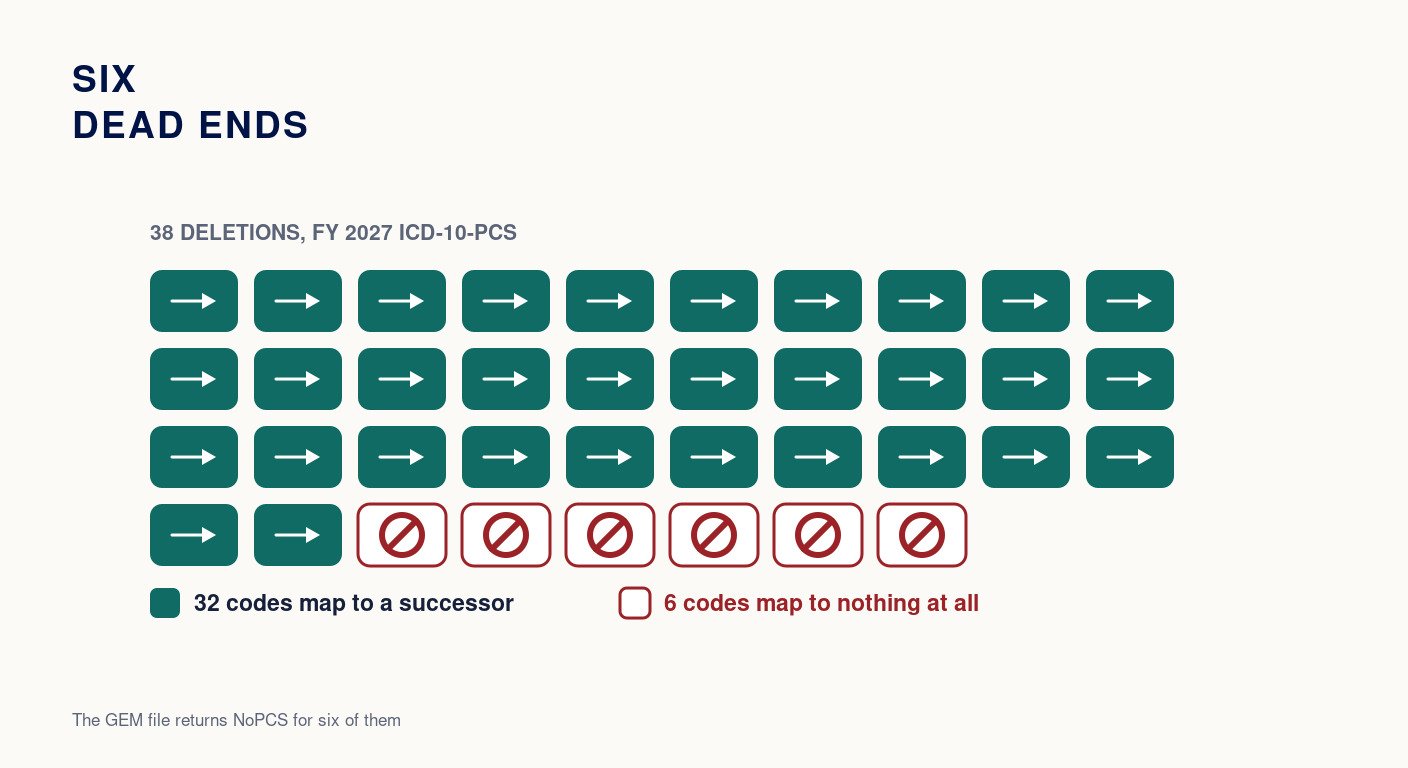
Six of the 38 have no ICD-10-PCS replacement at all. The rest map to standard codes that describe the procedure in less detail, and in two families the successor forces a choice the retired code never asked you to make.
The Six With Nothing to Report Instead
The ICD-10-PCS conversion table gives a successor for each deleted code. For these six it gives the value NoPCS.
| Deleted code | What it described |
|---|---|
| XD2G4V7 | Monitoring of Upper GI Oxygen Saturation, Percutaneous Endoscopic Approach |
| XD2G8V7 | Monitoring of Upper GI Oxygen Saturation, Via Natural or Artificial Opening Endoscopic |
| XD2H4V7 | Monitoring of Lower GI Oxygen Saturation, Percutaneous Endoscopic Approach |
| XD2H8V7 | Monitoring of Lower GI Oxygen Saturation, Via Natural or Artificial Opening Endoscopic |
| XXE5XR7 | Measurement of Infection, Mechanical Initial Specimen Diversion Technique Using Active Negative Pressure |
| XXE5XT7 | Measurement of Intracranial Arterial Flow, Whole Blood mRNA |
Losing a whole table is unusual and it is worth saying plainly what it means. From October 1 there is no ICD-10-PCS code for GI oxygen saturation monitoring. If the procedure is still performed at your facility, it stops being reportable in PCS. That does not make the procedure wrong, and it does not mean nothing is captured elsewhere on the record, but a code that has been on inpatient claims for several years simply disappears.
Twelve Fusion Codes Where You Now Choose the Approach Column
The custom made anatomically designed interbody fusion device codes, XRGA through XRGD across three approaches, are all deleted. Each maps to two standard fusion codes rather than one, and the two differ by the approach to the vertebral column.
| Deleted | Joint and approach | Successors |
|---|---|---|
| XRGA0R7 / XRGA3R7 / XRGA4R7 | Thoracolumbar, open / percutaneous / perc endoscopic | 0RGA0E0 or 0RGA0EJ / 0RGA3E0 or 0RGA3EJ / 0RGA4E0 or 0RGA4EJ |
| XRGB0R7 / XRGB3R7 / XRGB4R7 | Lumbar | 0SG00E0 or 0SG00EJ / 0SG03E0 or 0SG03EJ / 0SG04E0 or 0SG04EJ |
| XRGC0R7 / XRGC3R7 / XRGC4R7 | 2 or more lumbar joints | 0SG10E0 or 0SG10EJ / 0SG13E0 or 0SG13EJ / 0SG14E0 or 0SG14EJ |
| XRGD0R7 / XRGD3R7 / XRGD4R7 | Lumbosacral | 0SG30E0 or 0SG30EJ / 0SG33E0 or 0SG33EJ / 0SG34E0 or 0SG34EJ |
Read the full titles and the difference is clear. 0RGA0E0 is Fusion of Thoracolumbar Vertebral Joint with Interbody Fusion Device, Custom-Made Anatomically and Virtually Designed, Anterior Approach, Anterior Column, Open Approach. 0RGA0EJ is the same with Posterior Approach, Anterior Column. The retired X code carried neither qualifier, so the operative note now has to answer a question that did not previously reach the coder. If your documentation templates were built while the X code was in force, the surgical approach may not be stated in a way that lets you pick between them.
Eighteen Drug Codes That Lose the Drug Name
This is the largest group and the one with the clearest consequence. New Technology drug administration codes name the product. Their standard successors do not.
| Drug | Deleted | Successor |
|---|---|---|
| Amivantamab | XW033B7 peripheral XW043B7 central | 3E0330M 3E0430M |
| Lurbinectedin | XW03387 XW04387 | 3E03305 3E04305 |
| Trilaciclib | XW03377 XW04377 | 3E033GC 3E043GC |
| Terlipressin | XW03367 XW04367 | 3E033XZ 3E043XZ |
| Satralizumab-mwge | XW01397 | 3E013GC |
| Tixagevimab and Cilgavimab | XW023X7 | 3E023GC |
| Anacaulase-bcdb | XW00X27 skin XW01X27 subcutaneous | 3E00XGF 3E01XGF |
| Fostamatinib | XW0DXR7 mouth and pharynx XW0G7R7 upper GI XW0H7R7 lower GI | 3E0DXGC 3E0G7GC 3E0H7GC |
| High-dose immune globulin | XW133D7 XW143D7 | 30233S5 30243S5 |
| OTL-103 | XW133F8 | 30233C0 |
Look at what the successors actually say. 3E0330M is Introduction of Antineoplastic, Monoclonal Antibody, into Peripheral Vein, Percutaneous Approach. 3E03305 is Introduction of Other Antineoplastic. 3E033GC is Introduction of Other Therapeutic Substance. 3E033XZ is Introduction of Vasopressor.
From October 1, the PCS code no longer tells anyone which drug was given. Amivantamab and every other antineoplastic monoclonal antibody share one code. Trilaciclib, satralizumab and tixagevimab all land in Other Therapeutic Substance. That is expected behaviour for Section X, which exists to identify a new technology for a limited period rather than permanently, but it changes what your own inpatient data can answer. Any internal report, registry feed or utilisation review that identified these products from the PCS code stops working, and it will not error, it will simply return nothing.
Two Radial Artery Codes Go the Other Way
X2KB317 and X2KC317, bypass of the right and left radial artery using thermal resistance energy, map to 031B3ZF and 031C3ZF, Bypass Right or Left Radial Artery to Lower Arm Vein, Percutaneous Approach. Here the standard code keeps the anatomy and drops the energy source. This is the dialysis access creation procedure, so it is worth confirming which code your vascular access service is building before the first October case.
Three Codes Keep Their Number and Change Their Drug Name
These are the quietest change in the release, because nothing is added or deleted and a system that checks for valid codes will not flag them.
| Code | FY 2026 title | FY 2027 title |
|---|---|---|
| XW143F8 | Transfusion of OTL-103 | Transfusion of Etuvetidigene Autotemcel |
| XW0E33B | Introduction of DB-OTO | Introduction of Lunsotogene Parvec-cwha |
| XW0V0P7 | Introduction of Antibiotic-eluting Bone Void Filler | Introduction of Gentamicin-eluting Bone Void Filler |
The code number is unchanged, so claims keep working. What breaks is anything keyed to the description text: an encoder favourite saved by name, a charge description, a pick list, a protocol document. Note also that XW143F8 is revised while XW133F8, the peripheral vein version of the same OTL-103 transfusion, is deleted outright and maps to 30233C0. The same product is treated differently depending on the vein.
Six Guideline Changes in the Same Release
CMS flags guidelines A6, A7, B3.3, B3.4a, B3.5 and E1.a as updated for October 1, 2026. Most of it is capitalisation and phrasing. Three are worth reading:
- B3.3 now gives an example of a procedure that is not completed: If the intended procedure is discontinued or otherwise not completed (e.g., patient expires), code the procedure to the root operation performed. The parenthetical is new.
- B3.4a defines what sampling means: Lymph node sampling (i.e., removal of one or more lymph nodes) for biopsy is coded to the root operation Excision with the qualifier Diagnostic. The definition is new.
- B3.5 gains a second example of the deepest layer rule: Excisional debridement that includes muscle and tendon is coded to the tendon body part. This one is a genuine addition rather than a clarification, and debridement is high volume.
A6 and A7 change alphabetic index to Alphabetic Index. E1.a changes not assigned in addition to not coded in addition. Neither alters the rule.
What to Check Before October 1
- Check the discharge date, not the claim date. ICD-10-PCS codes follow the discharge. A September discharge billed in October still uses the retired code.
- Find out whether you report any of the six NoPCS procedures. If GI oxygen saturation monitoring is on your case list, decide now what the record will say instead.
- Check the fusion documentation. Anterior versus posterior approach to the anterior column now decides the code, and your templates may not capture it.
- Warn whoever owns your inpatient reporting. Any query that finds amivantamab, lurbinectedin or trilaciclib by PCS code returns nothing from October onward.
- Search your saved favourites for OTL-103, DB-OTO and antibiotic-eluting. The codes still work, the names do not.
- Re-read B3.5 if you code debridement. Muscle and tendon now goes to tendon.
FAQs
Why do New Technology codes get deleted?
Section X identifies a new technology for a limited period. When that period ends the code is retired and the procedure is reported with the standard code that describes it, which is why almost every successor in this release is a less specific code rather than a more specific one.
What do I report instead of XD2G4V7?
Nothing in ICD-10-PCS. The conversion table lists the successor as NoPCS and the whole XD2 table is deleted.
How do I choose between 0SG00E0 and 0SG00EJ?
By the approach to the vertebral column documented in the operative report. The 0 qualifier is anterior approach anterior column and the J qualifier is posterior approach anterior column.
Is XW143F8 still valid?
Yes. It keeps its number and its title changes from OTL-103 to Etuvetidigene Autotemcel. The peripheral vein version XW133F8 is deleted and maps to 30233C0.
How many ICD-10-PCS codes are there for FY 2027?
79,256, up from 79,193, after 101 additions and 38 deletions.
Sources
Codes, titles, successors and counts were read from the primary FY 2027 ICD-10-PCS files published by CMS: the order file and its addenda, the conversion table, the addendum, the version update summary and the FY 2027 Official ICD-10-PCS Coding Guidelines. The FY 2026 guidelines and order file were used for the before and after comparisons. All are free to download and none is licence gated. The related ICD-10-CM changes for the same date are covered separately in the FY 2027 diagnosis code deletions.
Leave a Reply