


Almost Nothing Changed, and Three Things People Will Tell You Changed Did Not
Every year the ICD-10-CM Official Guidelines for Coding and Reporting are reissued on October 1, and every year a round of summaries appears explaining what changed. For FY 2027 a lot of those summaries are going to be wrong in the same way, and the reason is a file most people do not know exists.
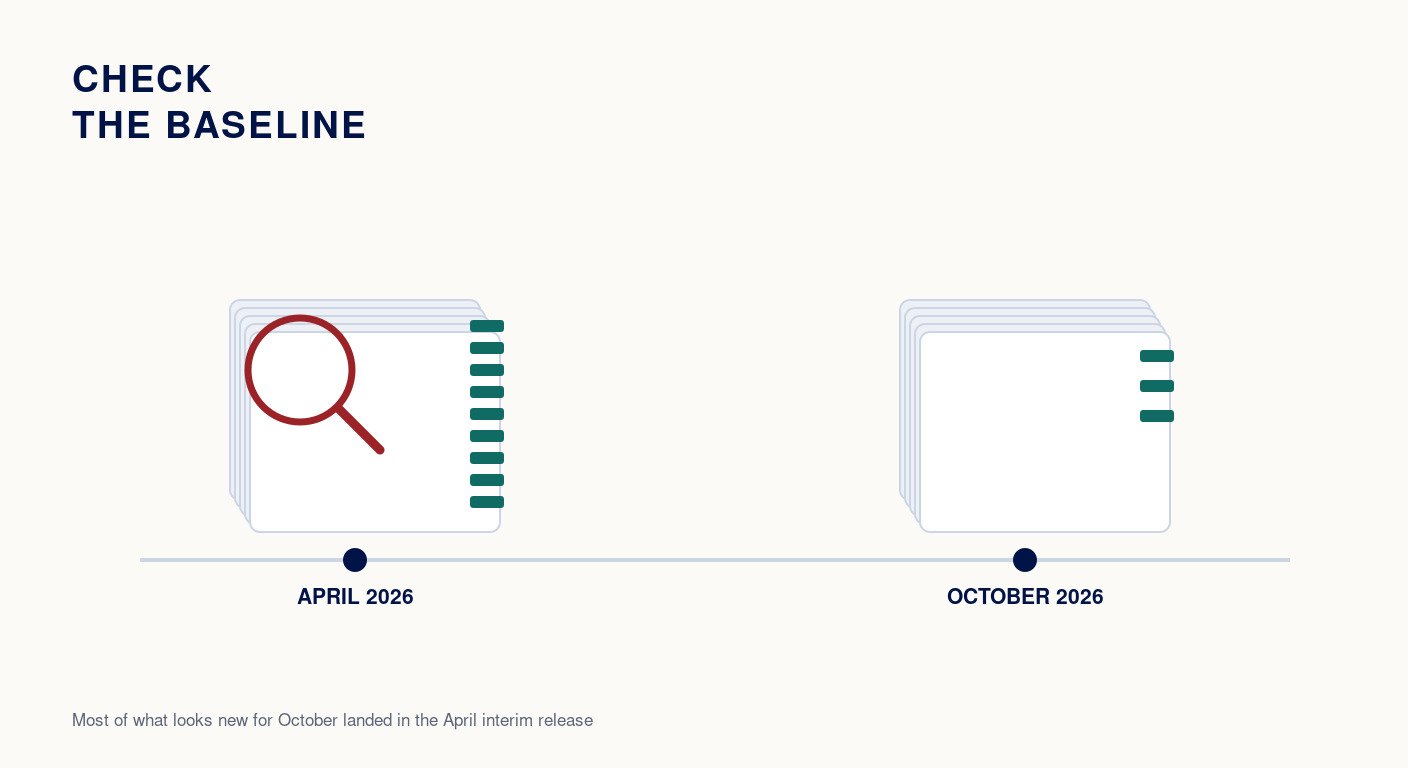
CMS and NCHS publish an interim revision of the guidelines in April, halfway through the fiscal year. The FY 2026 guidelines were reissued on April 1, 2026 and applied from that date through September 30, 2026. If you compare the new FY 2027 document against the October 2025 release, which is the one most people have saved, everything that changed in April looks like it changed in October.
Compared against the correct baseline, the April 1, 2026 version, the FY 2027 guidelines differ by about 240 lines and the substantive changes number three.
What Landed in April, Not October
These three are already in force and have been since April 1, 2026. If a FY 2027 summary presents them as new, it was written against the October 2025 file.
- The HIV guideline rewrite. Section I.C.1.a was substantially reworked, including the instruction that patients previously diagnosed with any HIV illness (B20) should never be assigned to R75 or Z21, and a new lettered subsection covering HIV disease or HIV positive status managed by antiretroviral medication.
- The comma convention. A new entry in the conventions section explaining that commas in the Alphabetic Index carry different meanings depending on context, including alternate verbiage, essential and nonessential modifiers, and as an alternative for and/or.
- Observation Stay in the outpatient section, and the related reorganisation around admission from outpatient surgery.
This is worth knowing for a practical reason beyond accuracy. If your last guideline training was built on the October 2025 document, you have been six months behind since April and the October update will not tell you, because the October document does not mark the April changes as new.
The Three Real FY 2027 Changes
1. Chapter 17 now runs to QA1 and covers genetic disorders
The chapter range extends from Q00-QA0 to Q00-QA1, and the word genetic disorder is threaded through the whole of Section I.C.17. The operative sentence now reads:
A malformation/deformation/chromosomal abnormality, or genetic disorder may be the principal/first-listed diagnosis or secondary diagnosis on a record.
The reason for the change is the new QA17 subcategory for inherited cancer predisposition syndromes. It matters beyond those five codes, because the guideline now explicitly states that a genetic disorder can lead the record, and the lifelong-use paragraph was reworded to say that whenever the provider diagnoses the condition it is appropriate to assign a code from Q00-QA1. We covered what that means in practice in the QA17 article.
2. I1A joins the hypertensive crisis instruction
A one-character change in Section I.C.9.a.10, and the highest volume change in the release. The guideline for hypertensive crisis previously read Code also any identified hypertensive disease (I10-I15). It now reads:
Assign a code from category I16, Hypertensive crisis, for documented hypertensive urgency, hypertensive emergency or unspecified hypertensive crisis. Code also any identified hypertensive disease (I10-I15, I1A). The sequencing is based on the reason for the encounter.
I1A is Other hypertension, which includes resistant hypertension. It sat outside the I10-I15 range, so a patient with documented resistant hypertension presenting in hypertensive crisis had a code-also instruction that did not reach their underlying diagnosis. It does now. Hypertension is among the most frequently reported conditions in US claims data, so this is a small edit with a wide footprint.
3. Two new notes on diethylstilbestrol exposure
Neither code is new. Both Z84.A and Z91.B existed in FY 2026. What is new is guidance telling you which is which, added to the family history and status code lists in Section I.C.21.
| Code | New note, quoted from the FY 2027 guidelines |
|---|---|
| Z84.A Family history of exposure to diethylstilbestrol | Code Z84.A is assigned when the patient has a family member that was exposed to DES that could cause the patient to be at a higher risk for a condition related to the exposure. This code is used, for example, when the patient’s maternal grandmother was exposed to DES |
| Z91.B Personal risk factor of exposure to diethylstilbestrol | This code is assigned to show the patient was directly exposed to DES in utero (e.g., when the patient’s mother was exposed to DES while the patient was in utero) |
DES was prescribed in pregnancy in the United States into the early 1970s, and the population now presenting is largely the grandchildren of the women who took it. That is precisely the case the new Z84.A note describes, and the two codes are easy to transpose without it.
The Editorial Changes, So You Can Stop Looking for Meaning in Them
The remaining differences are wording. Listing them is useful mainly so that nobody spends an afternoon working out what they imply.
- The POA section changes do not require the use of a POA indicator to do not require the reporting of a POA indicator, changes the U definition from if condition is present on admission to if condition was present on admission, changes codes for which this field is not applicable to codes for which the POA indicator is not applicable, and changes providers to provider. The rules are unchanged.
- Chapter 18 drops a word: ill-defined conditions regarding which no diagnosis becomes ill-defined conditions which no diagnosis.
- The newborn observation guideline reorders a phrase from no condition after study is found to be present to no condition is found to be present after study.
- The table of contents entry for Section I.C.2.e gains the word antineoplastic so that it matches the section heading, which already read that way in April. The body text of that guideline, including the Z51.0, Z51.11 and Z51.12 sequencing, is identical.
On the Procedure Side, Six Guidelines Changed
The ICD-10-PCS guidelines are a separate document and CMS flags A6, A7, B3.3, B3.4a, B3.5 and E1.a as updated for October 1, 2026. Three carry real content:
- B3.3 adds an example of an incomplete procedure: If the intended procedure is discontinued or otherwise not completed (e.g., patient expires), code the procedure to the root operation performed.
- B3.4a defines sampling: Lymph node sampling (i.e., removal of one or more lymph nodes) for biopsy is coded to the root operation Excision with the qualifier Diagnostic.
- B3.5 adds a second deepest-layer example: Excisional debridement that includes muscle and tendon is coded to the tendon body part. Debridement is high volume and this example did not previously exist.
A6 and A7 capitalise Alphabetic Index. E1.a changes not assigned in addition to not coded in addition. Neither changes the rule. The procedure code changes landing on the same date are covered in the FY 2027 ICD-10-PCS deletions.
How to Check This Yourself
- Confirm which FY 2026 file you have. Open it and read the second line. It says either UPDATED October 1, 2025 or UPDATED April 1, 2026. If it says October, you are missing six months of changes.
- Use the document’s own markers. The cover page states that narrative changes appear in bold, underlined items have moved, and italics indicate heading revisions. Reading the bold text is faster than any summary.
- Watch for the April file every year. It is published in a separate location from the annual release and is easy to miss entirely.
- Remember the guidelines are binding. Adherence when assigning ICD-10-CM codes is required under HIPAA, and the conventions and instructions inside the classification take precedence over the guidelines themselves.
FAQs
What changed in the FY 2027 ICD-10-CM guidelines?
Three substantive things: Chapter 17 extends to Q00-QA1 and covers genetic disorders, I1A is added to the hypertensive crisis code-also instruction, and two new notes distinguish Z84.A from Z91.B for diethylstilbestrol exposure. Everything else is wording.
Is there really an April version of the guidelines?
Yes. The FY 2026 guidelines were reissued as UPDATED April 1, 2026, covering April 1 through September 30, 2026. The FY 2027 document says on its cover that moved items are measured against the April 2026 version.
Did the HIV guidelines change for FY 2027?
No. They changed in April 2026 and have applied since then.
What is I1A?
Other hypertension, a category that sits outside the I10-I15 range and includes resistant hypertension. FY 2027 adds it to the code-also instruction under hypertensive crisis.
Which ICD-10-PCS guidelines changed?
A6, A7, B3.3, B3.4a, B3.5 and E1.a. The ones with real content are B3.3, B3.4a and B3.5.
Sources
This comparison was made from the primary documents: the ICD-10-CM Official Guidelines for Coding and Reporting FY 2027, the FY 2026 guidelines as UPDATED April 1, 2026, the FY 2026 guidelines as UPDATED October 1, 2025, and the FY 2027 and FY 2026 Official ICD-10-PCS Coding Guidelines. The list of changed ICD-10-PCS guideline numbers comes from the CMS ICD-10-PCS FY 2027 version update summary. All are published free by CMS and the CDC National Center for Health Statistics and none is licence gated. Quotations are verbatim.
Leave a Reply