


Twelve Solvent Codes Deleted, Thirty-Six Added
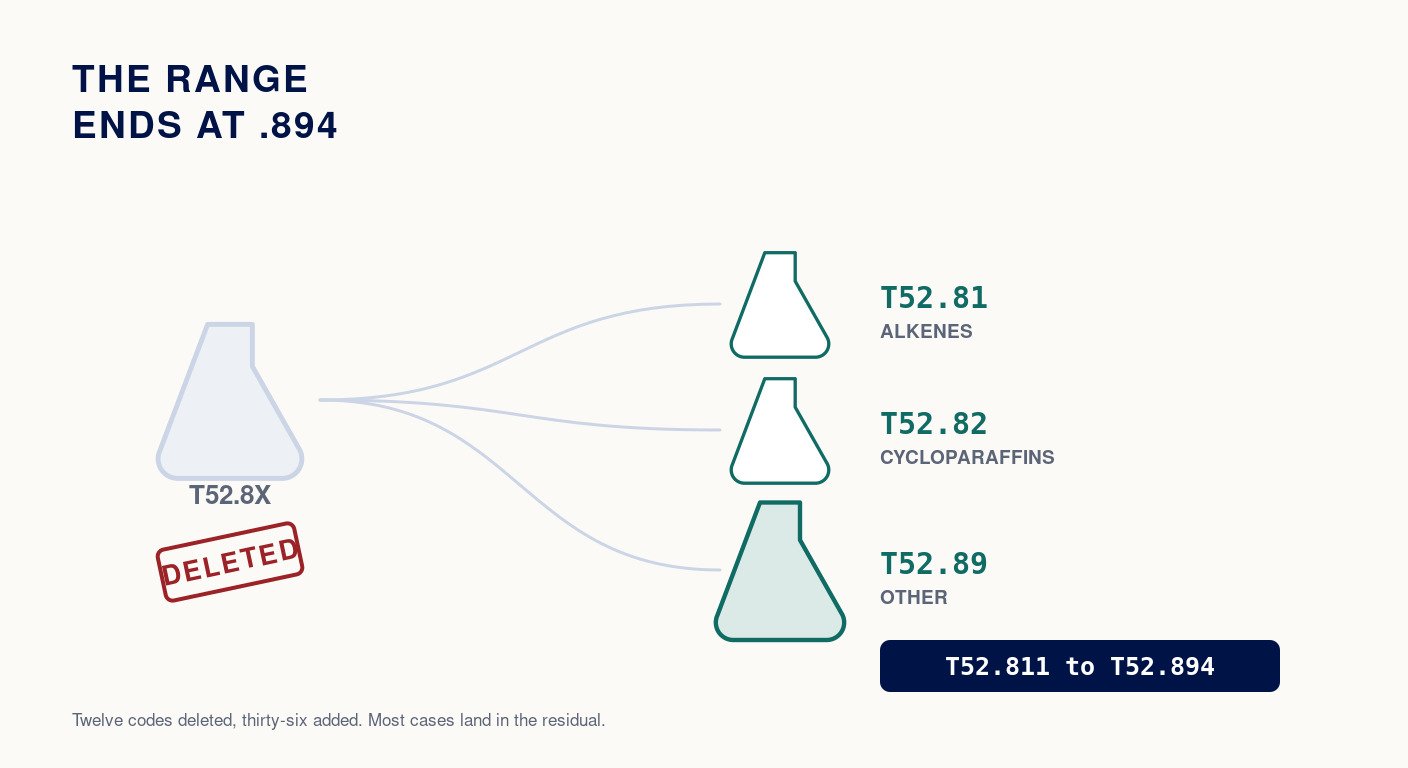
Toxic effect of other organic solvents was a single family: T52.8X1 through T52.8X4, one code per intent, each with three seventh characters. Twelve billable codes in total, and every organic solvent that was not benzene, toluene, xylene or one of the named alcohols landed in them.
All twelve were deleted on October 1, 2026. Thirty-six took their place, and they are the largest single block of additions in the FY 2027 update.
One Family Became Three
| New subcategory | Substance |
|---|---|
| T52.81- | Alkenes |
| T52.82- | Cycloparaffins |
| T52.89- | Other organic solvents |
The structure inside each is unchanged, which makes the mapping mechanical once you know which substance you have:
- fifth character 1 accidental (unintentional), 2 intentional self-harm, 3 assault, 4 undetermined
- seventh character A initial encounter, D subsequent encounter, S sequela
So the deleted T52.8X1A, accidental, initial encounter, maps to T52.811A, T52.821A or T52.891A depending on whether the solvent was an alkene, a cycloparaffin or something else. Every one of the twelve deleted codes has exactly three successors on the same pattern.
The Range Most People Will Get Wrong
It is tempting to summarise this as T52.811 through T52.824, because alkenes and cycloparaffins are the two new named substances and they occupy those numbers.
That summary is wrong, and it omits the codes that will carry the most volume. The range runs to T52.894, because T52.89- is where most cases will actually go. Alkenes and cycloparaffins are two specific chemical classes; the enormous residual category of organic solvents used in industry, cleaning and manufacturing is still residual, it has simply moved from T52.8X- to T52.89-.
A crosswalk or cheat sheet that stops at T52.824 will send every unnamed solvent to the wrong place.
What the Substance Has to Be Documented As
The split only helps if the record identifies the chemical class, and in practice many exposure records do not. A note saying solvent exposure, degreaser or paint thinner does not tell a coder whether the agent was an alkene.
Where the substance is not documented to the level the new codes need, T52.89- is the correct code, not a failure. It is the designated residual. What is not acceptable is guessing at a chemical class from a trade name, because the codes now assert something specific about the substance that the record may not support.
For occupational cases there is often a safety data sheet, an employer exposure record or a poison control consultation that names the agent precisely. Those are worth asking for, because they are the difference between a specific code and a residual one.
These Are Toxic Effect Codes, Not Poisoning Codes
T52 sits in the toxic effect range rather than the poisoning range, and the FY 2027 Official Guidelines are explicit about what that means:
When a harmful substance is ingested or comes in contact with a person, this is classified as a toxic effect. The toxic effect codes are in categories T51-T65. When coding a toxic effect, assign the toxic effect code first, followed by codes for all associated manifestations of the toxic effect.
Two consequences. The toxic effect code is sequenced first, with manifestations after it. And because the intent is built into the code itself, the guidelines state that no additional external cause code is required for codes in T36 to T65.
Only Two of the Three Seventh Characters Are POA Exempt
On inpatient claims, the D subsequent encounter and S sequela codes across all three new subcategories appear on the FY 2027 POA exempt list. The A initial encounter codes do not.
That is the standard pattern for injury and poisoning codes and it is the opposite of the assumption that a whole new family arrives exempt. An initial encounter for solvent toxicity needs a present on admission indicator like any other acute condition.
What to Check Before You Bill
- Check the date of service. T52.8X- codes are correct on or before September 30, 2026 and invalid after it, whatever date you submit.
- Extend your crosswalk to T52.894. Anything stopping at T52.824 is missing the residual codes that will carry most of the volume.
- Do not infer a chemical class from a product name. If the record does not identify the solvent, T52.89- is the right answer.
- Ask for the safety data sheet on occupational cases. It is usually the only document that names the agent.
- Sequence the toxic effect first, then the manifestations.
- Do not add an external cause code for intent. It is already in the code.
Common Questions
What replaced T52.8X1A?
T52.811A for alkenes, T52.821A for cycloparaffins, or T52.891A for other organic solvents, for dates of service on or after October 1, 2026.
How many codes changed?
Twelve billable codes deleted, thirty-six added: three subcategories, each with four intents and three seventh characters.
Which code if the solvent is not identified?
T52.89-, other organic solvents, with the appropriate intent and seventh character.
Do I need an external cause code as well?
No. The FY 2027 guidelines state that codes in T36 to T65 are combination codes including the substance and the intent, and no additional external cause code is required.
Are these codes POA exempt?
The D and S codes are. The A initial encounter codes are not.
Sources and Methodology
All thirty-six new descriptors and the twelve deletions were read from the FY 2027 ICD-10-CM code descriptions file and addendum published by CMS and the CDC National Center for Health Statistics. Successors are as listed in the NCHS ICD-10-CM Conversion Table FY 2027, which gives three for each deleted code. POA status was confirmed against the FY 2027 POA exempt code files. The sequencing and external cause quotations are from the ICD-10-CM Official Guidelines for Coding and Reporting FY 2027, Section I.C.19.e. All files are free and none is licence gated. The full deletion list is in our guide to all 30 deleted FY 2027 codes.
Leave a Reply