


Eleven Codes Changed Meaning Without Changing Number
When a HCPCS code is added or discontinued, something in your systems notices. A new code has to be loaded. A discontinued code starts rejecting. Either way there is an event.
The October 2026 quarterly update also contains 11 long description changes and 5 payment changes. Those produce no event at all. The code number is identical, the claim is accepted, and the only thing that moved is what the code means or what it pays.
| Action | Count |
|---|---|
| Added | 45 |
| Discontinued | 15 |
| Long description change | 11 |
| Payment change | 5 |
| Administrative field change | 1 |
The Pattern: A Generic Code Narrows
Two of the eleven follow the same logic, and it is the one worth understanding because it will recur in every quarterly update.
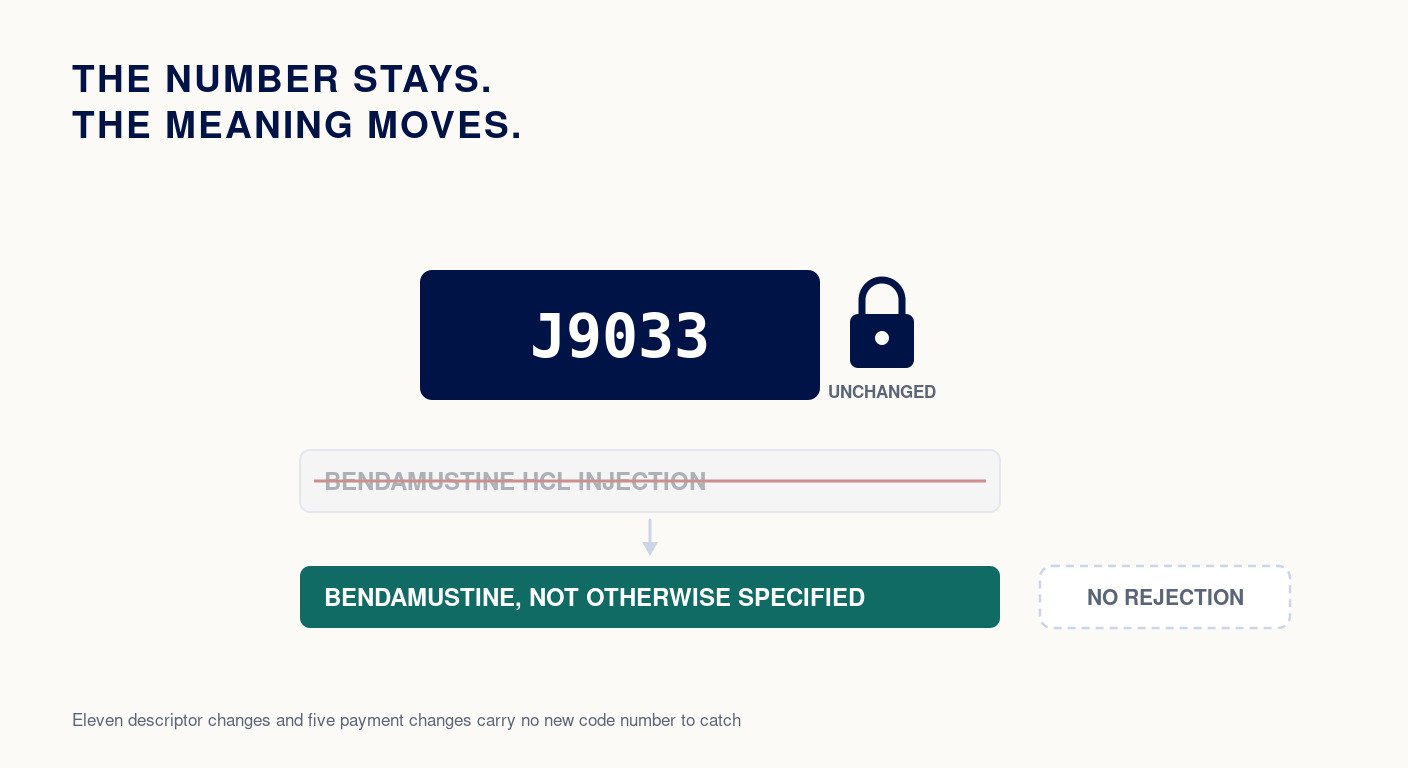
J9033 is now injection, bendamustine hydrochloride, not otherwise specified, 1 mg. The words not otherwise specified are new. They were added because the same update created J9066 for a manufacturer-specific bendamustine product. The old code did not change what it covers by accident; it narrowed, because something was carved out of it.
A9595 is piflufolastat f 18 (pylarify), diagnostic, 1 millicurie, and the update added A9613 for a different pylarify formulation. Same shape: the general code is now the residual, and a product that used to belong in it has its own code.
The practical consequence is that a code you have billed for years may now be the wrong one for a product you have always used, without the code number changing and without any rejection telling you.
The Full List of Eleven
| Code | Current long description |
|---|---|
| A9595 | Piflufolastat f 18 (pylarify), diagnostic, 1 millicurie |
| C1982 | Catheter, pressure-generating, e.g. one-way valve or occlusion balloon |
| C8004 | Simulation angiogram with use of a pressure-generating catheter |
| C9797 | Vascular embolization or occlusion procedure with use of a pressure-generating catheter |
| J3300 | Injection, triamcinolone acetonide (triesence), preservative free, 1 mg |
| J9033 | Injection, bendamustine hydrochloride, not otherwise specified, 1 mg |
| L1971 | Ankle foot orthosis, plastic or other material with ankle joint |
| L8030 | Breast prosthesis, silicone or equal, without integral adhesive, any type |
| L8031 | Breast prosthesis, silicone or equal, with integral adhesive, any type |
| L8035 | Custom breast prosthesis, post mastectomy, molded to patient model, any type |
| S0169 | Calcitrol, oral, 0.25 microgram |
Note the clustering. C1982, C8004 and C9797 all concern pressure-generating catheters and changed as a set, which points at a definitional revision across a procedure family rather than three unrelated edits. L8030, L8031 and L8035 are the breast prosthesis codes and likewise moved together, with the distinction between them resting on integral adhesive and on custom moulding.
L1971 changed while the update also added L1972, a closely related ankle foot orthosis code. The same narrowing pattern applies.
Five Payment Changes, All Skin Substitutes
Every payment change in the October update lands in one narrow band: A2040, A2041, A2042, A2043 and A2045. These are skin substitute products billed per square centimetre as add-on codes, listed separately in addition to a primary procedure.
The same update also added A2046 through A2050, a further five products in the same family. A wound care programme billing in this range has, in one quarter, five products whose payment moved and five new products to load, and none of it generates a rejection.
Why These Are Harder Than Deletions
A deleted code announces itself. The claim comes back, somebody investigates, the code gets fixed. The feedback loop works.
A description change has no feedback loop at all:
- The claim pays. Nothing flags a code that is valid but no longer the best fit for the product dispensed.
- Your charge master keeps the old text. Code descriptions are usually copied into the charge description master once and rarely refreshed, so the label your staff read may be the previous year’s.
- Payment changes appear as variance, not error. A shifted allowable looks like a payer issue or a contract question long before anybody checks whether the fee schedule moved.
- Nobody owns it. Adds and deletes have a process. Description changes usually do not.
What to Check
- Compare your charge master text against the current HCPCS file for these eleven codes. Where they differ, the file is right.
- Check whether a narrowed code still fits your product. If you bill J9033 or A9595, confirm the specific product you dispense has not been given its own code.
- Reconcile allowed amounts in the A2040 to A2045 range against September, not against expectation.
- Read the transaction report each quarter, not just the add and delete lists. It is published alongside the HCPCS file and it is the only place these changes are enumerated.
- Give description changes an owner. They need the same routing as adds and deletes, and usually have none.
Common Questions
Why did J9033 change?
It gained the words not otherwise specified because a manufacturer-specific bendamustine code, J9066, was added in the same update. The generic code narrowed.
Will a description change cause a denial?
Not by itself. The code number is unchanged and the claim will process. The risk is billing a code that no longer best describes what was supplied.
Which codes had payment changes in October 2026?
A2040, A2041, A2042, A2043 and A2045, all skin substitute add-on products.
How many changes were in the October 2026 HCPCS update in total?
45 additions, 15 discontinuations, 11 long description changes, 5 payment changes and 1 administrative field change.
Where are these changes published?
In the transaction report distributed with the quarterly alpha-numeric HCPCS file, on the worksheet titled Changes by Action Code.
Sources and Methodology
All counts and descriptions come from the October 2026 alpha-numeric HCPCS file published by CMS and its accompanying transaction report, compared against the July 2026 file. Counts were taken from the Changes by Action Code worksheet. Note that the workbook repeats the same records on a second worksheet sorted differently, so counting the file as a whole doubles every figure. HCPCS Level II is published by CMS and carries no licence restriction. The discontinued codes in the same update, and the unit changes they bring, are covered separately in our guide to the 15 drug codes that ended on September 30.
Leave a Reply