
 By Eman Zahra

Three Metastatic Sites Leave the Residual Codes
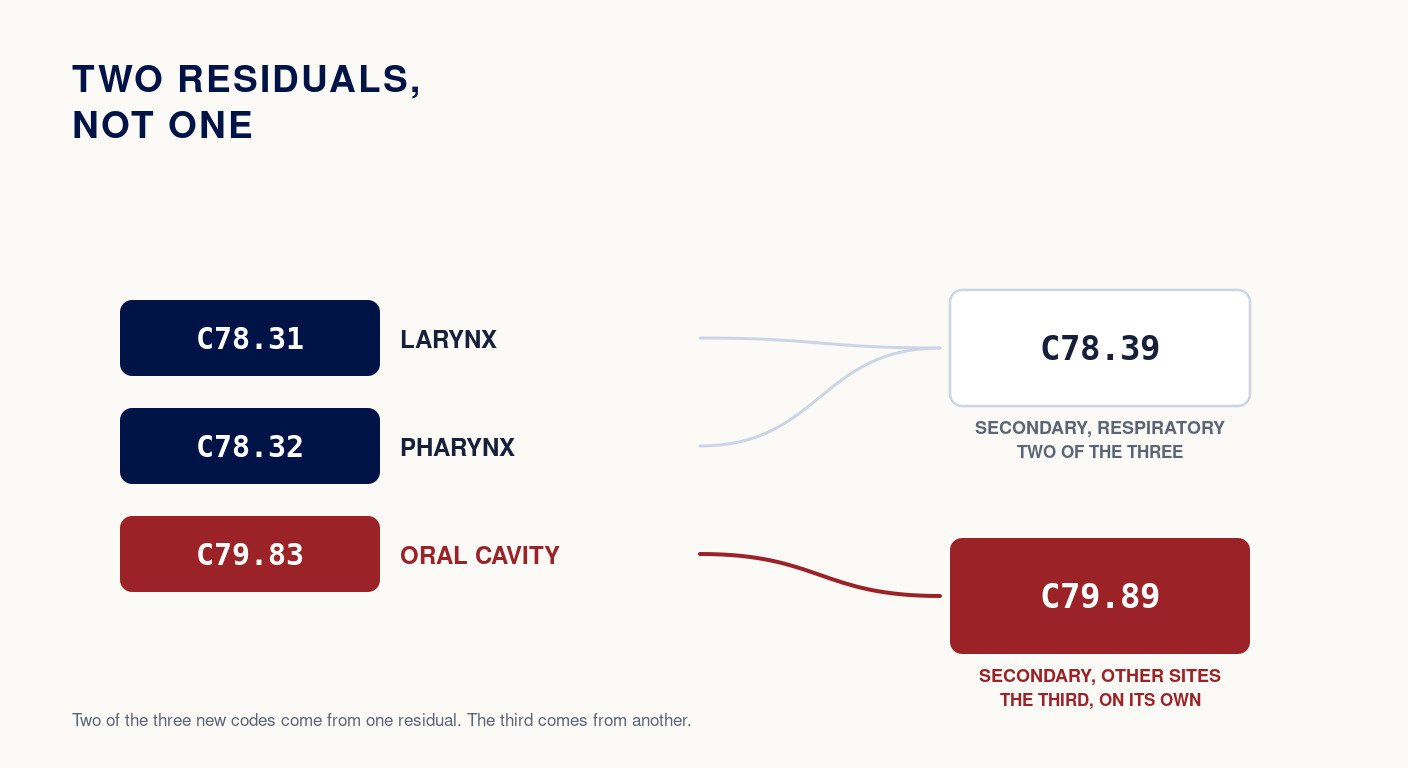
Secondary malignant neoplasm codes are organised by the site the cancer spread to. Until October 1, 2026 the head and neck were thinly covered: the larynx and pharynx both fell into a residual respiratory code, and the oral cavity into a residual code for other specified sites.
FY 2027 gives all three their own.
| New code | Description | Previously coded to |
|---|---|---|
| C78.31 | Secondary malignant neoplasm of larynx | C78.39 |
| C78.32 | Secondary malignant neoplasm of pharynx | C78.39 |
| C79.83 | Secondary malignant neoplasm of oral cavity | C79.89 |
Note that the three do not come from the same place. The larynx and pharynx were inside C78.39, secondary malignant neoplasm of other respiratory organs. The oral cavity was inside C79.89, secondary malignant neoplasm of other specified sites, which is a different chapter section entirely.
That matters if you are looking backwards. Historical laryngeal and pharyngeal metastases are in the respiratory residual; historical oral cavity metastases are in the general one. A single search of either will miss a third of the picture.
What the Families Look Like Now
| Code | Description |
|---|---|
| C78.30 | Secondary malignant neoplasm of unspecified respiratory organ |
| C78.31 | Secondary malignant neoplasm of larynx |
| C78.32 | Secondary malignant neoplasm of pharynx |
| C78.39 | Secondary malignant neoplasm of other respiratory organs |
| C79.81 | Secondary malignant neoplasm of breast |
| C79.82 | Secondary malignant neoplasm of genital organs |
| C79.83 | Secondary malignant neoplasm of oral cavity |
| C79.89 | Secondary malignant neoplasm of other specified sites |
Both residual codes remain valid and remain correct for sites that genuinely are not named. They are simply carrying less than they were.
Secondary, Not Primary, and the Distinction Is the Whole Point
These codes describe a metastasis to the larynx, pharynx or oral cavity. They are not codes for a cancer that started there.
Head and neck cancer is common enough as a primary disease that the risk of transposition is real. A primary laryngeal carcinoma has its own code in the C32 range; C78.31 says a cancer from somewhere else has spread to the larynx. The two describe different diseases with different staging, different treatment and different prognosis, and the codes are not interchangeable in either direction.
The general sequencing rules for neoplasms apply unchanged. Where treatment is directed at the metastatic site, the secondary code leads; where it is directed at the primary, the primary leads. Adding three sites does not alter that.
Why It Was Worth Doing
Metastasis to the upper aerodigestive tract carries consequences that are specific to the site: airway compromise, swallowing and speech, and decisions about radiation to a field that has often already been treated.
None of that was identifiable in claims data while the codes were residual. A patient with a laryngeal metastasis and a patient with a metastasis to an unnamed respiratory organ carried the same code, so the population could not be counted, and anything built on counting it, from service planning to outcomes research, had nothing to work with.
This is the same pattern as several other FY 2027 additions, where named conditions finally left residual codes. The value arrives only if the site is documented, which is a clinical documentation point rather than a coding one.
What to Check Before You Bill
- Check the date of service. These codes are invalid on or before September 30, 2026, when C78.39 and C79.89 were correct.
- Confirm the record says metastatic. These are secondary neoplasm codes and a primary head and neck cancer is coded elsewhere.
- Look for the site in the imaging or pathology report. Larynx, pharynx and oral cavity are distinguished, and the residual codes remain for anything else.
- Search both residuals for historical cases. C78.39 for larynx and pharynx, C79.89 for oral cavity.
- Do not retire C78.39 or C79.89. Both are still correct for unnamed sites.
Common Questions
What is the ICD-10 code for metastasis to the larynx?
C78.31, for dates of service on or after October 1, 2026. Before that it was C78.39.
What about the pharynx and oral cavity?
C78.32 for the pharynx, which also came from C78.39, and C79.83 for the oral cavity, which came from C79.89.
Are these codes for primary head and neck cancer?
No. They describe a cancer that spread to those sites from elsewhere.
Were any codes deleted?
No. All three are additions and both residual codes remain valid.
Does this change neoplasm sequencing?
No. The existing rules on primary versus secondary sequencing apply unchanged.
Sources and Methodology
Descriptors were read from the FY 2027 ICD-10-CM code descriptions file published by CMS and the CDC National Center for Health Statistics, and the complete C78.3 and C79.8 families were compared between the FY 2026 and FY 2027 files to confirm that nothing was deleted. Predecessors are as published in the NCHS ICD-10-CM Conversion Table FY 2027. All files are free and none is licence gated.
Leave a Reply