
 By Eman Zahra

Two New Categories, and the Instructions Attached to Them
FY 2027 created two new ICD-10-CM categories that are easy to miss because neither belongs to a family anyone was watching: K6A, diseases of the pelvis, not elsewhere classified, and J4B, pulmonary mycetoma.
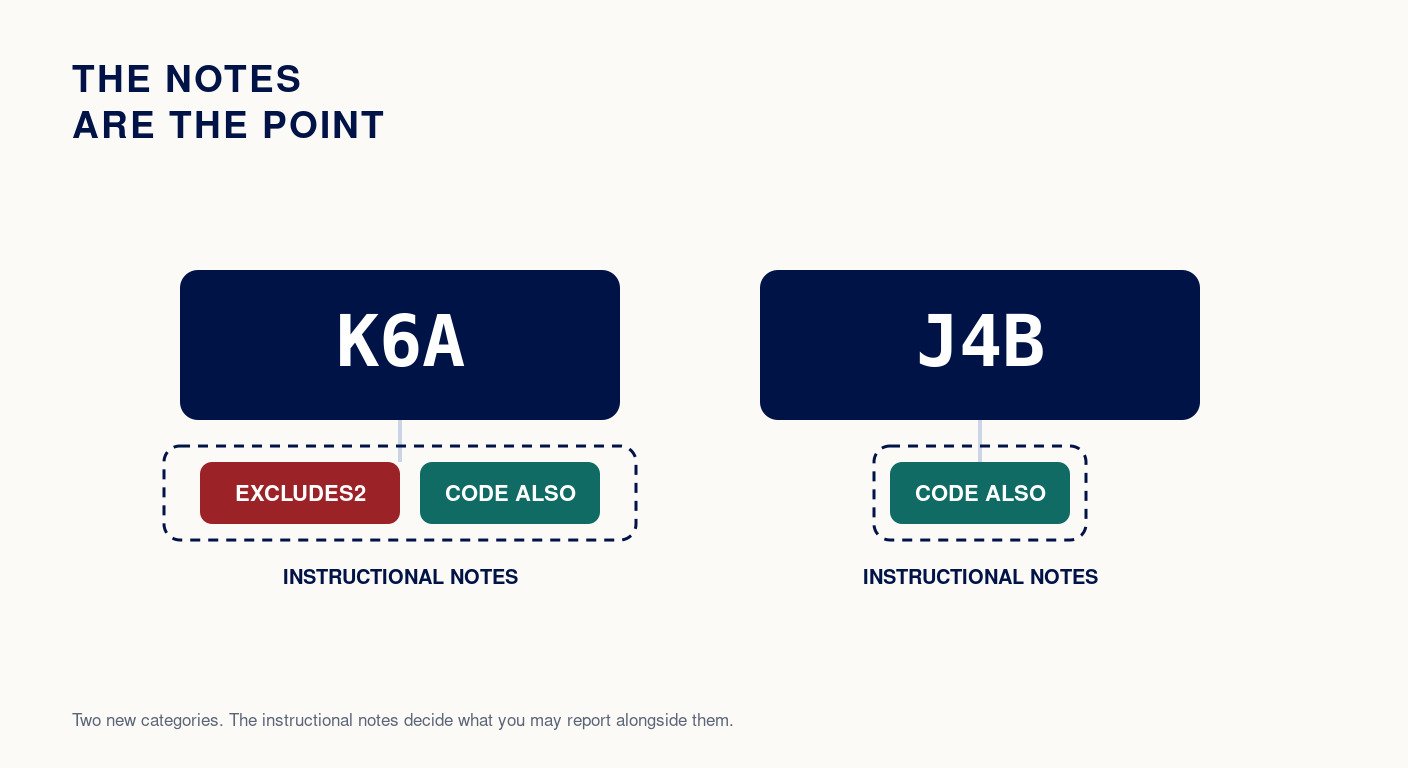
Both share a shape. A condition that used to be reported as part of something else now has a code of its own, and the tabular list attaches instructional notes telling you what to code alongside it and what not to code with it. Those notes are the whole point, and they are what a code list alone will never tell you.
K6A: Pelvic Abscess Leaves the Peritoneum
| New code | Description | Previously coded to |
|---|---|---|
| K6A.01 | Prevesical abscess (includes retropubic abscess) | K68.19 |
| K6A.09 | Other pelvic abscess (includes pelvic abscess, unspecified) | K68.19 and K65.1 |
| K6A.8 | Other diseases of the pelvis, not elsewhere classified | K92.89, N39.8, N50.89, N94.89, R68.89 |
A pelvic abscess used to be reported as a retroperitoneal abscess (K68.19) or a peritoneal abscess (K65.1), depending on how it was documented and who was coding it. Neither was quite right, and the inconsistency meant the same clinical entity landed in two different places.
The Excludes2 is the important bit
K6A.0 carries an Excludes2 for exactly the two codes it came from:
Excludes2: peritoneal abscess (K65.1); retroperitoneal abscess (K68.1-)
An Excludes2 means the excluded condition is not part of the code, but a patient can have both, and both may be reported together where both are documented. So this is not telling you to stop using K65.1 and K68.1-. It is telling you they are now different things from a pelvic abscess, and that a patient with a pelvic abscess and a separate retroperitoneal collection gets both codes.
The trap is treating the split as a straight migration and reporting K6A.09 in place of K65.1 on a patient who genuinely has a peritoneal abscess. The two now mean different things.
Two more notes on K6A.0
- Code also, if applicable: diverticular disease of intestine (K57.-) and female pelvic inflammatory disease (N73.-). These are the two common underlying causes, and the note asks for the cause alongside the abscess rather than instead of it.
- Use additional code (B95-B97) to identify the infectious agent, if known. Where cultures identified an organism, it gets its own code.
Note also that K6A.09 carries the inclusion term pelvic abscess, unspecified. There is no separate unspecified code; the residual child holds it.
J4B: The Fungal Ball Gets Its Own Code
J4B, pulmonary mycetoma, is a single new code with the inclusion term pulmonary fungal ball. It is a mass of fungal material colonising an existing lung cavity, typically from prior tuberculosis, sarcoidosis or other cavitary disease.
Its predecessors are the widest in the release: B47.- and J98.8, B37.1, B38.0, B38.1, B38.2 and B44.1. In other words the mycetoma was previously reported either as a mycetoma of unspecified site, as an unspecified lung disorder, or simply as whichever fungal infection caused it.
The structural change: one code becomes two
J4B carries a code also note:
Code also, if known, associated infection, such as: aspergillosis (B44.-); chronic pulmonary coccidioidomycosis (B38.1); pulmonary candidiasis (B37.1)
That is the real change. Previously the fungal infection code did all the work, and the structural finding, a fungal ball sitting in a lung cavity, had nowhere to go. From October 1 the two are reported separately: J4B for the mycetoma, plus the organism code for the infection.
An aspergilloma, the most common form, is therefore J4B with a code from B44.- rather than B44.1 alone. Dropping the organism code because J4B now exists would lose the half of the picture the old code carried.
Both Have a Format That Breaks Old Edits
K6A and J4B both carry a letter in the third character. So do several existing categories, but validation rules written on the assumption that an ICD-10-CM category is a letter followed by two digits will reject them.
This is worth a deliberate test rather than an assumption, because the failure appears at the clearinghouse rather than in the encoder, and it looks like a payer problem rather than a format problem. Submit one of each in a test batch before you need them.
What to Check Before You Bill
- Check the date of service. Both categories are invalid on or before September 30, 2026.
- Do not treat K6A.0 as a rename of K65.1 or K68.1-. The Excludes2 makes them separate conditions that can coexist.
- Keep coding the cause under K6A.0. Diverticular disease or pelvic inflammatory disease where documented, plus the organism from B95-B97.
- Keep coding the fungus under J4B. The mycetoma code is additional to the infection code, not a substitution for it.
- Test the format. A letter in the third character is what breaks, and it breaks downstream of your encoder.
- Use K6A.09 for an unspecified pelvic abscess. There is no separate unspecified code.
Common Questions
What is the ICD-10 code for pelvic abscess?
K6A.09, other pelvic abscess, which the tabular also lists as pelvic abscess unspecified. K6A.01 is specifically a prevesical or retropubic abscess.
Does K6A replace K65.1 and K68.19?
No. Both remain valid and K6A.0 carries an Excludes2 for them, meaning they are different conditions that a patient may have at the same time.
What is the code for aspergilloma?
J4B for the pulmonary mycetoma, with an additional code from B44.- for the aspergillosis, as the code also note directs.
Is J4B one code or several?
One. There are no children.
Why do these codes have a letter in the middle?
Because the numeric space in those chapters is exhausted. It is a valid ICD-10-CM format, but older validation rules sometimes reject it.
Sources and Methodology
Code descriptors, inclusion terms and all instructional notes quoted above, including the Excludes2 under K6A.0 and the code also note under J4B, were read from the FY 2027 ICD-10-CM Tabular List published by CMS and the CDC National Center for Health Statistics. Predecessors are as published in the NCHS ICD-10-CM Conversion Table FY 2027. That K65.1 and K68.1- remain valid was confirmed against the FY 2027 code descriptions file. All files are free and none is licence gated.
Leave a Reply