
 By Eman Zahra

Sinusitis Caused by a Tooth Now Has Its Own Codes
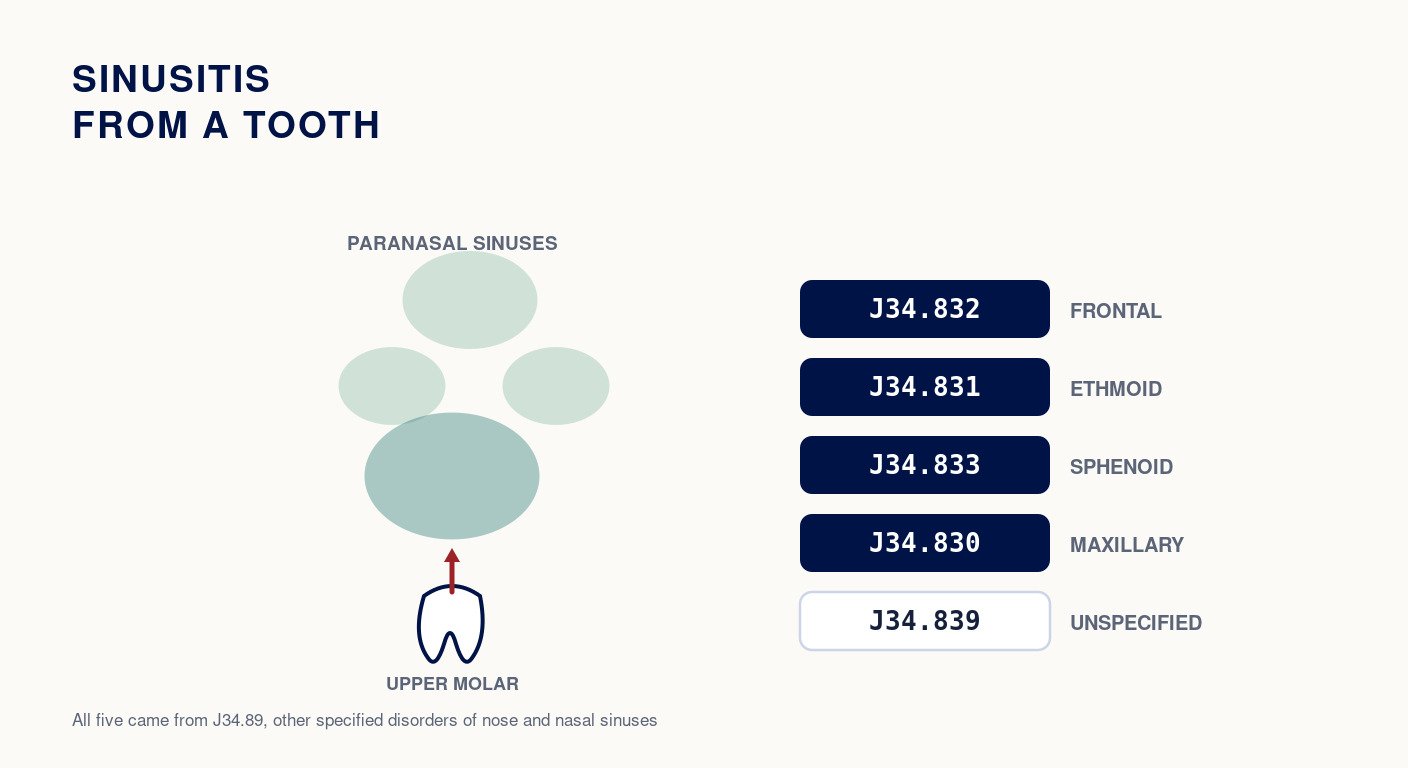
Odontogenic sinusitis is sinusitis caused by dental pathology, most often an infected upper molar or a complication of dental treatment, with the infection reaching the sinus through the thin floor of the maxillary antrum. It is a recognised and reasonably common entity, and until October 1, 2026 the code set had no way to say so.
The FY 2027 update adds five codes under the new subcategory J34.83, odontogenic sinusitis.
| New code | Description | Previously coded to |
|---|---|---|
| J34.830 | Odontogenic sinusitis, maxillary sinus | J34.89 |
| J34.831 | Odontogenic sinusitis, ethmoid sinus | J34.89 |
| J34.832 | Odontogenic sinusitis, frontal sinus | J34.89 |
| J34.833 | Odontogenic sinusitis, sphenoid sinus | J34.89 |
| J34.839 | Odontogenic sinusitis, unspecified | J34.89 |
Every one came out of the same place: J34.89, other specified disorders of nose and nasal sinuses. That is a residual code, and a diagnosis sitting in a residual code is invisible. Nobody could count odontogenic sinusitis, study its treatment, or tell it apart from anything else in that bucket.
The Coding Question Nobody Answers Cleanly
Here is the part worth being honest about. The new codes solve a classification problem. They do not, on their own, solve the billing problem that makes this condition awkward, which is who pays.
Odontogenic sinusitis sits on the boundary between medical and dental benefits. The sinus disease is plainly medical. The tooth that caused it is plainly dental. Treatment frequently requires both: an extraction or endodontic treatment on the dental side, and sinus management, imaging or surgery on the medical side. Those can fall under different plans, different deductibles and different prior authorisation rules, for the same episode of illness.
Having a diagnosis code that names the dental origin is genuinely useful here, because the alternative was a residual code that said nothing. But the split is decided by each payer’s own medical and dental benefit design, and there is no single federal rule that settles it. Anyone promising you a clean answer to the medical-versus-dental question is guessing. The practical route is to confirm coverage with the specific plan before treatment, on both sides, and to document the causal relationship clearly enough that whichever payer is asked can see it.
Maxillary Is Not the Default
The anatomy makes the maxillary sinus by far the most common site, since it is the one sitting directly above the upper molars. It would be easy to treat J34.830 as the code and move on.
The subcategory provides four named sinuses for a reason: odontogenic infection can extend beyond the maxillary sinus, and where imaging documents ethmoid, frontal or sphenoid involvement there is a specific code for it. J34.839 is the unspecified option, and it is the right code when the sinus is not documented, but it should not become the habitual choice when the imaging report names the sinus in the first line.
These Are Not the Same as Chronic Sinusitis Codes
J32.0, chronic maxillary sinusitis, remains valid and unchanged. It is not a synonym for J34.830.
The J32 family classifies sinusitis by chronicity and site. The new J34.83 subcategory classifies it by cause. A maxillary sinusitis of dental origin is what J34.830 describes; a chronic maxillary sinusitis with no documented dental cause is J32.0. The determining factor is what the record says about the origin, not which sinus is involved.
What to Check Before You Bill
- Check the date of service. These codes are invalid for a date of service on or before September 30, 2026, when J34.89 was correct.
- Look for the causal statement. These codes require the record to attribute the sinusitis to a dental source. Without that, you are coding ordinary sinusitis.
- Read the imaging report for the sinus. If it names ethmoid, frontal or sphenoid involvement, there is a code for it.
- Verify benefits on both sides before treatment. The medical and dental portions of the same episode can sit with different payers and different rules.
- Code the dental condition too where documented. The sinusitis code names the origin but does not describe the tooth.
Common Questions
What is the ICD-10 code for odontogenic sinusitis?
J34.830 maxillary, J34.831 ethmoid, J34.832 frontal, J34.833 sphenoid, or J34.839 unspecified, for dates of service on or after October 1, 2026.
What was it coded to before?
J34.89, other specified disorders of nose and nasal sinuses, which remains a valid code for other conditions.
Is this billed to medical or dental?
It depends on the individual plan’s benefit design, and the two halves of the episode may be covered separately. Confirm with the payer rather than assuming, because there is no single rule that decides it.
Can I use J34.830 instead of J32.0?
Only where the record attributes the sinusitis to a dental cause. J32.0 remains correct for chronic maxillary sinusitis without a documented odontogenic origin.
Which code if the sinus is not stated?
J34.839, odontogenic sinusitis, unspecified.
Sources and Methodology
The five J34.83 descriptors and the structure of the subcategory were read from the FY 2027 ICD-10-CM Tabular List and code descriptions file published by CMS and the CDC National Center for Health Statistics. Predecessors are as listed in the NCHS ICD-10-CM Conversion Table FY 2027, which gives J34.89 for all five. That J34.89 and J32.0 remain valid was confirmed against the FY 2027 code descriptions file. All files are free and none is licence gated. Coverage and benefit questions are payer-specific and are not addressed by any of these sources.
Leave a Reply