
 By Eman Zahra

One History Code Became Five
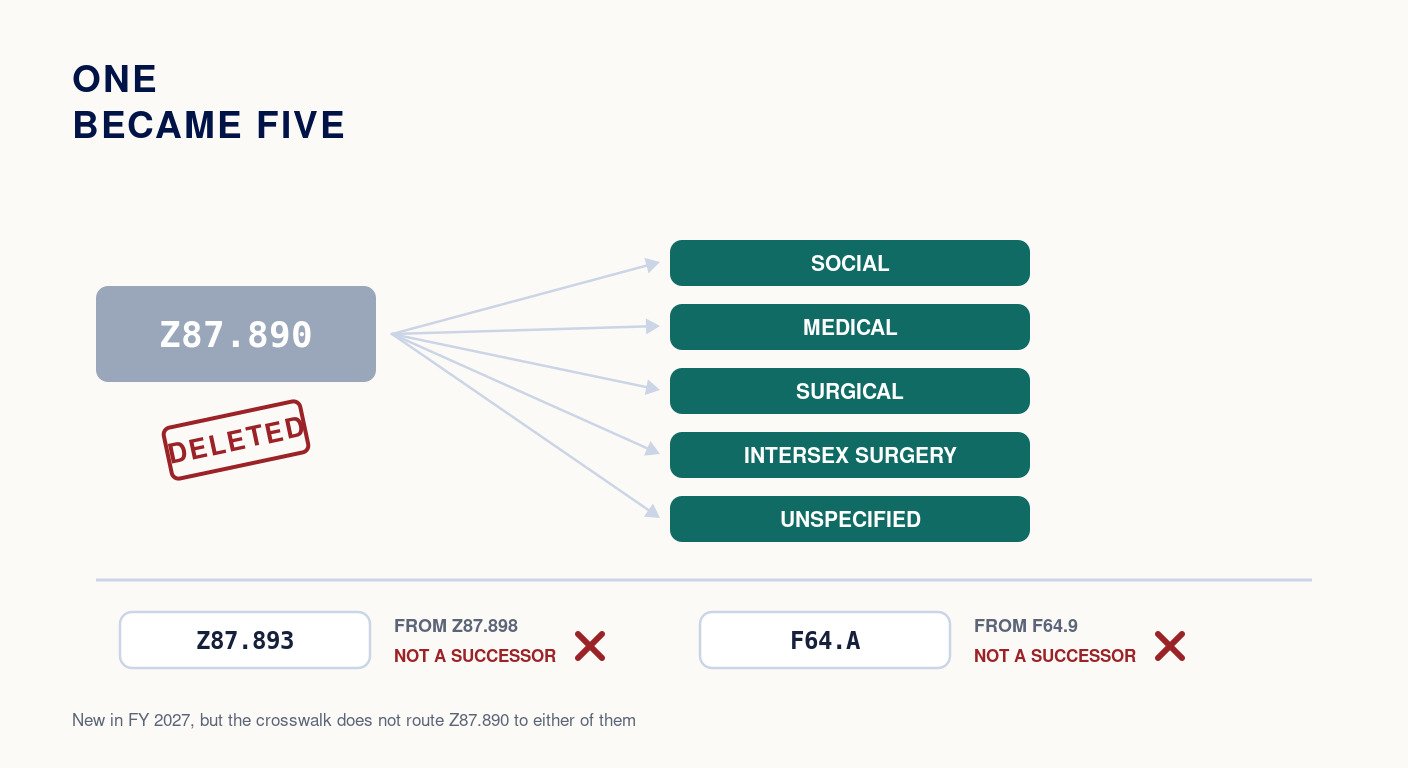
Z87.890, personal history of sex reassignment, was deleted on October 1, 2026. It was a single code covering everything, and it has been replaced by five that distinguish what kind of transition the history records.
| New code | Description | From |
|---|---|---|
| Z87.8901 | Personal history of social gender transition | Z87.890 |
| Z87.8902 | Personal history of medical gender transition | Z87.890 |
| Z87.8903 | Personal history of surgical gender transition | Z87.890 |
| Z87.8904 | Personal history of intersex surgery | Z87.890 |
| Z87.8909 | Personal history of unspecified gender transition | Z87.890 |
The five are not a hierarchy and they are not mutually exclusive by design; they describe different things. Social, medical and surgical transition are distinct processes that a given patient may have undergone in any combination. Intersex surgery is a separate matter again and is not a gender transition code, although it sits in the same group.
Z87.8909 is the unspecified option and is the correct code where the record establishes a history of gender transition without saying which kind. It is not a fallback to be avoided; it is the designed answer when the documentation does not go further.
Two More New Codes That Are Not Successors
Two other codes arrived in the same release and are easy to mistake for part of the Z87.890 split. Neither is.
| New code | Description | From |
|---|---|---|
| Z87.893 | Personal history of gender detransition | Z87.898, not Z87.890 |
| F64.A | Gender identity disorder, in remission | F64.9 |
Z87.893 came from Z87.898, personal history of other specified conditions, which is the general residual history code. It is a new history code in the same subcategory, not a replacement for the deleted one, and a crosswalk that lists it among the Z87.890 successors is wrong.
F64.A sits in a different chapter entirely. It came from F64.9 and is a diagnosis code in remission status rather than a personal history code. The distinction between an F64 code and a Z87.89 code is the distinction between a current diagnosis and a documented history, and the update did not blur it.
Why Specificity Here Affects Care, Not Just Data
History codes are easy to treat as administrative decoration. In this group they are not, because the three kinds of transition have genuinely different implications for what care a patient needs.
A history of surgical transition may be directly relevant to which anatomy is present and therefore which screening is indicated. A history of medical transition may bear on laboratory reference ranges and on medication interactions. A history of social transition, on its own, carries neither of those implications. Under the old single code all three were indistinguishable, so a record saying personal history of sex reassignment told a downstream clinician very little about what to do differently.
This is also where organ inventory codes matter. The Z87.89 codes record a history; they do not record which anatomy is present. Where screening or clinical decisions depend on that, it needs to be documented and coded in its own right rather than inferred from a transition history code.
All Seven Are POA Exempt
On inpatient claims none of these codes requires a present on admission indicator. All five Z87.890 successors and Z87.893 appear on the FY 2027 POA exempt list, alongside the rest of the Z87.89 subcategory.
That is consistent with what they are. A personal history describes something that happened before the admission by definition, so a POA indicator would add nothing.
What to Check Before You Bill
- Search your problem lists and favourites for Z87.890. It is deleted, so anywhere it was saved now holds an invalid code for current dates of service.
- Check the date of service, not the claim date. Z87.890 remains correct for a date of service on or before September 30, 2026.
- Do not map Z87.893 as a successor. It came from Z87.898 and describes something different.
- Use Z87.8909 when the record does not specify. Assigning a specific transition type the documentation does not support asserts something about the patient that is not in the chart.
- Keep F64 and Z87.89 separate. One is a diagnosis, the other a history.
- Code anatomy separately where it matters. These codes do not record which organs are present.
Common Questions
What replaced Z87.890?
Five codes: Z87.8901 social, Z87.8902 medical, Z87.8903 surgical, Z87.8904 intersex surgery and Z87.8909 unspecified, for dates of service on or after October 1, 2026.
Is Z87.893 one of the replacements?
No. It is a new code for personal history of gender detransition and it came from Z87.898.
Which code if the type of transition is not documented?
Z87.8909, personal history of unspecified gender transition.
Can more than one of these be reported?
They describe different processes, so the documentation governs. Report what the record supports.
What is F64.A?
Gender identity disorder, in remission, a new code in the F64 category that came from F64.9. It is a diagnosis code, not a history code.
Do these codes need a POA indicator?
No. All of them are on the FY 2027 POA exempt list.
Sources and Methodology
Descriptors were read from the FY 2027 ICD-10-CM code descriptions file published by CMS and the CDC National Center for Health Statistics, and the deletion of Z87.890 and the addition of F64.A were confirmed by comparing the FY 2026 and FY 2027 code lists. Every predecessor, including Z87.898 for Z87.893 and F64.9 for F64.A, is as published in the NCHS ICD-10-CM Conversion Table FY 2027. POA status was confirmed against the FY 2027 POA exempt code files. All files are free and none is licence gated. The complete FY 2027 deletion list is in our guide to all 30 deleted codes.
Leave a Reply