
 By Eman Zahra

Three Exposures That Finally Have Their Own Codes
Until October 1, 2026, a clinician documenting that a patient had been exposed to burn pits in Iraq had one place to put it: Z77.39, contact with and (suspected) exposure to other war theater. Agent Orange went to the same code. Blast overpressure had nowhere specific at all and fell to Z77.9, the general hazardous exposure code.
The FY 2027 ICD-10-CM update adds six codes that name these exposures directly, plus a seventh for gadolinium. For any practice seeing veterans, whether under VA community care, TRICARE or ordinary Medicare, this is the most consequential part of the release.
The New Codes and Where They Came From
| New code | Description | Previously coded to |
|---|---|---|
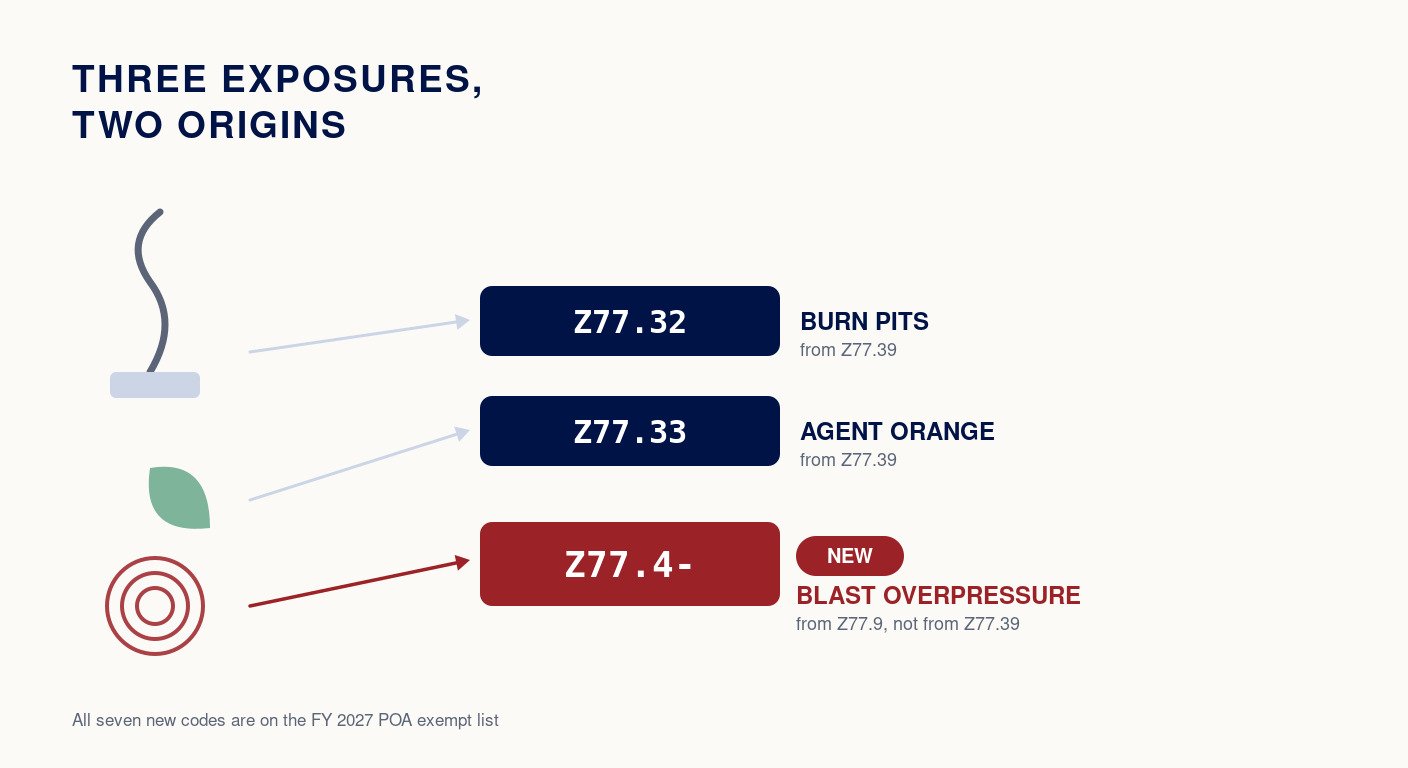
| Z77.32 | Contact with and (suspected) exposure to burn pits in war theater | Z77.39 |
| Z77.33 | Contact with and (suspected) exposure to Agent Orange | Z77.39 |
| Z77.40 | Contact with and (suspected) exposure to unspecified blast overpressure | Z77.9 |
| Z77.41 | Contact with and (suspected) exposure to low-level blast overpressure | Z77.9 |
| Z77.42 | Contact with and (suspected) exposure to high-level blast overpressure | Z77.9 |
| Z77.49 | Contact with and (suspected) exposure to other blast overpressure | Z77.9 |
| Z77.013 | Contact with and (suspected) exposure to gadolinium | Z77.018 |
Notice that the two families have different predecessors, which is the detail most likely to be got wrong. Burn pits and Agent Orange come out of the war theater subcategory. Blast overpressure does not: it comes out of the general hazardous exposure code, because before FY 2027 there was no war theater subcategory that fitted it.
Z77.4 Is an Entirely New Subcategory
Z77.32 and Z77.33 are new children of an existing parent. Z77.4, contact with and (suspected) exposure to blast overpressure, did not exist in FY 2026 in any form. Searching the complete FY 2026 code descriptions file for codes beginning Z77.4 returns nothing.
That matters operationally. A new child code slots into a family your systems already know. A new subcategory may not be in an edit table, a favourites list or a problem list picker until somebody puts it there.
The tabular list gives abbreviations in the inclusion terms that are worth knowing, because they are what appears in clinical documentation rather than the full code descriptor:
- Z77.40 includes blast overpressure NOS
- Z77.41 includes LLB overpressure, which is how low-level blast is usually written
- Z77.42 includes HLB overpressure for high-level blast
If a note says LLB and the coder does not know the abbreviation, the code defaults to Z77.40 unspecified and the distinction the new codes were created to capture is lost on the first claim.
What Did Not Change
Nothing was deleted. Every predecessor remains valid in FY 2027:
- Z77.31 contact with and (suspected) exposure to Gulf War theater, which the tabular notes also covers Persian Gulf War theater
- Z77.39 contact with and (suspected) exposure to other war theater, still correct for a theater exposure that is not Gulf War, burn pits or Agent Orange
- Z77.9 other contact with and (suspected) exposures hazardous to health
- Z77.018 contact with and (suspected) exposure to other hazardous metals, which keeps everything except gadolinium
So this is an addition, not a migration. A patient with a documented Gulf War deployment and documented burn pit exposure can carry Z77.31 and Z77.32 together; they describe different things.
Gadolinium Comes With a Companion Code
Z77.013 is easy to overlook in a release dominated by the veterans codes, and it is the one with a second half. FY 2027 also adds R78.72, abnormal gadolinium level in blood, which came from R78.79.
The pairing is the point. Z77.013 records the exposure; R78.72 records a laboratory finding. They answer different questions and a patient can have one without the other, since exposure to a gadolinium-based contrast agent is routine in imaging and an abnormal blood level is not.
All Seven Are POA Exempt
On inpatient claims, none of these codes requires a present on admission indicator. All seven appear on the FY 2027 POA exempt list.
That follows from what they describe. An exposure that happened in a war theater years before admission is not a condition that arose during the stay, and asking whether it was present on admission produces no useful information. The practical effect is that adding these codes to an inpatient record creates no extra POA documentation burden.
Why This Is Worth Coding Properly
Exposure codes do not usually drive payment on their own. They are status codes, and it is tempting to treat them as optional detail once the presenting complaint is coded.
Two reasons not to. First, they support medical necessity for follow-up and screening that would otherwise look unsupported: the exposure is often the entire clinical reason a test is being ordered in an asymptomatic patient. Second, these codes exist because the old ones made the population invisible. Everything a burn pit cohort did inside the claims data for years was indistinguishable from any other war theater exposure, because it was the same code. The first year of a new code is the year that determines whether anybody can see the group in the numbers at all.
What to Check Before You Bill
- Check the date of service, not the claim date. These codes are invalid for a date of service on or before September 30, 2026. Z77.39 and Z77.9 remain correct for earlier encounters.
- Teach the abbreviations. LLB and HLB in a note are Z77.41 and Z77.42, not Z77.40.
- Load Z77.4 deliberately. It is a new subcategory, not a new child, so it may be missing from lists that updated themselves for everything else.
- Do not retire Z77.31 or Z77.39. They are still the right codes for what they describe, and can sit alongside the new ones.
- Keep exposure and finding separate. Z77.013 is the exposure; R78.72 is the abnormal blood level.
- Check community care rules separately. The code set is the same for every payer, but VA community care and TRICARE have their own authorisation and submission requirements that this update does not touch.
Common Questions
What is the ICD-10 code for burn pit exposure?
Z77.32, contact with and (suspected) exposure to burn pits in war theater, for dates of service on or after October 1, 2026. Before that date it was Z77.39.
What is the code for Agent Orange exposure?
Z77.33. It also came from Z77.39.
Is there a code for blast overpressure?
Four of them: Z77.40 unspecified, Z77.41 low-level, Z77.42 high-level and Z77.49 other. All four are new, and all came from Z77.9.
Can I report Z77.31 and Z77.32 together?
Yes. Gulf War theater and burn pit exposure describe different things and neither excludes the other.
Do these codes need a POA indicator?
No. All seven are on the FY 2027 POA exempt list.
Was Z77.39 deleted?
No. Nothing in this group was deleted. Z77.31, Z77.39, Z77.9 and Z77.018 all remain valid.
Sources and Methodology
Code descriptors, inclusion terms and the structure of Z77.3 and Z77.4 were read from the FY 2027 ICD-10-CM code descriptions file and Tabular List published by CMS and the CDC National Center for Health Statistics. Predecessors are quoted from the NCHS ICD-10-CM Conversion Table FY 2027. POA exempt status was confirmed against the FY 2027 POA exempt code files. That Z77.4 did not previously exist was verified by searching the complete FY 2026 code descriptions file. All files are free to download and none is licence gated. The related FY 2027 deletions are covered in our list of the 30 deleted codes and their replacements.
Leave a Reply