
 By Eman Zahra

101 Additions, and Only 13 Are New Procedures
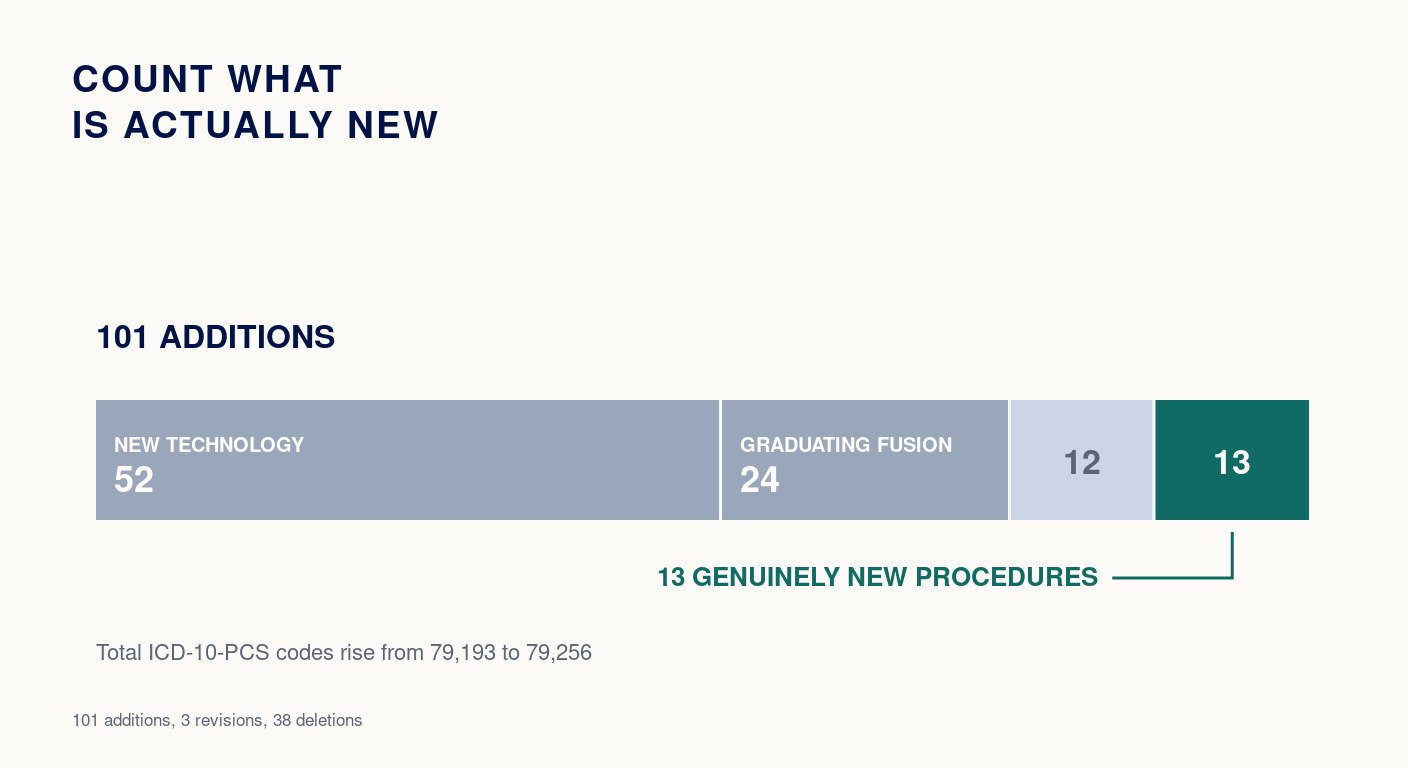
ICD-10-PCS added 101 codes for FY 2027. Most of that number is movement rather than novelty: 52 are New Technology codes in the newest group, and 24 of the 37 Medical and Surgical additions are the standard-section successors to New Technology fusion codes that retired in the same release.
Strip those out and 13 codes in the Medical and Surgical section describe something the code set could not previously describe. They fall into exactly two groups.
Four Valve Leaflet Division Codes
| Code | Procedure |
|---|---|
| 028F3Z0 | Division of Aortic Valve, Percutaneous Approach, Native Leaflet |
| 028F3Z1 | Division of Aortic Valve, Percutaneous Approach, Prosthetic Leaflet |
| 028G3Z0 | Division of Mitral Valve, Percutaneous Approach, Native Leaflet |
| 028G3Z1 | Division of Mitral Valve, Percutaneous Approach, Prosthetic Leaflet |
The qualifier is what makes these worth knowing about. Native leaflet and prosthetic leaflet are separate codes, which means the record has to establish whether the leaflet being divided was the patient’s own or part of a previously implanted valve.
That distinction lines up with a patient population that is now common: someone who has already had a valve replaced and is being considered for another procedure within it. The FY 2027 PCS guidelines discuss a related New Technology code in the context of a valve-in-valve transcatheter aortic valve replacement, so this is territory the classification is actively building out.
All four are percutaneous only. There is no open equivalent in this set.
Nine Drainage Codes With Active Mechanical Clearance
| Body part | Open | Percutaneous | Perc endoscopic |
|---|---|---|---|
| Right pleural cavity | 0W99003 | 0W99303 | 0W99403 |
| Left pleural cavity | 0W9B003 | 0W9B303 | 0W9B403 |
| Mediastinum | 0W9C003 | 0W9C303 | 0W9C403 |
These describe drainage with a drainage device where the device performs active mechanical clearance rather than relying on gravity or passive suction. The qualifier is the new part; drainage of these body parts with a device was already codeable.
The grid is complete and symmetrical: three body parts, three approaches, nine codes. Right and left pleural cavities are separate codes, so laterality has to be documented, and the mediastinum sits alongside them with the same three approaches.
For a coder the practical question is narrow and answerable from the operative note or the device documentation: did the drainage device actively clear the catheter, or was it a conventional chest tube? Only the first goes to these codes.
Why the 101 Figure Misleads
Annual summaries report the addition count, and 101 sounds like a substantial expansion of what inpatient coders can describe. Broken down it is not.
| What the 101 additions actually are | Codes |
|---|---|
| New Technology codes in the newest group | 52 |
| Standard successors to retiring New Technology fusion codes | 24 |
| Genuinely new Medical and Surgical procedures | 13 |
| Imaging | 4 |
| Extracorporeal or systemic assistance | 4 |
| Administration | 4 |
This is not a criticism of the release. A small number of genuinely new procedures is what a mature classification should produce in a normal year. It is a caution against reading the headline number as a measure of how much changed for a coder, and against assuming a large addition count means a large training burden.
The larger burden this year sits on the deletion side, where 38 codes expired and six have no replacement at all.
What to Check
- Check the discharge date. These codes apply to discharges on or after October 1, 2026.
- For valve division, establish native versus prosthetic. It is a separate code, not a detail.
- For drainage, establish whether clearance was active and mechanical. A conventional chest tube does not go to these codes.
- Document pleural laterality. Right and left are separate codes.
- Do not assume 101 additions means 101 new things to learn. Most of the count is codes moving between sections.
Common Questions
How many new ICD-10-PCS codes are there for FY 2027?
101 in total, but only 13 describe genuinely new Medical and Surgical procedures. 52 are New Technology codes and 24 are successors to retiring ones.
What are the new valve codes?
028F3Z0 and 028F3Z1 for aortic valve leaflet division, and 028G3Z0 and 028G3Z1 for mitral, all percutaneous, distinguishing native from prosthetic leaflets.
What does active mechanical clearance mean?
It is a qualifier on the new drainage codes describing a drainage device that actively clears rather than draining passively. The documentation has to support it.
Are the new drainage codes lateralised?
Yes. Right and left pleural cavities have separate codes, and the mediastinum has its own.
Why are so many additions in Section X?
Because a new New Technology group is created each year. Those 52 codes are the FY 2027 group.
Sources and Methodology
All codes and titles were read from the FY 2027 ICD-10-PCS order file and its addenda, published by CMS. Additions were classified by section from the first character of each seven-character billable code, excluding table headers. The 24 fusion successors were identified from their titles and confirmed against the FY 2027 ICD-10-PCS conversion table as the successors to the deleted XRGA, XRGB, XRGC and XRGD codes. The reference to a New Technology code in a valve-in-valve context is from guideline E1.a of the FY 2027 Official ICD-10-PCS Coding Guidelines. All files are free and none is licence gated.
Leave a Reply