
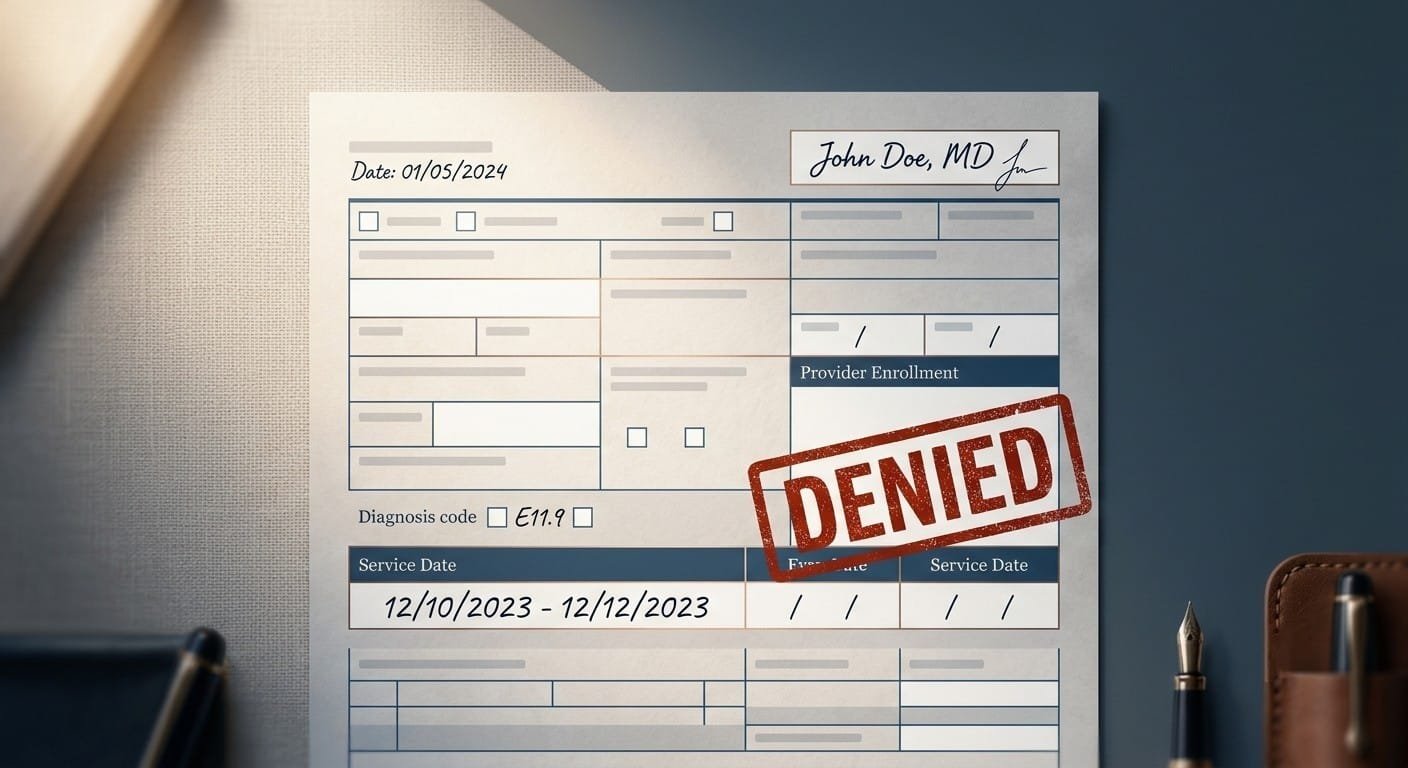


Picture the scenario. A new nurse practitioner starts Monday. Patients are booked through Friday. Front desk runs eligibility checks, sees an active plan, and the visit proceeds. Three weeks later, the remittance advice comes back: CO-B7, contractual obligation, provider not eligible to bill this service. The provider was credentialed with the hospital. She was never enrolled with that specific payer.
This is the single most expensive blind spot in revenue cycle onboarding. It is invisible until a claim bounces, and by the time it bounces, dozens more have already gone out the door behind it.
How does a not-yet-credentialed provider trigger a claim denial?
A payer denies a claim when the rendering provider NPI has no active enrollment record on file at the date of service. The system flags it automatically, commonly returning CO-B7, CO-170, or CO-29, and pays zero, regardless of medical necessity or documentation quality.
Credentialing and enrollment are not the same step, and conflating them is where most denials begin. Credentialing verifies who the provider is: license, education, malpractice history, board status. Enrollment is the separate act of loading that verified provider into a specific payer’s claims-adjudication system under an NPI tied to a tax ID. A provider can be fully credentialed at the hospital level and still be invisible to United, Aetna, or a specific Medicare Advantage plan. The claims engine does not check credentialing files. It checks enrollment status at the instant the claim hits the clearinghouse.
What specific denial codes show up when a provider is not in the payer system?
The most frequent codes are CO-B7 (provider not eligible to bill), CO-170 (provider type not eligible for the service billed), CO-29 (timely filing, often a secondary failure after a credentialing delay), and CO-109 (claim sent to the wrong payer or plan). Each maps to a distinct root cause.
CO-B7 fires when a claim posts before the enrollment effective date. CO-170 fires when the provider type, taxonomy, or supervising-physician linkage does not match payer policy, which is common with nurse practitioners and physician assistants billing independently. CO-109 is less about credentialing and more about plan routing, but it surfaces constantly in the same window because a patient’s Medicare Advantage enrollment and the practice’s credentialing status both shift without warning. None of these codes are appealable on the merits of care delivered. They are administrative, and administrative denials require an administrative fix, not a clinical one. Checking the provider’s NPI record and taxonomy against NPPES is usually the fastest first step.
What is the realistic financial exposure of a single credentialing gap?
A provider seeing fifteen patients daily at roughly 120 dollars average reimbursement generates close to 9,000 dollars weekly. A sixty-day enrollment gap therefore exposes nearly 72,000 dollars in claims, split between immediate denials and retroactive recoupment once the payer audits the period.
That figure assumes a single provider and a single payer. Multiply it across a multi-specialty group onboarding three or four clinicians a quarter, each requiring parallel applications with Medicare, state Medicaid, and four or five commercial plans, and the exposure compounds fast. Commercial credentialing now typically runs sixty to one-hundred-twenty days per payer, Medicaid varies by state but often stretches to one-hundred-eighty, and even Medicare Advantage plans that market faster turnaround frequently land in the thirty-to-sixty-day band. Rework cost is its own line item separate from the denied revenue itself: every denial requires staff time to research, document, and resubmit, and that labor cost rarely makes it into the original financial model.
Can claims be billed retroactively once Medicare enrollment is approved?
Medicare allows retrospective billing for up to 30 days prior to the enrollment effective date when circumstances precluded earlier enrollment, per CMS Internet-Only Manual Pub. 100-08, Chapter 10, Section 10.6.2. That window extends to 90 days only under a presidentially declared disaster. Outside those two narrow exceptions, services rendered before the effective date are not billable.
This is the detail that catches groups off guard. The effective date itself is the later of the date the application was filed or the date the provider actually began furnishing services, so submitting the CMS-855I a week after the provider’s first patient encounter does not retroactively legitimize that week. The fix is procedural: file before day one, not after it, and document the filing date with a certified mail receipt or electronic confirmation that survives an audit trail.
What should billing teams do the moment a credentialing-related denial appears?
Hold, do not resubmit blindly. First confirm the enrollment effective date with the payer’s provider services line. If the date of service falls after enrollment was effective, correct the claim with the approved NPI and resubmit immediately under the payer’s corrected-claim process before the timely filing window closes.
If the date of service falls before the effective date, resubmission will fail again, and the claim moves into a hold queue pending either a retrospective billing exception or, more commonly, financial write-off. This is why a dedicated credentialing tracker, separate from general accounts receivable, matters: it lets billing staff distinguish a fixable timing error from a permanently unrecoverable claim within minutes instead of weeks. Most payers cap corrected-claim and appeal windows between 90 and 180 days from the original date of service, so speed directly determines whether revenue is salvageable.
What compliance risk sits underneath a credentialing gap beyond the denied revenue?
Billing under a supervising or already-enrolled provider’s NPI for services actually rendered by an unenrolled clinician can constitute a False Claims Act violation, since the claim misrepresents who performed the service. Practices sometimes attempt this as a workaround, and it converts a denial problem into a federal liability problem.
The American Medical Association and the AAPC both caution against this substitution practice for the same reason auditors flag it instantly during payer audits: the documentation will show one provider, the claim will show another, and the mismatch reads as upcoding or misrepresentation regardless of intent. The Office of Inspector General has pursued recoupment and penalties in cases built on exactly this pattern. The compliant alternative, where the payer permits it, is provisional billing under a supervising physician’s NPI with explicit documentation that the supervising physician was present and clinically involved, not merely listed for billing convenience.
How can a practice prevent this gap before the next provider’s start date?
Begin payer applications sixty to ninety days before the confirmed start date, never after. Build a credentialing tracker listing every contracted payer, application date, and expected effective date, and block the provider’s schedule from billing any payer where enrollment has not been confirmed in writing.
CAQH profile accuracy matters as much as the applications themselves, since most commercial payers pull directly from that database and a stale or unattested CAQH record stalls every downstream enrollment simultaneously. Tie front-desk scheduling software to the credentialing tracker so a provider physically cannot be booked against a payer plan where enrollment is still pending. This single workflow change, linking scheduling to enrollment status, eliminates the majority of preventable CO-B7 denials before a claim is ever generated.
The mechanics of credentialing rarely make it into a new hire’s onboarding conversation, yet they determine whether that hire is cash-flow positive in month one or a six-figure write-off by month four. Treat enrollment as a revenue cycle function with its own deadlines and owner, not an HR afterthought, and the gap closes before it costs anything.
For related operational guidance, see the companion pieces on CAQH attestation errors and provisional billing compliance referenced in the topical map above.
Leave a Reply