
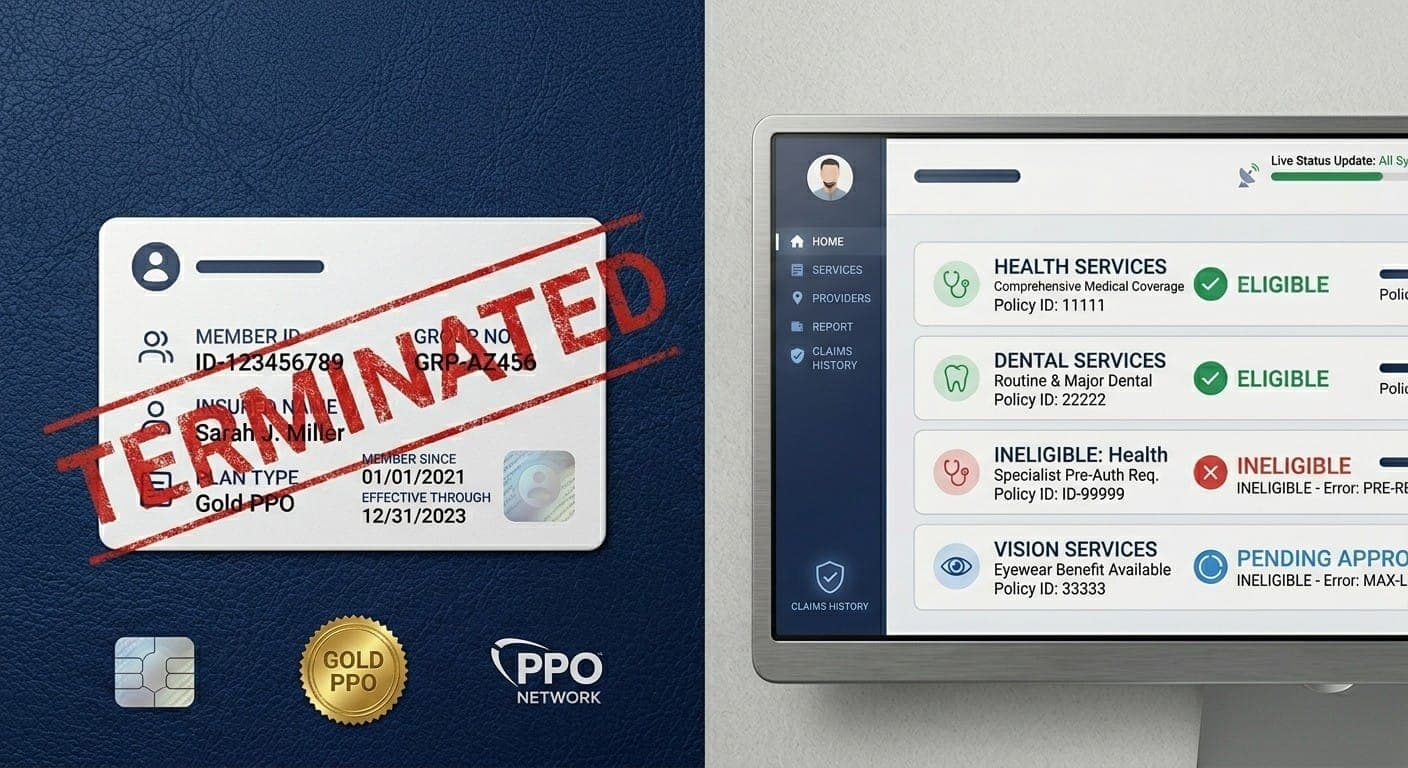


The numbers are not ambiguous. Approximately 2.9 million Medicare Advantage enrollees faced forced plan terminations in 2026. That is roughly 10% of all non-employer HMO and PPO plan members — a tenfold spike from the 1% average recorded between 2018 and 2024. For every beneficiary scrambling to find new coverage, a billing team somewhere faces a claim submitted to a dead plan, a missing referral, and a denial that should have been preventable.
This is not an enrollment story. It is a revenue cycle crisis hiding inside a patient-access headline.
Why Did Medicare Advantage Plans Exit at Record Rates in 2026?
Medicare Advantage plan exits in 2026 reached an unprecedented 10% forced disenrollment rate, up from 6.9% in 2025 and a historical average of 1.0% between 2018 and 2024. According to research published by the Johns Hopkins Bloomberg School of Public Health, approximately 2.9 million non-employer HMO and PPO enrollees lost coverage as insurers exited unprofitable counties, driven by rising medical utilization, risk adjustment recalibration, and inadequate rate growth from CMS.
The exit cascade began with CMS’s phased-in recalibration of the CMS-HCC risk adjustment model between 2024 and 2026. That model determines how much extra capitation a plan receives for sicker enrollees. As CMS tightened the model and excluded unlinked chart-review diagnoses, plans that relied heavily on retrospective risk-score inflation saw their per-member-per-month revenue erode sharply.
UnitedHealthcare exited 225 counties and withdrew entirely from Vermont. Humana pulled back from 194 counties, including full exits from North Dakota, South Dakota, and Puerto Rico. Aetna exited Wyoming and reduced service in 100 additional counties. Vermont’s situation stands apart: 92.2% of its enrollees lost coverage — a market death spiral two years in the making. The Trump administration injected $25 billion in additional 2026 plan funding, but it was not enough to stop the exits already in motion. For 2027, CMS finalized a 2.48% net average rate increase in April 2026, partly to prevent further market destabilization.
What Happens to In-Flight Claims When a Medicare Advantage Plan Exits?
When a Medicare Advantage plan terminates, claims for services rendered before the termination date must still be processed by the exiting plan through a runout period. CMS requires MAOs to maintain claims-processing infrastructure through that window under contract obligations. However, provider RCM teams face a critical dual-submission risk: submitting to the terminated plan after its system goes dark triggers a CO-29 timely filing denial from the replacement plan.
The operational risk is asymmetric. Under 42 CFR § 424.44, Original Medicare allows 12 months from the date of service to file. But if that patient reverts to a Medicare Advantage replacement plan, the new plan’s timely filing window may be as narrow as 90 to 120 days. Aetna Medicare Advantage contracts typically require 120 days. UnitedHealthcare contracts range from 90 to 180 days depending on the provider agreement and state.
Miss that window chasing the wrong payer and the denial code is CO-29. CO-29 denials are not eligible for standard CMS redetermination appeals. The revenue is permanently gone.
The practical solution is a plan-exit claims register. Flag every claim with a date of service in the 60 days preceding the exit date, segment by payer, and run a parallel submission strategy: file to the terminated plan’s runout address AND document a timely submission to the new plan within 10 business days of confirming coverage transition through a live 270/271 real-time eligibility check.
How Does the Open Enrollment Gap Create Catastrophic Revenue Leakage?
The Medicare Advantage Open Enrollment Period (MA OEP) runs January 1 through March 31, allowing one plan change with coverage effective the first of the following month. When a plan exits December 31, the patient’s coverage transition and their billing footprint diverge by 30 to 90 days — a gap where services rendered in January can carry three different payer identities before the RCM team reconciles them.
A patient whose plan exited December 31, 2025, may have been auto-enrolled into a default Medicare Advantage plan by CMS under 42 CFR § 422.60. That auto-enrollment is retroactive to January 1. But the patient walks in on January 7 with their expired UnitedHealthcare card — because they have not yet received the new plan’s ID card, which CMS requires plans to issue within 10 days of enrollment confirmation.
Your front desk runs the old card. The claim goes to a terminated plan. The correction submission to the correct plan arrives February 15. That new plan — say, an Aetna HMO — requires a Primary Care Physician referral for the January 7 visit. No referral was obtained. The claim generates a CO-4 denial (missing authorization/referral) on top of the CO-29 risk.
Two denials. Zero revenue. One preventable front-desk workflow failure.
The fix is mandatory real-time eligibility checks — not card scans — via 270/271 EDI transactions for every Medicare-aged patient at every encounter. Practices that implemented automated RTE checks 48 hours before appointment saw denial rates from eligibility errors drop below 3%, versus 14% to 22% for those relying on card presentation alone.
What Are Prior Authorization Obligations During a Plan Transition?
Under 42 CFR § 422.212(b)(8), finalized in the CMS-4208-F rule and effective January 1, 2026, any new Medicare Advantage plan a patient transitions into must honor existing prior authorizations for active courses of treatment for a mandatory 90-day period. The new plan cannot require a fresh prior authorization for ongoing treatment within that window. This is not optional; it is a federal mandate codified in the CY 2026 MA Final Rule.
This protection was strengthened further by CMS-0057-F, effective January 1, 2026. Standard PA decisions now require a response within 7 calendar days. Expedited requests must resolve within 72 hours. Payers must provide a specific denial reason and publish annual PA approval rate metrics by procedure category.
Despite the mandate, compliance gaps are routine. New plans arriving mid-transition often demand fresh PA documentation regardless of the 90-day rule. The response is documentation-driven: obtain written confirmation of every active authorization before December 31, attach it to the first claim submission under the new plan, and cite 42 CFR § 422.212(b)(8) explicitly in the appeal if denied.
CMS-4208-F also closed the retroactive inpatient denial loophole. A plan that has approved an inpatient admission can only reopen that approval for obvious error or fraud — not based on post-admission chart review. For hospital systems, this eliminated a major avenue for retroactive claim downgrades.
How Should Billing Teams Audit Eligibility After an MA Plan Exit?
Billing teams must execute a three-tier eligibility audit protocol following any confirmed Medicare Advantage plan exit: pull a 90-day claims aging report filtered by the exiting payer’s ID, run batch 270/271 EDI transactions for every affected patient to confirm new plan enrollment, and cross-reference CMS’s Plan Crosswalk File to map terminated contract numbers to successor plans. This sequence prevents CO-29 and CO-4 compound denials at scale.
The CMS Plan Crosswalk File maps terminated contract IDs to replacement plans at the county level. When UnitedHealthcare exited 225 counties, the Crosswalk listed every contract migration. Billing teams that loaded it on January 2 ran accurate claims within the first week. Teams that waited for patient-initiated updates spent February managing a denial backlog.
Clearinghouses like Waystar and Change Healthcare process real-time eligibility transactions and flag MA plan changes at the patient level. Configuring eligibility alerts for MA patients over 64 is now a baseline RCM function, not optional.
What False Claims Act Risks Emerge During MA Enrollment Transitions?
Billing to a terminated Medicare Advantage plan for services rendered after exit date — without knowledge of the termination — does not automatically create False Claims Act exposure under 31 U.S.C. § 3729. The scienter requirement demands knowing submission of a false claim. Honest billing error is not fraud.
However, the risk calculates differently when practices systematically skip eligibility verification. OIG audits have repeatedly found that inadequate eligibility protocols are a leading precursor to improper payment patterns. Collecting payment from a terminated plan and failing to return it after discovering the error is a retained overpayment. Under 42 U.S.C. § 1320a-7k(d), overpayments not reported and returned within 60 days of identification create False Claims Act liability.
The second exposure vector is upcoding during transitions. When patients move from MA to fee-for-service Original Medicare, reimbursement rates and documentation standards shift. Practices that retain their MA-era billing logic and apply it to FFS MAC submissions risk generating inflated or non-covered procedure codes — a pattern the OIG’s Work Plan targets directly, especially given the CMS-HCC recalibration environment entering 2027.
Build the compliance wall now: mandatory eligibility verification, a 90-day PA transition protocol citing CMS-4208-F, and a 60-day overpayment return calendar. The plans exited. The claims still need to be filed — correctly, to the right payer, within the right window.
Leave a Reply