
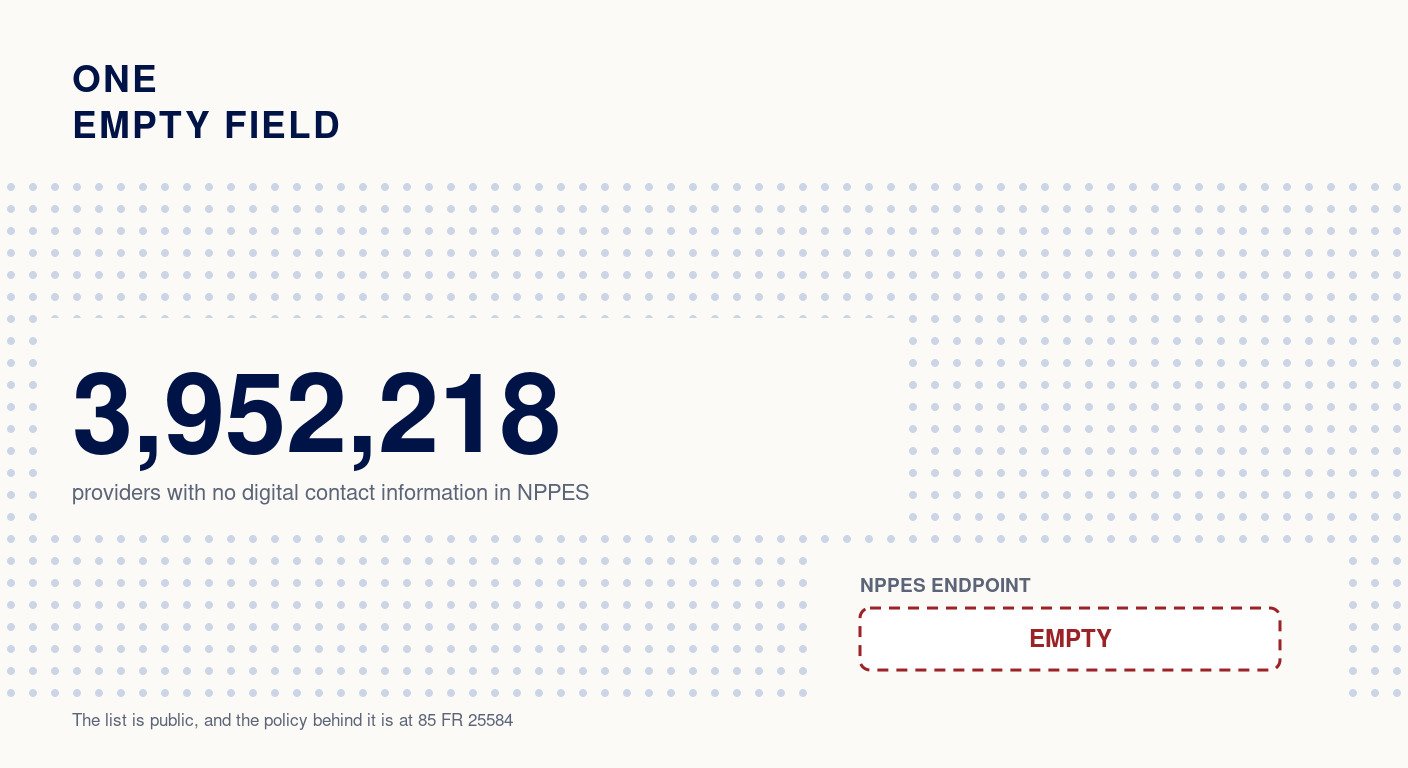


3,952,218 Providers Are Named on a CMS Public List
CMS publishes a dataset called Public Reporting of Missing Digital Contact Information. It contains the NPI and name of every provider and clinician who does not have digital contact information recorded in NPPES.
The current file holds 3,952,218 entries. Against roughly 2 million NPIs on the Order and Referring file and 2.9 million enrollment records in the revalidation list, that is not a fringe group. It is most of the profession.
Almost none of them know they are on it.
Where the List Comes From
This is not an enforcement action and it is not an error list. It exists because CMS said it would create it.
In the May 2020 Interoperability and Patient Access final rule, at 85 FR 25584, CMS finalised a policy to publicly report the names and NPIs of those providers who do not have digital contact information included in the National Plan and Provider Enumeration System. The dataset is that policy being carried out.
Public reporting is the entire mechanism. There is no penalty attached, no claim consequence, and no enrollment consequence. The list is the consequence.
What Digital Contact Information Actually Means
This is where most of the confusion sits, and it is why so many providers are on the list without having done anything wrong.
Digital contact information in this context is not a phone number, a practice address or an email address. It is an endpoint: the electronic address another organisation would use to exchange health information with you securely. A Direct address, a FHIR endpoint, a query endpoint, that sort of thing.
NPPES has fields for these. They sit in a part of the record that a provider or their credentialing staff completes once, usually at enumeration, and then never revisits. A practice with a fully populated NPPES record in every respect that matters to them day to day can have those endpoint fields empty, and nothing in the ordinary course of business will point it out.
Why It Is Worth Fixing Anyway
With no penalty attached it is reasonable to ask whether this matters at all. Three reasons it might.
- It is public and it is permanent enough. The file is published, downloadable and indexed by anyone who cares to. A provider directory, a credentialing vendor or a health system evaluating a referral relationship can check it.
- It is the address other people use to reach you electronically. The reason CMS wants the field populated is that interoperability depends on being able to find a counterparty. An empty endpoint means records that could have moved electronically arrive by fax, or do not arrive.
- Public reporting policies rarely stay purely informational. That is an observation about how these things tend to develop rather than a prediction, and CMS has announced nothing further. But a field that is already being publicly reported is a cheap one to populate now.
How to Check and How to Fix
The check is direct: the dataset is searchable by NPI on the CMS open data site, and an NPI that appears in it has no digital contact information recorded.
The fix is in NPPES rather than in PECOS or on any claim. The endpoint fields are part of the NPPES record and are updated there, by whoever holds the NPPES credentials for that NPI. For a group practice that is frequently not the same person who manages Medicare enrollment, which is part of why the field goes unattended.
Two practical notes. The list is a periodic snapshot rather than a live view, so a record updated today will not disappear from the published file immediately. And because the fields live in NPPES, updating a Medicare enrollment record does nothing for this; they are separate systems, in the same way that an NPPES taxonomy and a Medicare specialty code are separate.
What the Dataset Does Not Say
- It carries no judgement. The file contains an NPI and a name and nothing else. It does not allege non-compliance and there is no penalty in it.
- It does not distinguish why the field is empty. A provider who has no endpoint and a provider who has one but never entered it look identical.
- It does not track whether anyone fixed it. There is no date and no status.
- Being absent is not a compliance statement either. It means the field is populated, not that the endpoint works.
We have deliberately not reproduced any names from the file. The dataset is public and searchable at source, and the useful fact here is the scale of it rather than who is on it.
Common Questions
What is digital contact information in NPPES?
An electronic endpoint used to exchange health information securely, such as a Direct address or a FHIR endpoint. It is not a phone number, postal address or ordinary email address.
Is there a penalty for being on this list?
No. The policy finalised at 85 FR 25584 provides for public reporting, and public reporting is the mechanism.
How many providers are on it?
3,952,218 in the current file.
Where do I fix it?
In NPPES, not in PECOS and not on a claim. The two systems are separate.
How quickly will I come off the list?
The file is a periodic snapshot, so an update will not remove an entry immediately.
Sources and Methodology
The record count is the total reported for the CMS Public Reporting of Missing Digital Contact Information dataset through the public data API at data.cms.gov, and the field structure was confirmed by retrieving sample records. The policy description and the citation to 85 FR 25584 are quoted from the dataset’s own published description, which attributes it to the May 2020 CMS Interoperability and Patient Access final rule. Comparison figures for the Order and Referring file and the Revalidation Due Date List come from those datasets’ own record counts. All are free and none is license gated.
Leave a Reply