


CMS Publishes Who Is Waiting
Waiting on a Medicare enrollment application is one of the least transparent experiences in practice administration. The application goes in, the provider cannot bill, and there is no obvious way to tell whether it has been received, logged, or lost.
There is a way, and it is published twice a week. CMS maintains two datasets, Pending Initial Logging and Tracking Physicians and Pending Initial Logging and Tracking Non Physicians, listing the NPI and name of every provider with an initial enrollment application in process.
| Dataset | Applications pending |
|---|---|
| Physicians | 5,108 |
| Non-physicians | 7,300 |
| Total | 12,408 |
Non-physician applications outnumber physician applications by a wide margin, which tracks the growth of nurse practitioners, physician assistants, therapists and the other practitioner types that enrol separately.
What Appearing on the List Tells You
The files carry three fields: NPI, last name and first name. That is all. There is no date, no status, no stage and no expected completion.
Sparse as that is, it answers the question that matters most at the start of the process. If the NPI is on the list, CMS has the application and has logged it. That is not nothing, because the alternative explanations for silence, that the application was never received or was rejected at intake, are the ones worth ruling out first.
Equally, an application submitted weeks ago whose NPI does not appear is worth chasing rather than waiting on.
The Refresh Rate Is the Useful Part
Both files are replaced about twice a week, in step with the Order and Referring file. Over the life of the dataset CMS has published hundreds of snapshots.
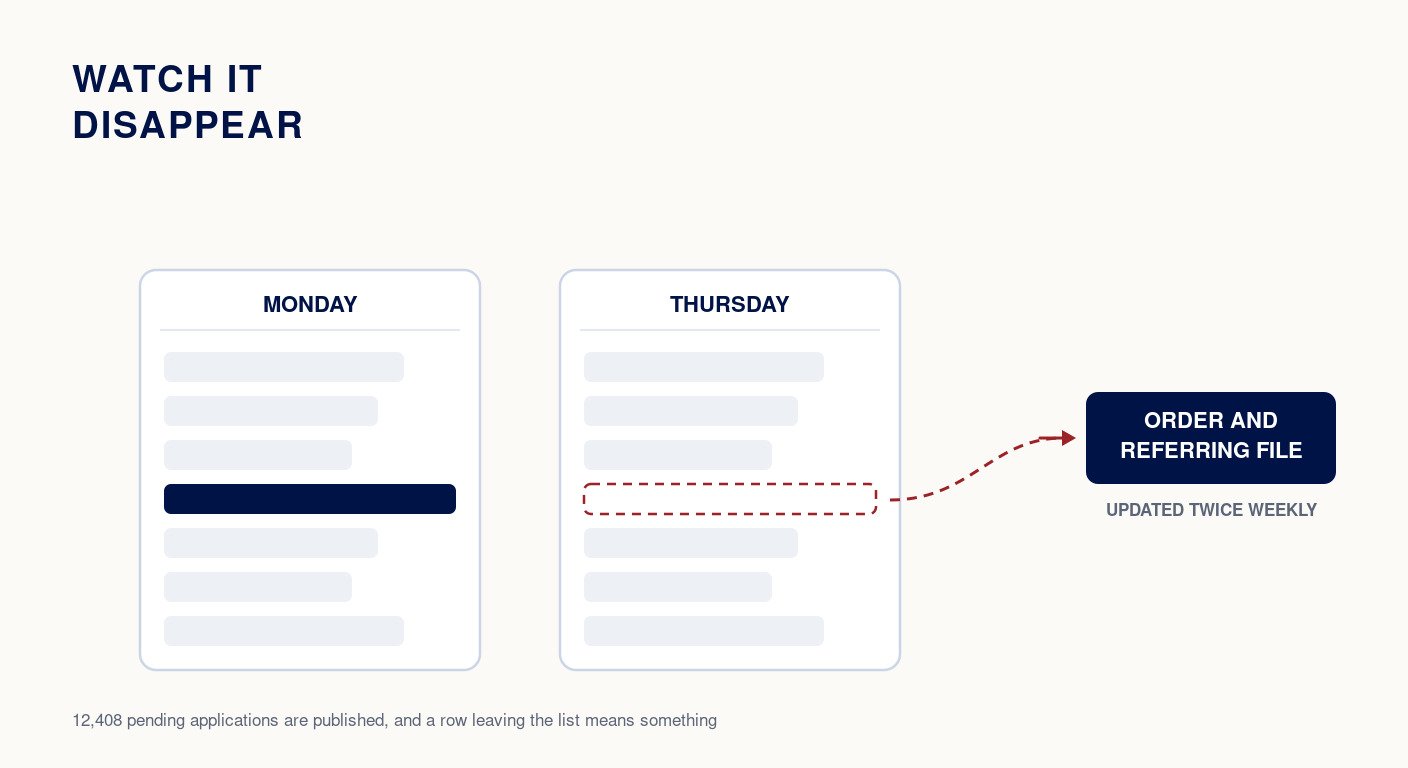
That cadence makes a simple technique possible. Check on Monday and check again on Thursday. An NPI that has disappeared from the pending list between snapshots has left the queue, and the natural next step is to check whether it has appeared on the Order and Referring file, which is the file that says a provider may order and refer in Medicare.
Disappearing from a pending list is not proof of approval, and the dataset does not report outcomes. But the combination of leaving one list and joining the other is a reasonable indication that the enrollment completed, and it is available days before most practices would otherwise hear anything.
Why 12,408 Is Worth Context
Twelve thousand applications in flight sounds like a backlog. Set against roughly 2 million NPIs currently eligible to order and refer, and 2.9 million Medicare enrollment records, it is a small fraction, and it is a snapshot of a queue rather than a measure of delay.
A queue of a given size can mean fast processing with high volume or slow processing with low volume, and this file cannot tell you which. It has no dates in it. Anyone quoting a pending count as evidence about processing times is reading something into it that is not there.
What This Cannot Do
- It gives no timeline. No submission date, no age, no estimate.
- It covers initial applications. Revalidations, reassignments and changes of information are handled elsewhere.
- Leaving the list is not an approval notice. It records that the application is no longer pending, not what was decided.
- It is no substitute for PECOS. PECOS remains the system of record and the place to check status properly.
- Name matching is unreliable. Search by NPI; names appear in inconsistent formats across the file.
Common Questions
How do I check whether my Medicare enrollment application is in process?
Search your NPI in the CMS pending initial logging and tracking dataset for physicians or non-physicians. Appearing there means CMS has logged the application.
How many applications are pending?
12,408 in the current files: 5,108 physicians and 7,300 non-physicians.
How often is it updated?
About twice a week.
My NPI disappeared from the list. Am I approved?
Not necessarily. It means the application is no longer pending. Check whether the NPI now appears on the Order and Referring file, and confirm in PECOS.
Does it show revalidations?
No. These are initial enrollment applications only.
Sources and Methodology
Record counts are the totals reported for the CMS Pending Initial Logging and Tracking Physicians and Pending Initial Logging and Tracking Non Physicians datasets through the public data API at data.cms.gov, both as published on 29 September 2026. The field structure was confirmed by retrieving sample records. Comparison figures for eligible and enrolled providers come from the Order and Referring file and the Revalidation Due Date List. The refresh cadence is taken from the frequency of published snapshots. All datasets are free and none is license gated. You can check an NPI against the Order and Referring file with our ordering and referring eligibility check.
Leave a Reply