
 By Eman Zahra

Section X Is a Revolving Door
ICD-10-PCS Section X holds New Technology codes. They are added in annual groups, they identify a specific new procedure or product, and they are not permanent. The FY 2027 update shows the whole cycle in one release.
| Movement | Codes |
|---|---|
| Section X codes added | 52 of 101 total additions |
| Section X codes deleted | 37 of 38 total deletions |
More than half of everything added and essentially everything deleted happens in one section. Section X is where the code set churns, and understanding its rhythm tells you when a code you rely on will stop working.
The Seventh Character Is the Group, and the Group Is the Clock
Every Section X code ends in a character identifying its New Technology group. Counting the valid Section X codes in FY 2027 by that character shows the population by vintage:
| Group character | Codes valid in FY 2027 |
|---|---|
| 2 | 9 |
| 3 | 5 |
| 5 | 20 |
| 6 | 25 |
| 7 | 54 |
| 8 | 59 |
| 9 | 47 |
| A | 129 |
| B | 106 |
| C | 52 |
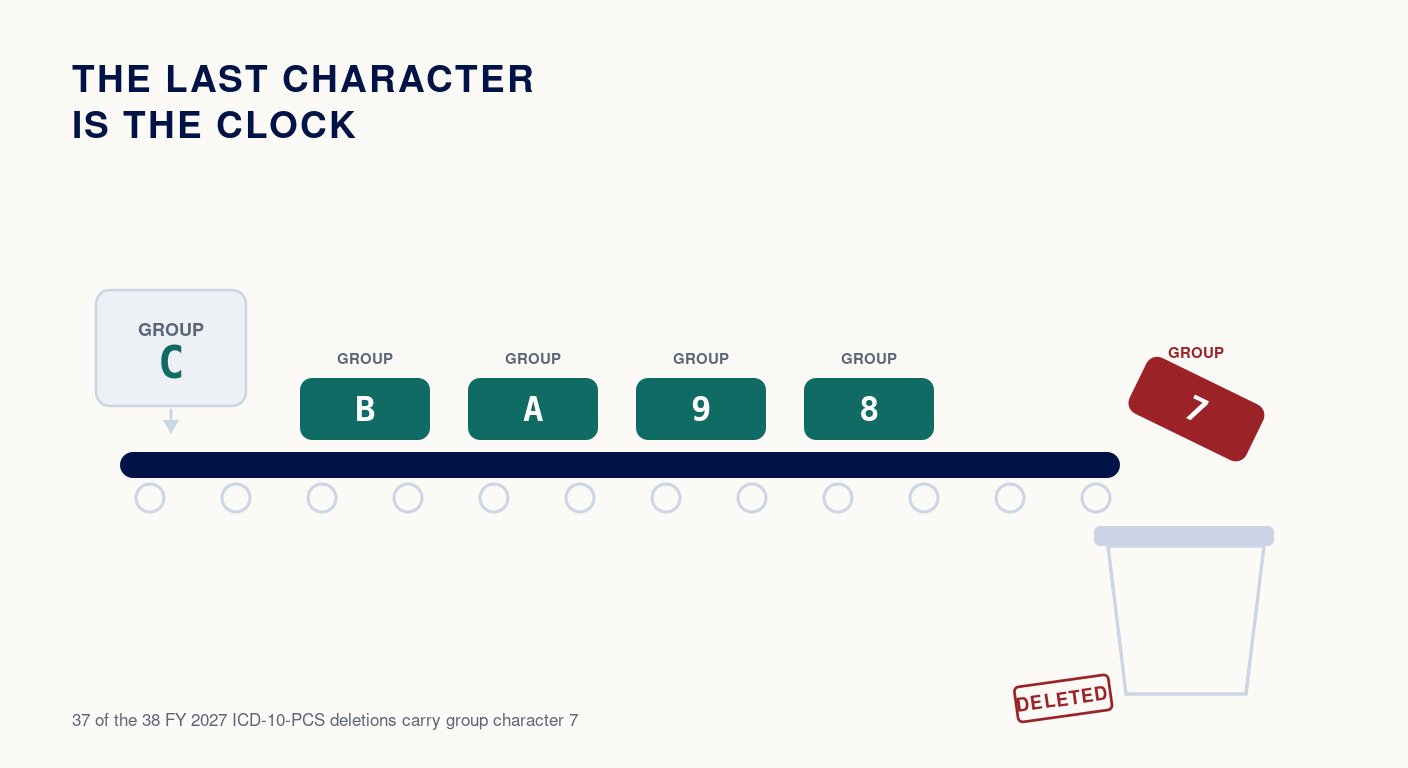
Two things follow. Group C, the newest, accounts for 52 codes, which is exactly the number of Section X additions in this release. Each annual update creates a new group.
And at the other end, 37 of the 38 deletions are Group 7 codes, with 54 Group 7 codes surviving. Group 7 is being retired, not all at once but substantially, several years after it was created.
The practical reading: if you bill a Section X code, look at its last character. The older the group, the closer it is to retirement, and Group 7 is the one that went this year.
Where the Retired Codes Go
This is the part that makes the whole release make sense, and it is not obvious from either list on its own.
Of the 101 additions, 37 are in Section 0, Medical and Surgical. Read their titles and 24 of those 37 are custom-made interbody fusion device codes across the thoracolumbar, lumbar, two-or-more lumbar and lumbosacral joints, at three approaches each, in two column variants.
Those are precisely the successors to the twelve XRGA, XRGB, XRGC and XRGD New Technology codes deleted in the same release.
So the arithmetic is not 101 new procedures. It is a set of procedures graduating: they leave Section X, where they identified a new technology for a limited period, and arrive in the standard section, where they will live permanently. The count goes up in one place because it went down in another.
Note also what changed in the move. The X codes carried no approach-to-the-column qualifier. Their standard successors come in pairs, anterior and posterior approach to the anterior column, which is a distinction the operative note now has to support. We covered that and the rest of the mapping in the 38 expiring ICD-10-PCS codes.
Why Codes Get Less Specific on the Way Out
Not every Section X code graduates into an equally specific standard code. Most of the retired drug administration codes named the product; their successors describe a class.
That is the intended behaviour rather than a defect. Section X exists to make a new technology identifiable while it is new, which is what supports tracking its use and any associated payment arrangement. When that period ends, the procedure is reported the way every comparable procedure is reported.
The consequence for anyone running inpatient analytics is concrete and worth planning for: a product you can currently identify from the PCS code becomes invisible in that field when its group retires. Not gradually, and with no error. The query simply returns nothing from the effective date.
What to Do With This
- Inventory the Section X codes you actually bill, and note the group character on each.
- Treat an old group as a scheduled risk. Group 7 went this year. Older groups are thin because they have already been through this.
- Check the conversion table before assuming a successor exists. Six FY 2027 deletions map to no PCS code at all.
- Warn whoever owns inpatient reporting before a group retires, not after the dashboard goes flat.
- Expect new documentation requirements on graduation. Standard codes often carry qualifiers the New Technology code did not.
Common Questions
Why do ICD-10-PCS New Technology codes get deleted?
Section X identifies a technology while it is new. When that period ends the code is retired and the procedure is reported with the standard code that describes it.
How do I tell which New Technology group a code belongs to?
The last character. Groups run 1 to 9 and then A, B and C for 10, 11 and 12.
Which group retired in FY 2027?
Group 7. It accounts for 37 of the 38 deletions, with 54 Group 7 codes still valid.
How many codes were added?
101, of which 52 are Section X and 37 are Medical and Surgical. Twenty-four of those 37 are successors to deleted New Technology fusion codes.
Will a retired code still work for an older discharge?
Yes. ICD-10-PCS codes follow the discharge date, so a September discharge billed later still uses the code that was valid then.
Sources and Methodology
All counts were produced from the FY 2027 ICD-10-PCS order file and its addenda, published by CMS. Section X codes were counted by taking every valid code beginning with X and grouping on the seventh character. Additions and deletions were classified by section from the first character of each code in the addenda, counting only seven-character billable codes and excluding table headers. Successor relationships come from the FY 2027 ICD-10-PCS conversion table. All files are free and none is licence gated.
Leave a Reply