


The File Almost Nobody Opens
Present on admission reporting applies to inpatient claims, and not every code requires an indicator. CMS publishes the exempt list separately from the code set, updates it every year, and it is the annual file that gets read least.
For FY 2027 the master list holds 38,399 entries, up from 38,349 in FY 2026. The change files show 62 additions, 12 deletions and 1 revised descriptor.
Those numbers are small, and the reason they are small is the useful part: the exempt list does not move on its own. It moves because the code set moved.
Every Deletion Is a Deleted Code
| Removed from the exempt list | Why |
|---|---|
| S23.420D, S23.420S | Sternoclavicular sprain codes deleted with no successor |
| T52.8X1D, T52.8X1S, T52.8X2D, T52.8X2S, T52.8X3D, T52.8X3S, T52.8X4D, T52.8X4S | Organic solvent codes deleted and split three ways |
| Z68.1 | Adult BMI code deleted and split at 18.5 |
| Z87.890 | Personal history of sex reassignment deleted and split into five |
There is no case here of CMS deciding a code should now require a POA indicator. Every removal is a code that stopped existing. If you want to know what left the exempt list, the answer is the deletion list from the main code set.
The A Character Rule
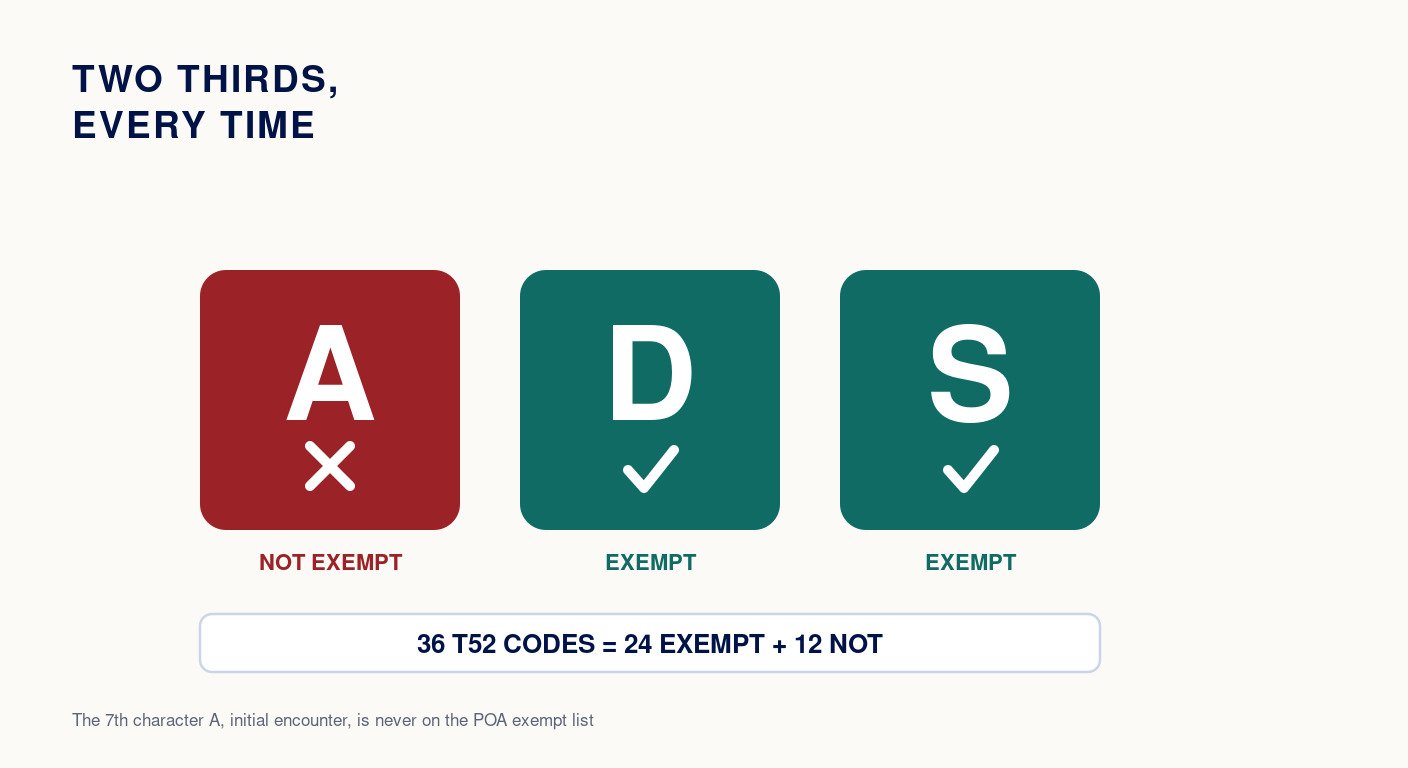
Look closely at the solvent deletions. The list removed T52.8X1D and T52.8X1S. It did not remove T52.8X1A, because T52.8X1A was never on the exempt list.
That is the rule worth carrying away, and it is visible throughout the additions:
| Category | New codes in FY 2027 | Added to exempt list |
|---|---|---|
| T52 organic solvents | 36 | 24 |
| T59 hexamethylene diisocyanate | 12 | 8 |
| T65 medetomidine | 12 | 8 |
Twelve base codes with three seventh characters gives 36 codes; exactly two thirds of them, 24, are exempt. Four base codes gives 12 codes, and 8 are exempt. The arithmetic holds in every injury and poisoning family in the release.
A is initial encounter and it is not exempt. That is coherent: whether an acute injury or poisoning was present when the patient was admitted is exactly the question a POA indicator exists to answer. A subsequent encounter or a sequela is by definition not a condition arising during that admission, so the indicator would add nothing.
The practical error this prevents is assuming a whole new family arrives exempt because most of it did.
The Other 22 Additions Are Wholly Exempt
| Category | Added | What they are |
|---|---|---|
| Z77 | 7 | Burn pits, Agent Orange, blast overpressure, gadolinium exposure |
| Z87 | 6 | Gender transition history codes and detransition |
| QA1 | 5 | Lynch syndrome, BRCA1, BRCA2, Li-Fraumeni, other |
| Z68 | 2 | The two new adult BMI codes |
| Z86 | 1 | Personal history of Clostridioides difficile infection |
| Q87 | 1 | Loeys-Dietz syndrome |
Every one of these is either a status code, a history code or a genetic condition, and each has the same logic behind it. An exposure in a war theatre, a history of a procedure, a germline syndrome and a body mass index are all things that were true before the patient arrived. Asking whether they were present on admission produces no information.
The QA1 entries are the notable ones, because those five codes were created in FY 2027 to let inherited cancer predisposition syndromes be named directly. Their presence on the exempt list means reporting QA17 on an inpatient claim adds no POA documentation burden at all.
One Revised Descriptor, and It Is a Typo
The revise file contains a single code. Z29.14 changes from encounter for prophylactic rabies immune globin to encounter for prophylactic rabies immune globulin.
The code number, its exempt status and its meaning are unchanged. A misspelling was corrected, and it is one of only four descriptor revisions in the entire FY 2027 ICD-10-CM release.
Why Any of This Matters
POA reporting is not optional on inpatient claims, and the exempt list is the authority on which codes are outside it. Two practical consequences follow from the structure above.
- You do not need to monitor this file separately. If you have handled the code set additions and deletions, the exempt list has already followed. It changed by 62 and 12 because the code set did.
- You do need to know the A character rule, because that is the one place the exempt list does something the code set does not tell you. A new injury or poisoning family does not arrive exempt; two thirds of it does.
The FY 2027 guidelines also reworded the POA section itself, changing do not require the use of a POA indicator to do not require the reporting of a POA indicator, and the U definition from if condition is present on admission to if condition was present on admission. Those are editorial. The rules did not change.
Common Questions
How many codes are POA exempt for FY 2027?
38,399 entries on the master exempt list, up from 38,349 in FY 2026.
Are the new medetomidine codes POA exempt?
The D and S codes are. The A initial encounter codes are not, which is the standard pattern for injury and poisoning codes.
Why were twelve codes removed from the exempt list?
Because all twelve were deleted from the code set. No code was reclassified as requiring a POA indicator.
Are the new QA17 genetic syndrome codes exempt?
Yes, all five.
What changed in the POA guidelines for FY 2027?
Wording only. The substance of the reporting rules is unchanged.
Sources and Methodology
Counts were produced from the FY 2027 POA exempt code files published by CMS and the CDC National Center for Health Statistics: the master exempt list, the addition file, the deletion file and the revision file, with the FY 2026 master list used for the year-on-year comparison. Additions were grouped by the category portion of each code. New code counts per family come from the FY 2027 ICD-10-CM code descriptions addendum. The guideline wording comparison is between the FY 2027 Official Guidelines and the FY 2026 guidelines as updated April 1, 2026. All files are free and none is licence gated.
Leave a Reply