
 By Eman Zahra

Twenty-Eight New Codes for One Obstetric Event
Vanishing twin syndrome is the loss of one fetus in a multiple gestation, usually early, with the pregnancy continuing. It is not rare, and with the volume of early ultrasound now performed it is detected far more often than it once was.
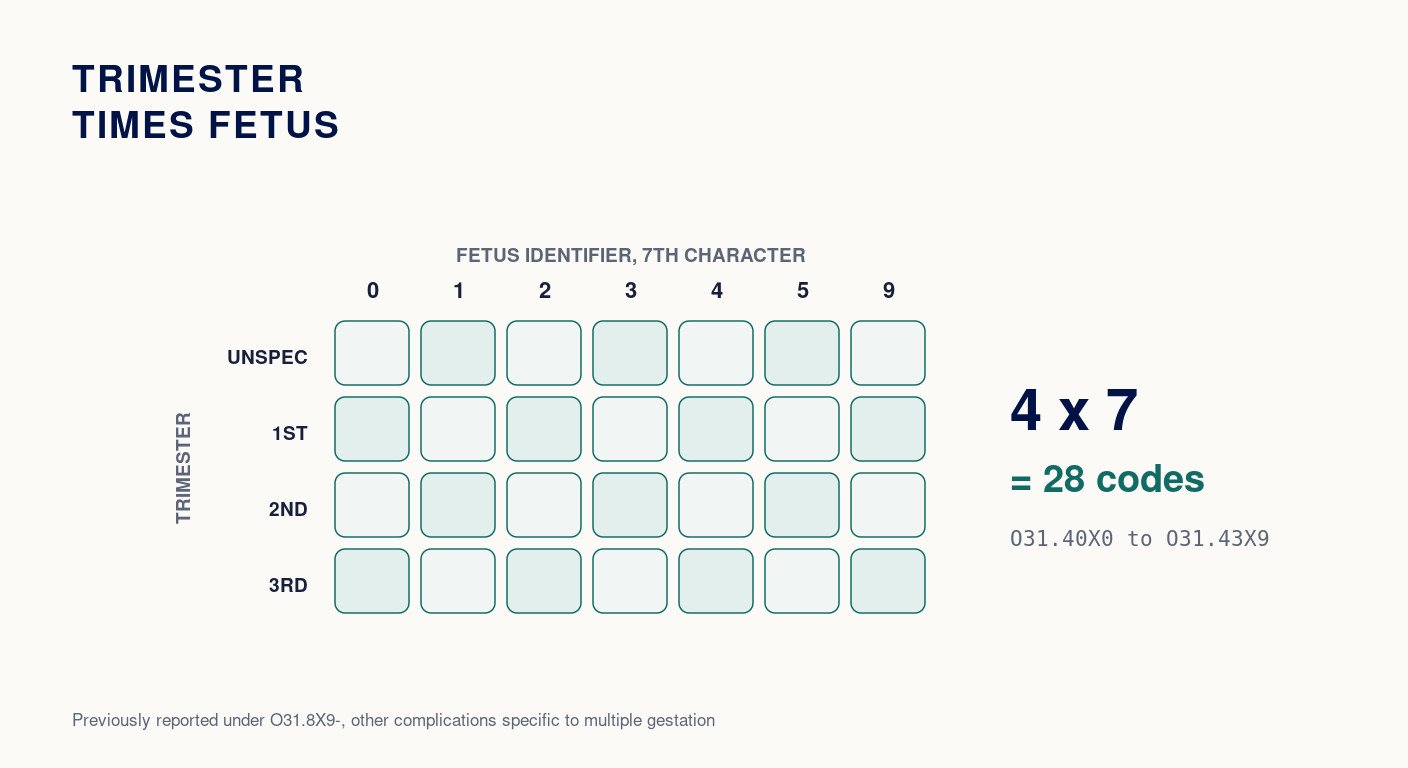
Until October 1, 2026 there was no code for it. The FY 2027 update adds 28 codes under the new subcategory O31.4, continuing pregnancy after vanishing twin syndrome of one fetus or more. Twenty-eight is a large number for one clinical event, and the reason is the two axes obstetric codes carry.
How the 28 Codes Are Built
The subcategory is four trimesters multiplied by seven fetus identifiers.
| Character | Meaning |
|---|---|
| O31.40 | Unspecified trimester |
| O31.41 | First trimester |
| O31.42 | Second trimester |
| O31.43 | Third trimester |
| then a seventh character for the fetus | |
| 0 | Not applicable or unspecified |
| 1 to 5 | Fetus 1 through fetus 5 |
| 9 | Other fetus |
So O31.41X2 is continuing pregnancy after vanishing twin syndrome, first trimester, fetus 2. The X in the sixth position is a placeholder, and it is not optional: the seventh character has to land in the seventh position or the code is invalid.
Where These Codes Came From
The NCHS Conversion Table maps each new code to its equivalent in O31.8X9-, other complications specific to multiple gestation, matching trimester for trimester and fetus for fetus. O31.40X0 came from O31.8X90, O31.41X1 from O31.8X91, and so on through the set.
That is a residual code inside a residual subcategory, which tells you how invisible this event has been in claims data. Every vanishing twin, every other unlisted multiple gestation complication, and everything else that did not fit elsewhere shared the same codes.
O31.8X9- has not been deleted. It remains correct for the other complications it was always meant to cover.
The Fetus Identifier Is the Part That Goes Wrong
Seventh character fetus identifiers already exist across chapter 15, so the mechanism is not new. What makes this subcategory awkward is what it is describing.
The fetus identifier is assigned in the maternal record and must stay consistent across the pregnancy. In a vanishing twin the fetus being identified is the one that was lost, and the numbering has to line up with how the ultrasound reports labelled the gestations. If the early scan called them A and B and the record later switches to 1 and 2, or if the surviving fetus is renumbered after the loss, the seventh character stops meaning anything.
The 0 character, not applicable or unspecified, exists precisely for this. Where the documentation does not identify which fetus was lost, or where identification is not meaningful, the 0 is the honest choice. Inventing a number to fill the field is worse than using the one CMS provided for the purpose.
Trimester Is Determined by the Encounter
A detail that trips people on any chapter 15 code with a trimester axis: the trimester character reflects the trimester at the time of the encounter being coded, not the trimester in which the event occurred.
A vanishing twin identified at nine weeks, on a pregnancy now being seen at twenty-six weeks, is coded with the third character for the trimester of that visit. This matters for this subcategory more than most, because the loss is usually first trimester and the pregnancy continues for months afterwards, generating encounters in later trimesters that still carry the diagnosis.
Why the Diagnosis Stays Relevant
It would be easy to treat this as a historical note once the pregnancy is progressing normally. Clinically it is not purely historical: a pregnancy that began as a multiple gestation is managed differently from one that did not, and the fact of the loss can matter to surveillance and to interpretation of later findings.
For coding, the consequence is simply that the code can appear on more than the encounter at which the loss was found, with the trimester character moving as the pregnancy advances.
What to Check Before You Bill
- Check the date of service. These codes are invalid on or before September 30, 2026, when O31.8X9- was the code.
- Keep the X placeholder. The seventh character has to be in the seventh position. O31.41 with a fetus character in the sixth is not a valid code.
- Use the trimester of the encounter. Not the trimester of the loss.
- Use 0 when the fetus is not identified. It is the designed answer, not a fallback to be avoided.
- Check fetus numbering against the scans. The identifier has to be consistent with how the pregnancy was documented from the start.
- Do not retire O31.8X9-. It remains correct for the other complications it covers.
Common Questions
What is the ICD-10 code for vanishing twin syndrome?
A code from subcategory O31.4-, continuing pregnancy after vanishing twin syndrome of one fetus or more, selected by trimester and fetus identifier, for dates of service on or after October 1, 2026.
Why are there 28 codes?
Four trimester values multiplied by seven fetus identifiers.
What was vanishing twin coded to before?
O31.8X9-, other complications specific to multiple gestation, matched on trimester and fetus.
Which trimester character do I use?
The trimester at the encounter being coded, not the trimester in which the loss occurred.
What if the record does not say which fetus?
Use the seventh character 0, not applicable or unspecified.
Sources and Methodology
All 28 codes and their descriptors were read from the FY 2027 ICD-10-CM code descriptions file published by CMS and the CDC National Center for Health Statistics, and counted directly from that file. Predecessors are as listed in the NCHS ICD-10-CM Conversion Table FY 2027. That O31.8X9- remains valid was confirmed against the FY 2027 code list. Guidance on trimester selection and fetus identifiers is in the ICD-10-CM Official Guidelines for Coding and Reporting FY 2027, chapter 15. All files are free and none is licence gated.
Leave a Reply