
 By Eman Zahra

What Changed for Lynch Syndrome and BRCA on October 1, 2026
Until now, a patient with Lynch syndrome, a pathogenic BRCA1 or BRCA2 variant, or Li-Fraumeni syndrome had no ICD-10-CM code for the syndrome itself. There was only a code for the risk it created: Z15.09 Genetic susceptibility to other malignant neoplasm, or one of its siblings by cancer site. Effective for dates of service on or after October 1, 2026, the FY 2027 ICD-10-CM update adds five codes under a new subcategory, QA17, that name the syndromes directly.
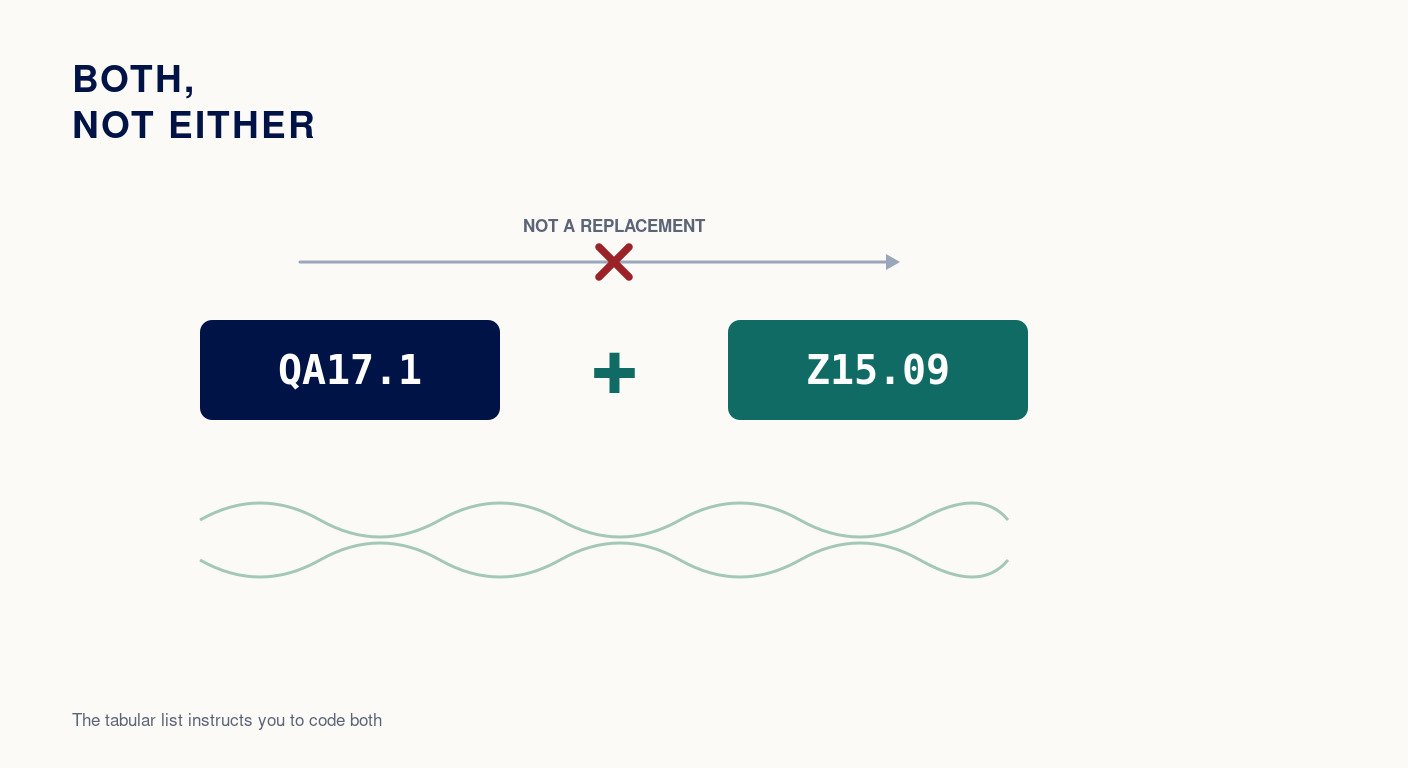
The part almost everyone gets wrong is what happens to Z15.09. It is not deleted. It is not superseded. The tabular list instructs you to report both codes. That single detail is the difference between a clean claim and a rework queue, and it is what makes this update more confusing than a straightforward code replacement such as the I42.0 deletion in the same release.
The Five New QA17 Codes
| New code | Description | Also indexed as |
|---|---|---|
| QA17.1 | Lynch syndrome | Hereditary nonpolyposis colorectal cancer susceptibility; Lynch syndrome due to EPCAM, MLH1, MSH2, MSH6 or PMS2 |
| QA17.90 | Familial cancer syndrome with pathogenic BRCA1 mutation | BRCA1-cancer predisposition syndrome; hereditary breast and ovarian cancer syndrome with pathogenic BRCA1 mutation |
| QA17.91 | Familial cancer syndrome with pathogenic BRCA2 mutation | BRCA2-cancer predisposition syndrome; hereditary breast and ovarian cancer syndrome with pathogenic BRCA2 mutation |
| QA17.92 | Li Fraumeni syndrome | No inclusion terms listed |
| QA17.98 | Other inherited neoplasm predisposition syndrome of multiple systems | No inclusion terms listed |
QA17 sits inside category QA1 Genetic disorders associated with neoplasms, not elsewhere classified. If the format looks unfamiliar, that is because it is: QA1 is only the second ICD-10-CM category ever to carry a letter in the second character. The first, QA0, arrived one year earlier in FY 2026 for neurodevelopmental disorders. Any edit, scrubber rule or validation pattern written on the assumption that an ICD-10-CM code is a letter followed by two digits will reject these codes. That is worth testing before October rather than discovering it in a rejection report.
QA17 Is Not a Replacement for Z15.09
The National Center for Health Statistics publishes a Conversion Table with every annual update, showing the previously assigned code equivalent for each new code. For FY 2027 it lists the same predecessor for all five QA17 codes:
| Current code assignment | Effective | Previous code assignment |
|---|---|---|
| QA1.71 | October 1, 2026 | Z15.09 |
| QA1.790 | October 1, 2026 | Z15.09 |
| QA1.791 | October 1, 2026 | Z15.09 |
| QA1.792 | October 1, 2026 | Z15.09 |
| QA1.798 | October 1, 2026 | Z15.09 |
A conversion table shows historical equivalence for data retrieval. It does not say the old code retires, and here it does not. Every Z15.0 code remains billable in FY 2027: Z15.01 breast, Z15.02 ovary, Z15.03 prostate, Z15.04 endometrium, Z15.05 fallopian tube, Z15.060 colorectal, Z15.068 other digestive, Z15.07 urinary tract and Z15.09 other. None was deleted.
What settles the question is the instructional note printed under QA1 in the tabular list. It reads, in full:
Code also, if applicable, any associated conditions, such as: genetic susceptibility to malignant neoplasm by site (Z15.0-); malignant neoplasms (C00.0-C96.9); personal history of malignant neoplasm (Z85.-)
There is no Excludes1 between QA1 and Z15. Z15 does carry an Excludes1 for chromosomal anomalies, but its range is Q90 to Q99, which stops short of QA0 and QA1. So the two codes are not mutually exclusive, and the tabular explicitly asks for both. A BRCA1 patient with no current malignancy is QA17.90 plus Z15.01, not one or the other.
One exclusion does apply. QA1 carries an Excludes2 for multiple endocrine neoplasia [MEN] syndromes (E31.2-). MEN does not move into QA17, and Z15.81 Genetic susceptibility to multiple endocrine neoplasia is unaffected.
Which Code Goes First
This is the practical reason the new codes exist, and it is a sequencing question rather than a coverage one.
Z15.0 is a Chapter 21 factor code. It carries a Code first note for any current malignant neoplasm (C00-C75, C81-C96), which means that whenever an active cancer is documented, Z15.0- cannot lead. On an encounter where the genetic risk is the reason for the visit and there is no current malignancy, Z15.09 has historically been the only code available to carry the visit, and a factor code in that position is exactly what many payer edits are built to question.
QA17 is a Chapter 17 code, and the FY 2027 Official Guidelines were amended to extend that chapter from Q00-QA0 to Q00-QA1. Section I.C.17 states:
A malformation/deformation/chromosomal abnormality, or genetic disorder may be the principal/first-listed diagnosis or secondary diagnosis on a record.
The same section adds that Chapter 17 codes may be used throughout the life of the patient, and that although these conditions are present at birth they may not be identified until later in life, so whenever the provider diagnoses the condition it is appropriate to assign a code from Q00-QA1. A Lynch syndrome diagnosis made at age fifty two is squarely inside that instruction.
So from October 1, the syndrome itself can be first-listed on a surveillance or counselling encounter, with the site-specific susceptibility code reported alongside it. Whether an individual payer honours that sequencing is a separate matter and should be confirmed against that payer’s policy, but the code set no longer forces the encounter to lead with a factor code.
On Inpatient Claims, All Five Are POA Exempt
NCHS publishes a separate list of codes that do not require a present on admission indicator. All five QA17 codes appear on the FY 2027 addition list, alongside Q87.A Loeys-Dietz syndrome:
- QA1.71 Lynch syndrome
- QA1.790 Familial cancer syndrome with pathogenic BRCA1 mutation
- QA1.791 Familial cancer syndrome with pathogenic BRCA2 mutation
- QA1.792 Li Fraumeni syndrome
- QA1.798 Other inherited neoplasm predisposition syndrome of multiple systems
That follows from what the codes describe. A germline syndrome is present at birth by definition, so a POA indicator adds nothing. The practical effect is that reporting QA17 on an inpatient claim creates no POA documentation burden. Every Z15.0 code is already on the same exempt list, so reporting both codes together changes nothing on that field either.
The Alphabetic Index Contradicts Itself on Li-Fraumeni
This one is worth knowing before it costs you a rework. The FY 2027 Alphabetic Index contains two entries for Li-Fraumeni syndrome, reachable by two ordinary lookup paths, and they give different codes.
| Lookup path | FY 2027 index says | FY 2026 index said |
|---|---|---|
| Syndrome → Li-Fraumeni | QA1.792 | Z15.01 |
| Family, familial → Li-Fraumeni (syndrome) | Z15.01 | Z15.01 |
Z15.01 is Genetic susceptibility to malignant neoplasm of breast, which is a poor fit for a syndrome that predisposes to sarcoma, brain tumours, adrenocortical carcinoma and leukaemia as well. Follow the Syndrome path. If your encoder returns Z15.01 for Li-Fraumeni after October 1, it is reading the stale index entry rather than malfunctioning, and the tabular list overrides the index in any conflict.
Lynch syndrome and BRCA have no equivalent conflict. There was no index entry for Lynch at all in FY 2026, and the FY 2027 entries are new and consistent:
- Syndrome → Lynch (due to EPCAM) (due to MLH1) (due to MSH2) (due to MSH6) (due to PMS2) → QA1.71
- Syndrome → BRCA1-cancer predisposition → QA1.790
- Syndrome → BRCA2-cancer predisposition → QA1.791
- Syndrome → familial cancer, with pathogenic BRCA1 mutation → QA1.790
- Syndrome → hereditary breast and ovarian cancer, with pathogenic BRCA1 mutation → QA1.790
What to Check Before You Bill
- Test the code format first. Submit QA17.1 through your clearinghouse in a test batch. Two letters at the front of an ICD-10-CM code is a pattern most validation rules have never seen.
- Check the date of service, not the date of the claim. QA17 codes are invalid for a date of service on or before September 30, 2026, no matter when you submit. Z15.09 remains correct for those encounters.
- Do not delete Z15 from your problem lists or favourites. The tabular asks for both codes. Removing Z15.0- strips the site-specific detail the QA17 code does not carry.
- Confirm the genetic finding is documented as a diagnosis. QA17 names a syndrome. It needs a provider statement of the syndrome or the pathogenic variant, not a lab result sitting unreferenced in the chart.
- Re-verify your encoder after the October update loads. Look up Li-Fraumeni by both paths described above and see which code comes back.
- Leave MEN alone. The Excludes2 keeps multiple endocrine neoplasia in E31.2- and Z15.81.
Where These Codes Sit in the FY 2027 Update
The FY 2027 release is small by recent standards. Counted from the CMS code descriptions addendum, it adds 190 billable codes, deletes 30, and revises the wording of 4. The NCHS Conversion Table lists exactly 190 codes with an October 1, 2026 effective date, which matches. Higher figures in circulation generally come from the order file, which counts 253 additions because it includes non-billable category and subcategory headers alongside the billable codes.
Against that total, five codes is a small share of the release and an easy one to skim past in a summary. It is also one of the few changes in FY 2027 that alters how an existing, widely reported code is used rather than simply renaming or subdividing one.
FAQs
Is Z15.09 deleted for FY 2027?
No. Z15.09 and every other Z15.0 code remains valid and billable in FY 2027. The QA17 codes are added alongside them.
Do I report QA17.90 instead of Z15.01 for a BRCA1 patient?
No. The tabular note under QA1 says to code also the genetic susceptibility by site. Report QA17.90 for the syndrome and Z15.01 for the breast susceptibility. Add Z15.02 as well if ovarian susceptibility is documented.
What is the correct code for Lynch syndrome after October 1, 2026?
QA17.1, with the applicable Z15.0- site code reported alongside it. For a Lynch patient with documented colorectal susceptibility that is QA17.1 plus Z15.060.
Can QA17.1 be the first-listed diagnosis?
The FY 2027 Official Guidelines, Section I.C.17, state that a genetic disorder may be the principal or first-listed diagnosis or a secondary diagnosis. Individual payer sequencing policy still applies and should be confirmed.
Why is the predecessor Z15.09 rather than Z15.01 for BRCA1?
Because NCHS mapped the syndrome, not the organ. QA17 covers inherited predisposition syndromes involving multiple systems, so the historical equivalent is the non-site-specific Z15.09.
Are these codes in Chapter 17 or Chapter 21?
Chapter 17. The FY 2027 Official Guidelines extend Chapter 17 from Q00-QA0 to Q00-QA1 for this reason. Z15 stays in Chapter 21.
Sources
Every code, note and quotation above was taken from the primary FY 2027 files published by CMS and the CDC National Center for Health Statistics, not from a secondary summary: the ICD-10-CM FY 2027 code descriptions and addendum, the FY 2027 Tabular List and Alphabetic Index, the NCHS ICD-10-CM Conversion Table FY 2027, and the ICD-10-CM Official Guidelines for Coding and Reporting FY 2027. All are free to download and are not licence gated. The FY 2026 equivalents were used for the before and after comparisons.
Leave a Reply