
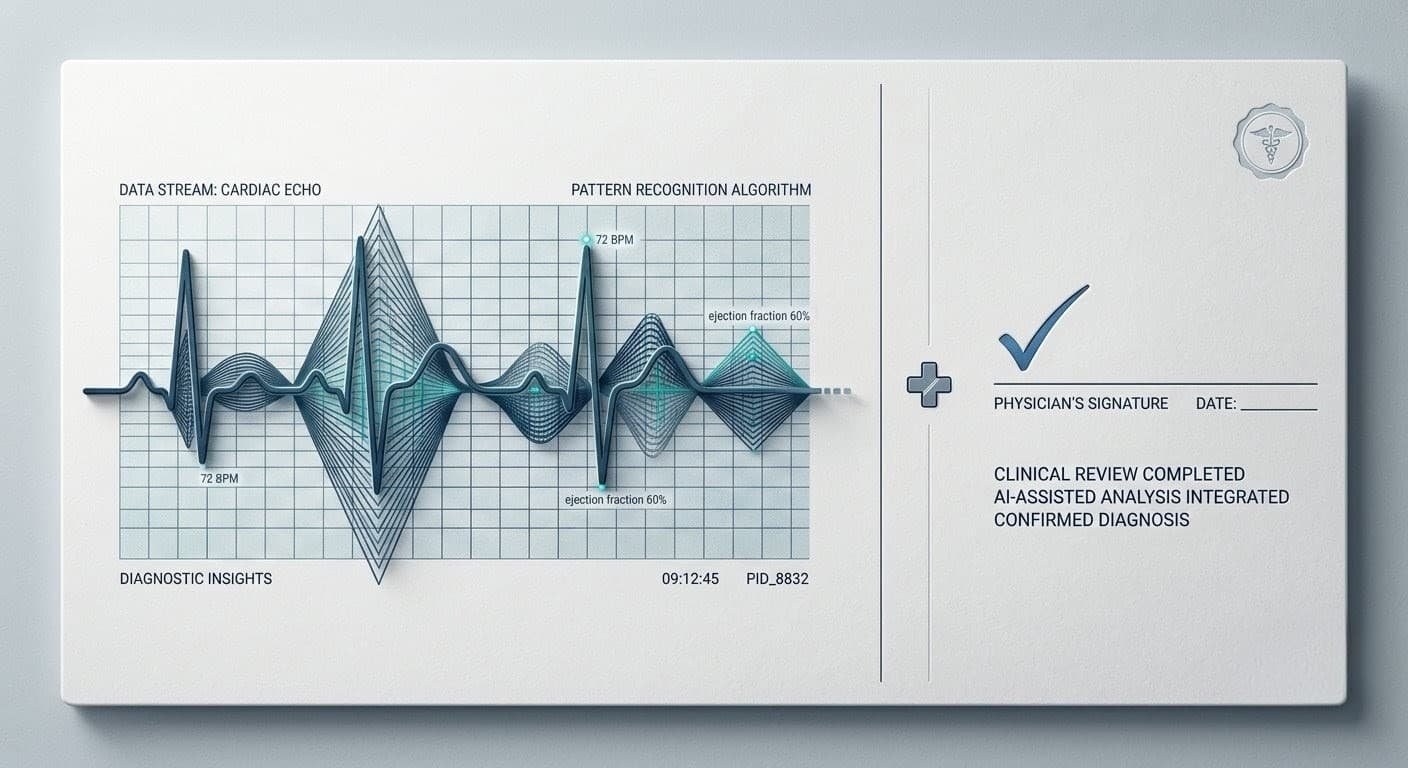


The AMA’s 2026 CPT set adds 288 new codes, deletes 84, and revises 46, formally recognizing augmented intelligence as a billable clinical input for the first time. New Category I and III codes cover AI-assisted cardiac, pulmonary, and imaging analysis. Physicians retain final interpretive responsibility under every new code.
For twenty years, CPT coding assumed a single actor: a clinician performing a service and documenting it. That assumption broke in 2026. The AMA’s new code set describes a two-party workflow — an algorithm that processes data and a physician who validates it — and bills the collaboration as one unit of clinical work rather than two disconnected steps.
Cardiology absorbed the heaviest concentration of new codes. Perivascular fat analysis, coronary plaque assessment via CT angiography, and ECG algorithmic detection of atrial fibrillation now carry distinct code numbers rather than falling into a generic “interpretation” bucket. Radiology, pulmonology, and urology each picked up smaller but financially meaningful additions, including CT-based interstitial lung disease classification and prostate estimation mapping for surgical planning.
None of these codes bill for the software itself. Billing that ignores this distinction — treating the AI license fee as the reimbursable event — is the fastest route to a denial or, worse, a post-payment recoupment demand.
Which specific documentation elements does an AI-augmented claim require?
A compliant AI-augmented claim must name the specific FDA-cleared algorithm and version used, describe how it contributed to the finding, and record the physician’s independent interpretation and final clinical decision. Generic phrases like “computer-aided detection” without a named tool do not satisfy payer or auditor scrutiny.
Coders trained on legacy templates will find this requirement unfamiliar. A radiology report that says “AI flagged a nodule, confirmed on review” reads as thorough to a human eye and as dangerously vague to a payer’s claims-edit engine. The engine wants the vendor name, the software version, what the algorithm specifically flagged, and language that shows the physician engaged in independent judgment rather than accepting the output wholesale.
Practices that built AI documentation into their EHR templates before January 2026 report meaningfully cleaner first-pass claim acceptance. Practices still running 2025-era macros are generating claims that look complete to internal staff and fail silently at the payer, because the missing algorithm-identification field triggers an automated denial with no obvious front-end warning.
The fix is structural, not cultural. Add a discrete, required field to the encounter template — algorithm name, version, and a one-line physician attestation — and make the claim un-submittable without it. Relying on staff memory to include this language consistently, across a full shift of encounters, is not a durable compliance strategy.
What financial risk does a practice carry if AI documentation is incomplete?
Incomplete AI documentation drives claim denials, since payers are actively auditing these codes for missing physician-review language. Beyond denials, the practice — not the software vendor — carries False Claims Act liability if an AI-suggested code is accepted without meaningful clinical review, exposing the organization to per-claim penalties and treble damages.
The revenue-leakage side of this equation is real but secondary to the legal exposure. Radiology practices already operate with denial rates in the 12 to 18 percent range industry-wide, and prior-authorization failures account for the largest single share. Layer a new, unfamiliar documentation requirement onto that baseline and the denial rate on AI-augmented claims specifically will run higher until templates catch up.
The legal exposure is the part competitor content consistently underweights. Under the False Claims Act, reckless disregard for the truth satisfies the fraud standard — actual intent to deceive is not required. If a coder accepts a high volume of AI-generated code suggestions with only cursory review, a government attorney can argue that no meaningful human oversight occurred, regardless of what the vendor’s marketing materials promised about “keeping a human in the loop.”
That argument has teeth now. The Department of Justice’s False Claims Act recoveries exceeded $6.8 billion in the prior fiscal year, with more than 80 percent originating from healthcare. Kaiser Permanente’s January 2026 settlement, the largest Medicare Advantage FCA recovery on record, resolved allegations tied directly to algorithmic chart-mining for risk-adjusting diagnoses. A separate 2024 settlement involving an automated billing rule that systematically upcoded evaluation-and-management claims shows the exposure is not limited to risk-adjustment coding.
How does OIG guidance specifically address AI-generated billing prompts?
OIG’s February 2026 Medicare Advantage Industry Compliance Program Guidance names AI-generated diagnosis prompts delivered through EHR platforms as a potentially abusive practice. The guidance requires human review substantive enough to prevent automation bias, not a formality — meaning documented clinical linkage, not a rubber-stamped acceptance click.
This is the citation competitor articles miss almost entirely. The guidance does not ban AI-assisted prompting. It sets a bar for what “human review” has to look like to count as a legitimate compliance control rather than a paper exercise. A coder who accepts the large majority of algorithmic suggestions in a fraction of a second per chart is, in the government’s framing, not meaningfully reviewing anything.
Practices should treat this as a design requirement for their AI billing workflow, not an abstract legal warning. Build a review-time floor into the coding platform. Require a documented clinical rationale, however brief, for accepting or rejecting each AI-flagged diagnosis or code suggestion. Route every claim above a defined dollar threshold, and every Level 5 E/M or modifier-25 claim, through a second human reviewer before submission.
What operational workflow captures AI revenue while limiting audit exposure?
Practices that capture AI-augmented revenue safely designate an internal AI billing lead, validate clearinghouse readiness for new modifiers, build algorithm-identification fields directly into EHR templates, and run quarterly micro-audits comparing AI-suggested codes against final billed codes to catch systemic drift before a payer or the OIG does.
Start with clearinghouse validation. A new code set means nothing if the practice’s clearinghouse rejects it or silently drops the required modifier during the 837 transaction. Confirm, in writing, that the clearinghouse and every contracted payer’s adjudication system recognize the new Category I and III codes before routinely billing them.
Assign ownership. A named AI billing lead — not a diffuse “the team will handle it” arrangement — tracks CMS transmittals, payer-specific coverage policies, and denial patterns tied to the new codes, then feeds that intelligence back into template design.
Run the numbers quarterly, not annually. Pull every claim where the AI tool’s suggested code differs from the code ultimately billed. A pattern of the physician always accepting the AI’s higher-level suggestion is precisely the fact pattern that turned a UCHealth automated billing rule into an eight-figure settlement. Catching that drift internally, through a documented micro-audit, is the difference between a template fix and a federal investigation.
Coordinate the compliance function with the revenue cycle function instead of letting them operate in separate silos. Denial-management staff see the payer-side symptoms — the rejected claims, the specific CARC/RARC codes attached to AI-related denials — before compliance staff ever see a pattern worth escalating. A weekly hand-off between the two functions, even a short one, surfaces documentation gaps while they are still a training fix rather than a six-month backlog of appealable claims.
Practices that treat AI-augmented coding as a revenue feature bolted onto existing workflows will eventually generate exactly the enforcement exposure the OIG guidance describes. Practices that treat it as a new documentation discipline, with named accountability and a recurring audit cadence, will capture the reimbursement the AMA built these codes to unlock — without becoming the next cited settlement.
Leave a Reply