
 By Eman Zahra
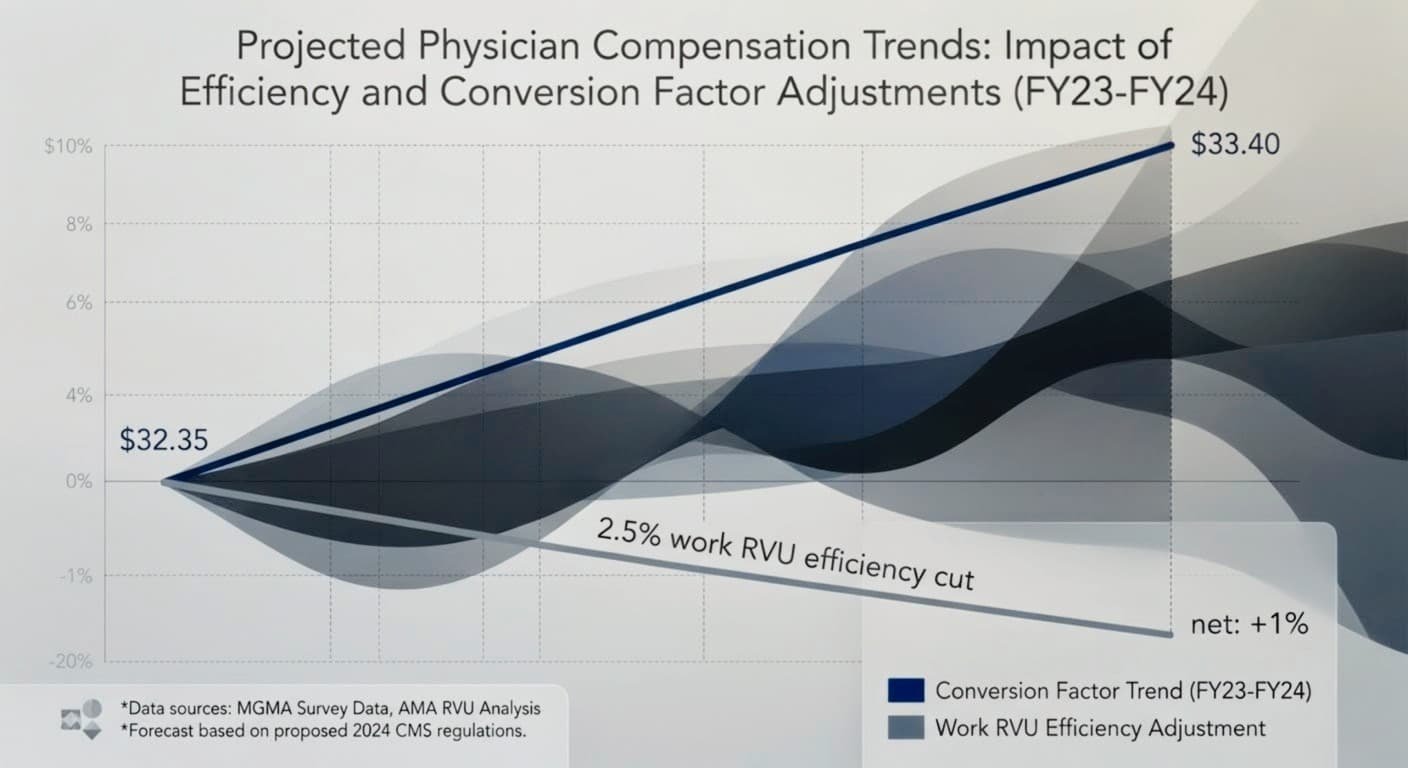
CMS finalized two 2026 conversion factors: $33.57 for qualifying APM participants and $33.40 for everyone else, both up from 2025’s $32.35. Beneath that increase sits a 2.5% efficiency adjustment cutting work RVUs on roughly 7,700 codes, dragging neurology’s net specialty impact down to an estimated 1% gain.
That gap between the visible number and the operational reality is where most billing teams get burned. A rising conversion factor reads as good news in a practice management dashboard summary. It isn’t, once the efficiency adjustment is layered underneath it.
Two forces are moving in opposite directions inside the same rule. Congress delivered a 2.5% temporary conversion factor increase through the One Big Beautiful Bill Act, layered on top of statutory 0.75% and 0.25% updates for qualifying and non-qualifying clinicians. CMS then finalized a separate, unrelated 2.5% cut to the work RVU component of thousands of procedural and diagnostic codes. Neurology practices bill heavily into that second category.
How Does the 2.5% Efficiency Adjustment Actually Cut Neurology Revenue?
The efficiency adjustment reduces the work RVU on non-time-based procedure and diagnostic codes by 2.5%, applied once in 2026 and then every three years thereafter. Evaluation and management, telehealth, behavioral health, care management, and maternity codes are explicitly exempt, which shields neurology’s E&M volume but leaves its diagnostic testing exposed.
That exemption boundary matters more than most billing managers realize. A neurology practice’s E&M visits keep their full work RVU value under the 2026 rule. Its electrodiagnostic testing volume does not, because EEG, EMG, and nerve conduction interpretation codes are diagnostic procedures, not time-based cognitive services.
CMS separately finalized a reduction to the facility practice expense allocation tied to physician work RVUs, cutting the facility-setting PE contribution to half of the non-facility rate. Hospital-based and procedure-heavy neurology programs absorb both cuts simultaneously, while office-based cognitive-visit-dominant practices absorb closer to one.
Which Neurology CPT Codes Absorb the Efficiency Adjustment?
EEG interpretation, nerve conduction studies, and needle EMG codes lose 2.5% of their work RVU value under the 2026 efficiency adjustment because they’re classified as non-time-based diagnostic procedures. A complete needle EMG study (CPT 95886), carrying roughly 1.56 work RVUs, drops to approximately 1.52 — a small per-unit loss that compounds across monthly testing volume.
Nerve conduction study codes follow the same math. CPT 95907, valued near 0.40 work RVUs, falls to roughly 0.39. CPT 95913, valued near 1.19 work RVUs for studies involving thirteen or more nerves, falls to roughly 1.16. A single combined EMG and NCS visit commonly generates three to five work RVUs before any separately billable E&M service, meaning the efficiency adjustment shaves a proportional slice off every electrodiagnostic encounter a practice bills.
None of these reductions show up as a line-item denial. They arrive silently, embedded in the fee schedule itself, which is exactly why reconciliation against 2025 baselines matters before year-end revenue projections get finalized.
Does the Conversion Factor Increase Offset the RVU Cut?
Partially, and unevenly across service types. The conversion factor increase applies uniformly to every code’s total RVU, while the efficiency adjustment only touches the work RVU portion of non-exempt codes, so E&M-heavy practices net closer to the full 3.26% to 3.77% conversion factor gain than procedure-heavy ones do.
Practices with heavy electrodiagnostic testing volume see their conversion factor gain partially clawed back by the work RVU cut on those specific codes, netting out somewhere between the two figures depending on service mix.
The American Academy of Neurology’s projected 1% net specialty impact reflects an average across the specialty’s typical billing mix. A single-specialty group weighted heavily toward EMG, EEG, and NCS testing volume should expect a materially thinner margin than that specialty-wide average suggests, because testing-heavy practices carry more efficiency-adjustment-exposed RVU volume per encounter than the specialty baseline assumes.
What Financial Risk Does This Create for Neurology Practices?
The primary financial risk isn’t the cut itself. It’s practices continuing to model 2026 revenue off 2025 conversion factor and RVU assumptions, then discovering the variance months into the fiscal year when collections don’t match forecast, leaving a budget gap that surfaces only after the damage has already accumulated across a full quarter of claims.
Revenue cycle teams using legacy fee schedule tables risk systematically over- or under-projecting collections on every electrodiagnostic claim filed after January 1. Left uncorrected through a full fiscal year, that variance compounds across every EMG, NCS, and EEG claim a practice files, distorting budget-to-actual reporting for the entire testing service line.
Physician compensation models pegged to work RVU production face a second, subtler exposure. Employment contracts that calculate compensation from raw wRVU totals will show reduced productivity credit on unchanged clinical effort, since the RVU basis itself shrank. That disconnect between clinical work performed and RVU credit awarded is already prompting congressional pushback through the proposed Efficiency Adjustment Delay Act. Physicians translating that shift into per-hour terms can use the physician true hourly rate calculator, which accounts for overhead and unbillable administrative time.
What Compliance Risk Comes From Misapplying the 2026 Rates?
Billing systems that fail to update conversion factor and RVU tables for dates of service on or after January 1, 2026, create genuine overpayment exposure, not just a revenue-modeling headache. Claims priced against stale 2025 figures can result in improper payments that trigger the 60-day overpayment refund obligation once identified.
Practices should treat the fee schedule transition the same way they’d treat any other systemic pricing change: verify the update landed correctly in the practice management system, spot-check a sample of January claims against the published CY2026 rates, and document the reconciliation. That documentation matters if a payer or auditor later questions pricing accuracy across the transition period.
Undercharging carries its own quieter risk. Practices that fail to apply the conversion factor increase on eligible codes simply leave revenue on the table indefinitely, since underpayment rarely triggers the same audit scrutiny as overpayment does.
How Should Neurology Practices Recalculate Revenue Projections for 2026?
Rebuilding revenue projections starts with separating exempt from non-exempt code volume, applying the correct conversion factor increase across the board, and layering the 2.5% work RVU reduction only onto the non-time-based diagnostic and procedural codes that actually carry it.
E&M-heavy practices can reasonably project close to the full conversion factor gain. Testing-heavy practices need a blended model that nets the conversion factor increase against the efficiency adjustment specifically on EEG, EMG, and NCS code families, rather than applying a single specialty-wide percentage across every claim type.
QP status adds another variable groups should confirm before modeling anything. A practice’s 2025 qualifying APM participation determines whether it prices 2026 claims against the $33.57 or $33.40 conversion factor, and that determination happens well before claims start flowing under the new rates.
What Should Practices Watch for in 2027 and Beyond?
The efficiency adjustment recalculates on a three-year cycle, with the next iteration scheduled for CY2029 rulemaking based on efficiency gains measured from 2027 through 2029, meaning the current 2.5% reduction stays fixed as a baseline until that next cycle lands.
Legislative activity around delaying or modifying the efficiency adjustment remains active, and any statutory change would flow directly into future fee schedule updates. Practices should treat 2026 as the new operating baseline while monitoring whether Congress intervenes before the next scheduled recalculation.
The structural lesson carries forward regardless of legislative outcome: headline conversion factor movement and actual per-code reimbursement can diverge substantially, and any practice modeling revenue off the top-line percentage alone is modeling against the wrong number.
Leave a Reply