
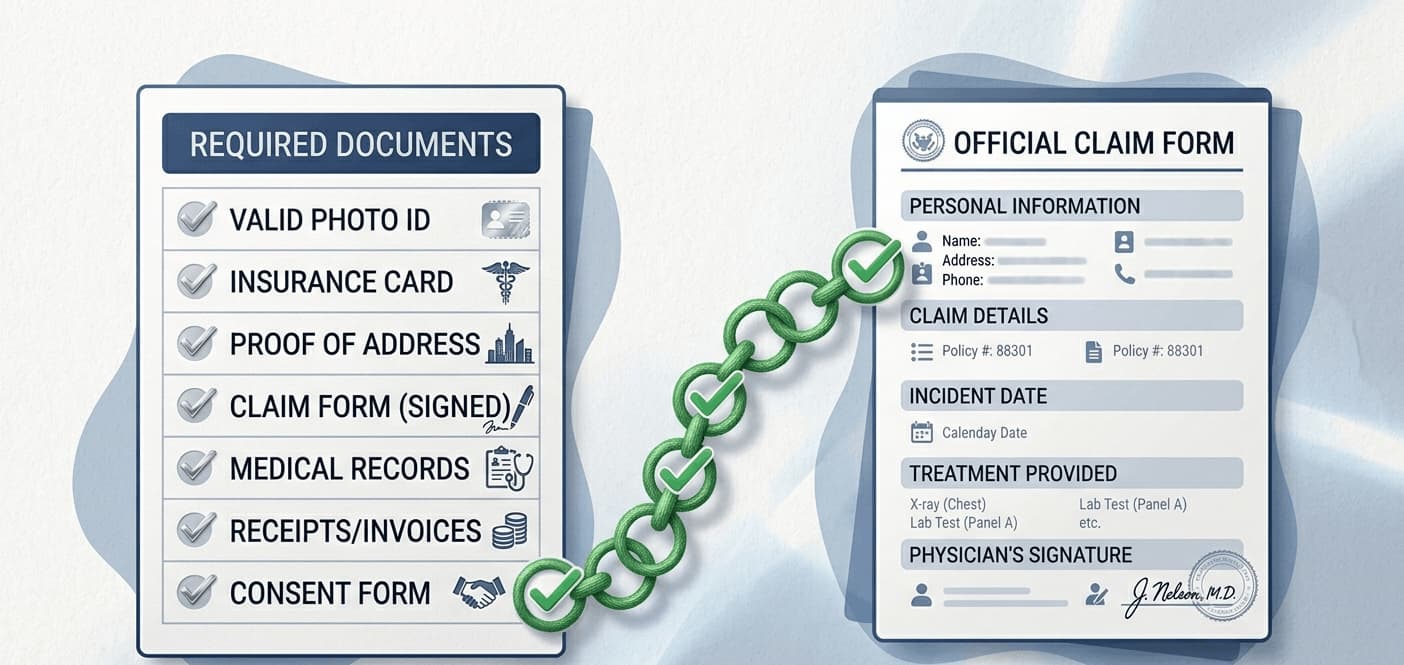


DME denials don’t accumulate suddenly. They compound—slowly, invisibly—until your accounts receivable aging report signals a crisis. Industry data consistently shows that missing or incomplete documentation drives more than 60% of initial claim rejections for durable medical equipment. Most of those denials are preventable. The rules are complex, but they are knowable. What follows is a practitioner-level breakdown of every documentation requirement standing between your submitted claim and a paid one.
What Documentation Does CMS Require for DME Billing in 2026?
CMS requires four core documents for a compliant DME claim: a Standard Written Order (SWO), clinical records supporting medical necessity, a face-to-face encounter note for specific equipment categories, and proof of delivery. Items on the Required Prior Authorization List—expanded to 74 HCPCS codes as of April 2026—also require conditional approval before supplier delivery.
Understanding the full documentation stack isn’t optional. Each layer connects to the others, and a gap in any one creates a path to denial that MAC reviewers and Recovery Audit Contractors exploit systematically. The Centers for Medicare & Medicaid Services has made clear through successive DMEPOS policy updates that documentation standards will tighten, not loosen. Suppliers who treat documentation as a billing afterthought lose far more than individual claims—they accumulate audit exposure.
What Is a Standard Written Order, and Why Did It Replace the CMN?
A Standard Written Order is the CMS-mandated physician authorization document for DME billing. Effective since 2020, it replaced the Certificate of Medical Necessity and DME Information Form for most equipment categories. A valid SWO must be complete, signed by the ordering physician, and in the supplier’s possession before equipment delivery or claim submission.
The retirement of the CMN didn’t reduce the documentation burden—it redistributed it. Before, the CMN structured what a physician needed to confirm. Now, suppliers must extract equivalent clinical evidence from unstructured chart notes. Those notes must tell a coherent medical story that justifies the equipment, the diagnosis, and the functional need.
If the underlying clinical documentation doesn’t clearly describe the patient’s limitations, diagnosis progression, and treatment rationale, no SWO compensates for it.
What Clinical Information Must a Valid SWO Include?
A valid SWO must include the beneficiary’s name and date of birth, prescribing physician’s NPI, the order date, a detailed item description with quantity and frequency, applicable ICD-10 diagnosis codes, and the physician’s signature and date. Missing any single element triggers an immediate denial or audit flag from the DME MAC.
CMS tolerates no ambiguity here. Vague item descriptions—”wheelchair” without specifying type, weight capacity, or HCPCS code—rank among the top SWO errors MACs flag during post-payment audits. Every field must be exact. High-performing billing teams treat SWO validation as a hard gate: no complete, signed order means no claim moves forward, full stop.
How Do Local Coverage Determinations Define What’s Billable?
Local Coverage Determinations, issued by the four DME MACs—CGS, Noridian, Palmetto GBA, and National Government Services—define the exact medical criteria patients must meet for each equipment category to qualify for Medicare reimbursement. A claim that fails to satisfy the applicable LCD‘s coverage criteria constitutes a documentation deficiency, regardless of the SWO’s completeness.
LCDs aren’t uniform across equipment types. The criteria governing power mobility devices differ substantially from those covering continuous positive airway pressure (CPAP) equipment or home oxygen therapy. A supplier billing across multiple categories routinely manages four to eight distinct LCDs simultaneously, each tied to its MAC jurisdiction.
Every LCD specifies required diagnosis codes, documentation thresholds, and in many cases, measurable clinical parameters. For home oxygen therapy, the applicable LCD requires arterial blood gas results or pulse oximetry readings showing oxygen saturation at or below 88%, measured under defined conditions. Without those specific values in the physician’s chart notes, the claim fails LCD criteria even if the written order looks complete. Submitting a claim without meeting the LCD criteria is a fast path to denial. CMS LCD L33797, Oxygen and Oxygen Equipment
When Does CMS Require Prior Authorization for DMEPOS Items?
CMS mandates prior authorization for all 74 items on its Required Prior Authorization List, expanded in April 2026. This includes power mobility devices, specific orthotic codes, and advanced support surfaces. Prior authorization is a condition of payment—a missing provisional affirmation results in automatic denial. Suppliers with a 90% or higher affirmation rate may qualify for exemption beginning June 2026.
On December 2, 2025, CMS issued CMS-1828-F, establishing a prior authorization exemption process. Suppliers who achieve a provisional affirmation rate of 90% or higher may qualify, with the first exemption cycle beginning June 1, 2026, running annually thereafter. That exemption isn’t a concession—it’s a compliance benchmark that rewards suppliers who build clean workflows from the start. cms
For items not on the required list, prior authorization may still be a commercial payer mandate. Verifying PA requirements by payer, plan, and HCPCS code before equipment delivery separates proactive billing teams from those permanently managing claim exceptions.
What Proof of Delivery Requirements Must DME Suppliers Meet?
Proof of delivery must confirm the specific DME item received by the patient or an authorized representative. A valid POD must include the patient’s name, delivery address, item description, quantity, delivery date, and a recipient signature. Payers treat an absent or incomplete POD as presumptive evidence that equipment delivery never occurred, and will deny the claim accordingly.
What Happens When Proof of Delivery Is Missing or Incomplete?
When proof of delivery is absent or unsigned, payers deny the claim on grounds that supplier delivery cannot be confirmed. CERT program audits consistently cite POD deficiencies as a leading cause of improper DME payments. Recovery Audit Contractors specifically target POD failures because they enable automated, high-volume recoupment with minimal dispute from suppliers who lack compliant delivery records.
This is a documentation failure with outsized financial consequences. A missing signature or illegible delivery address can unravel an otherwise complete claim. Suppliers using electronic proof of delivery platforms—such as Brightree, WellSky, or NikoHealth—substantially reduce this exposure by capturing timestamped, geolocation-verified signatures at the point of delivery. The technology pays for itself in a single audit cycle.
What Are the Most Common Documentation Errors That Trigger DME Denials?
The leading DME documentation errors include unsigned or incomplete SWOs, missing face-to-face encounter notes for required equipment, clinical records that fail LCD coverage criteria, absent proof of delivery, expired prior authorization, and HCPCS code mismatches between the written order and the submitted claim. Each error type maps directly to a distinct denial reason code.
Billing teams often chase individual denials without recognizing systemic patterns behind them. An unsigned SWO isn’t a one-time clerical error—it signals a broken intake workflow. Missing face-to-face encounter notes for CPAP or oxygen claims reveal a referral coordination gap between the ordering physician and the DME supplier. HCPCS mismatches typically trace back to outdated internal fee schedules or staff who haven’t been trained on annual code updates.
The American Association of Professional Coders (AAPC) and the Healthcare Billing and Management Association (HBMA) both recommend internal documentation audits at minimum quarterly. Auditors and payers scrutinize documentation closely; a single missing element can trigger denials or requests for additional information. Per CMS guidelines published at cms.gov/dmepos-compliance, suppliers enrolled under DMEPOS Supplier Standards must maintain internal quality assurance systems that catch these errors before claims reach the MAC. AMBCI
How Should DME Suppliers Build a Denial-Prevention Documentation Workflow?
An effective DME denial-prevention workflow requires four sequential controls: LCD verification before accepting a referral, SWO validation via a mandatory completeness checklist, real-time prior authorization tracking against the CMS Required Prior Authorization List, and electronic proof of delivery capture with forced completion fields. Together, these controls intercept the most common failure points before a claim ever reaches submission.
Prevention starts upstream—not at the billing desk. By the time an incomplete SWO lands in a clearinghouse queue, the supplier has already lost leverage. The equipment may be delivered, the patient may have left the physician’s practice, and the order date may be aging toward the timely filing window. Medicare mandates claim submission within 12 months of date of service; many commercial payers require submission within 90 to 180 days. Miss those deadlines, and the revenue is gone entirely.
Building these controls into a DMEPOS-specific practice management platform—Brightree, WellSky, and Bonafide Management Systems are designed precisely for this operating environment—transforms documentation compliance from a reactive scramble into a structured, auditable process. That structural shift is what separates suppliers who consistently maintain clean claim rates above 95% from those who perpetually cycle through denials, appeals, and recoupment.
DME billing documentation requirements to avoid denial aren’t a checklist you complete once. They are operational standards you maintain on every claim, across every equipment category, and with every payer. The SWO, the LCD alignment, the prior authorization, the proof of delivery—each is a link in a chain. Break one, and the entire claim unravels. Build the workflow around every link, and denials stop being your default outcome.
Leave a Reply