
 By Eman Zahra

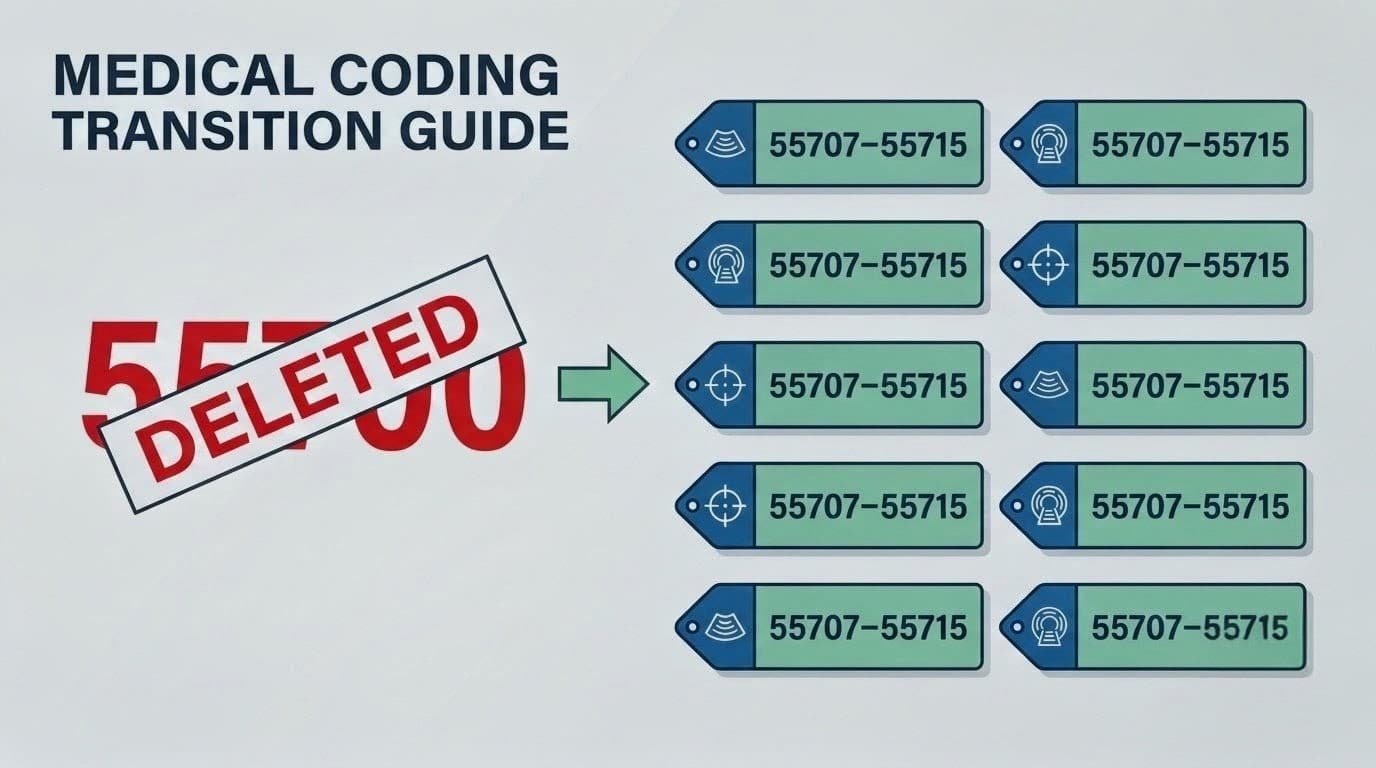
CPT 55700 is gone. Effective January 1, 2026, the code is deleted, and it cannot be used for any 2026 date of service. It has been replaced by a family of nine codes — 55707 through 55715 — that split the old catch-all descriptor into distinct options for approach, imaging method, and lesion targeting. Choosing correctly now depends on documentation that used to be optional.
This article is general education for medical billing and coding professionals. It is not legal, financial, or insurance advice. CPT rules, payer policies, and reimbursement figures change. Verify every code and dollar amount against the current AMA CPT code set and your payer’s own policy before submitting a claim or making a financial decision.
The Quick Answer: Use 55707–55715, Not 55700
There is no single replacement for 55700. Nine codes now cover what one code used to cover. The correct choice depends on three variables: approach (transrectal or transperineal), imaging guidance (ultrasound, MRI-ultrasound fusion, or in-bore CT/MRI), and sampling type (systematic, targeted, or both). Get any one wrong, and the claim hits the wrong code — or gets denied.
Why CMS and the AMA Retired 55700
CPT 55700 went through the AMA CPT Editorial Panel‘s 2023–2024 review cycle before its deletion took effect January 1, 2026. The old descriptor — “needle or punch, single or multiple, any approach” — covered every technique with one code, from a basic ultrasound biopsy to a precision MRI-fusion procedure. That worked decades ago. It stopped working once MRI-fusion and in-bore biopsy became standard tools, because payers couldn’t distinguish a routine procedure from a more resource-intensive one. The new code family closes that gap.
The New Prostate Biopsy Code Family at a Glance
| Code | Approach | Imaging Guidance | Sampling Type |
|---|---|---|---|
| 55705 (revised) | Any approach | None (nonimaging-guided) | Incisional |
| 55706 (unchanged) | Transperineal | Stereotactic template | Saturation (35–60 cores) |
| 55707 | Transrectal | Ultrasound | Systematic |
| 55708 | Transrectal | Ultrasound + MRI fusion | Systematic + targeted, first lesion |
| 55709 | Transperineal | Ultrasound | Systematic |
| 55710 | Transperineal | Ultrasound + MRI fusion | Systematic + targeted, first lesion |
| 55711 | Transrectal | MRI-ultrasound fusion | Targeted only, first lesion |
| 55712 | Transperineal | MRI-ultrasound fusion | Targeted only, first lesion |
| 55713 | In-bore CT- or MRI-guided | Systematic + targeted, first lesion | |
| 55714 | In-bore CT- or MRI-guided | Targeted only, first lesion | |
| +55715 | N/A (add-on) | Fusion or in-bore | Each additional targeted lesion |
How to Pick the Right Code: A 4-Step Decision Path
Step 1 — Transrectal or transperineal? Check the operative note for the entry route. This alone splits the code family roughly in half.
Step 2 — What imaging guidance was used? Three options: standard ultrasound only, MRI-ultrasound fusion, or in-bore CT/MRI (the patient biopsied inside the scanner). The note should name the modality explicitly. “Guidance” alone is not enough documentation.
Step 3 — Systematic, targeted, or both? A systematic (sextant) biopsy samples a fixed pattern across the gland. A targeted biopsy samples a specific lesion seen on prior imaging. Many patients get both in one session — that combination has its own code (55708 or 55710) rather than being billed as two separate procedures.
Step 4 — More than one targeted lesion? If the urologist targets a second, third, or further lesion with fusion or in-bore guidance, add +55715 once for each additional lesion beyond the first. It is always listed with a primary code — never billed alone.
Code-by-Code Breakdown
55705 and 55706 — the codes that didn’t disappear. 55705 was revised, not deleted. Its 2026 descriptor drops the old “incisional” language and now reads “any approach, nonimaging-guided,” covering a biopsy performed without imaging assistance. 55706 is untouched: it still applies to transperineal stereotactic template saturation biopsy, a high-core-count procedure typically done under anesthesia.
55707 / 55709 — ultrasound-only, systematic. Use these for a standard sextant biopsy with no MRI fusion involved: 55707 for transrectal, 55709 for transperineal.
55708 / 55710 — systematic plus fusion-targeted, combined. These apply when the urologist takes systematic cores and targets a specific lesion with MRI-ultrasound fusion in the same session.
55711 / 55712 — fusion-targeted only. Use these when only the fusion-targeted lesion is sampled, with no systematic cores taken: 55711 transrectal, 55712 transperineal.
55713 / 55714 — in-bore CT/MRI-guided. These apply when the biopsy happens inside the imaging unit itself, real time, rather than fusing pre-biopsy MRI images with live ultrasound.
+55715 — the additional-lesion add-on. This code exists solely to capture extra targeted lesions beyond the first, under fusion or in-bore guidance. It carries no independent value on its own line.
Imaging Guidance Is Now Bundled — Stop Billing 76872 and 76942 Separately
Under the old system, a transrectal ultrasound-guided biopsy was routinely billed as three lines: 55700, plus 76942 (ultrasound needle guidance), plus 76872 (diagnostic transrectal ultrasound). That workflow no longer applies. The new biopsy codes fold imaging guidance into their own valuation, and the CMS National Correct Coding Initiative Policy Manual treats guidance as integral to the procedure rather than separately reportable. Billing 76872 or 76942 alongside any of the new prostate biopsy codes will trigger an NCCI edit denial in most cases. The exception is a genuinely independent diagnostic transrectal ultrasound performed outside of, and unrelated to, the biopsy encounter.
Common Denial Triggers and How to Avoid Them
- Using 55700 on a 2026 claim. The code is retired. Any use after December 31, 2025 denies automatically.
- Billing 76872 or 76942 with a new biopsy code. Both are now bundled; separate billing invites an NCCI edit rejection.
- Choosing the wrong approach code. Transrectal and transperineal codes are not interchangeable — the operative note must clearly state the route.
- Under-documenting lesion count. If +55715 is billed, the note must support each additional targeted lesion individually.
Reimbursement Notes
Relative value units differ across the nine codes, generally reflecting the added complexity of fusion and in-bore techniques over standard ultrasound guidance. Exact payment varies by locality and by year. Do not use last year’s 55700 payment as a benchmark — look up each new code individually with the CMS Physician Fee Schedule Look-Up Tool, and confirm commercial payer rates separately, since crosswalk timing varies by plan.
Documentation Checklist for Coders
- Approach (transrectal or transperineal, or in-bore) stated explicitly
- Imaging modality named (ultrasound, MRI-ultrasound fusion, or in-bore CT/MRI)
- Systematic cores, targeted cores, or both, clearly distinguished
- Number of distinct targeted lesions, if more than one
- No deleted or bundled codes (55700, 76872, 76942) on the claim
For the full crosswalk and coding scenarios, see AAPC’s urology coding alert on the 2026 prostate procedure codes.
Frequently Asked Questions
Is CPT 55700 still valid for any 2026 claim? No. It was deleted effective January 1, 2026, and cannot be used for any 2026 date of service. Claims submitted with 55700 for 2026 dates of service will be denied. Use the appropriate code from the 55707–55715 family instead, based on approach, imaging, and targeting documented in the operative note.
What single code replaced 55700? No single code replaced it. Nine codes — 55707 through 55715 — now cover what 55700 used to cover in one code. The correct one depends on approach (transrectal or transperineal), imaging guidance (ultrasound, fusion, or in-bore), and whether sampling was systematic, targeted, or both.
Can I still bill 76872 or 76942 with the new biopsy codes? Generally no. Imaging guidance is now bundled into the new prostate biopsy codes’ valuation. Billing 76872 or 76942 separately alongside them typically triggers an NCCI edit denial, except when a truly independent diagnostic ultrasound is performed outside the biopsy encounter.
What’s the difference between 55707 and 55708? Both codes describe a transrectal, ultrasound-guided systematic biopsy. 55707 covers systematic sampling alone, with no MRI fusion involved. 55708 covers that same systematic sampling plus MRI-ultrasound fusion targeting of a specific lesion, performed together in one session — the combination code, not two separate procedures.
Does +55715 replace 55700 on its own? No. +55715 is an add-on code, not a standalone replacement. It exists solely to capture each additional targeted lesion beyond the first, under fusion or in-bore guidance. It must always be listed alongside a primary biopsy code from the 55707–55714 range; it cannot be billed by itself on a claim.
Methodology note: This article was compiled from the AMA CPT Editorial Panel‘s published 2026 code changes, the CMS National Correct Coding Initiative Policy Manual, and payer bulletins confirming code adoption for 2026. Reimbursement figures were intentionally left directional rather than fixed, since RVUs and payer rates change and should be verified at the source.
Last updated: August 10, 2026
Author/reviewer note: Reviewed by Sarah Callahan, CMRS, CHC, for accuracy against current CPT and CMS guidance.
Leave a Reply