
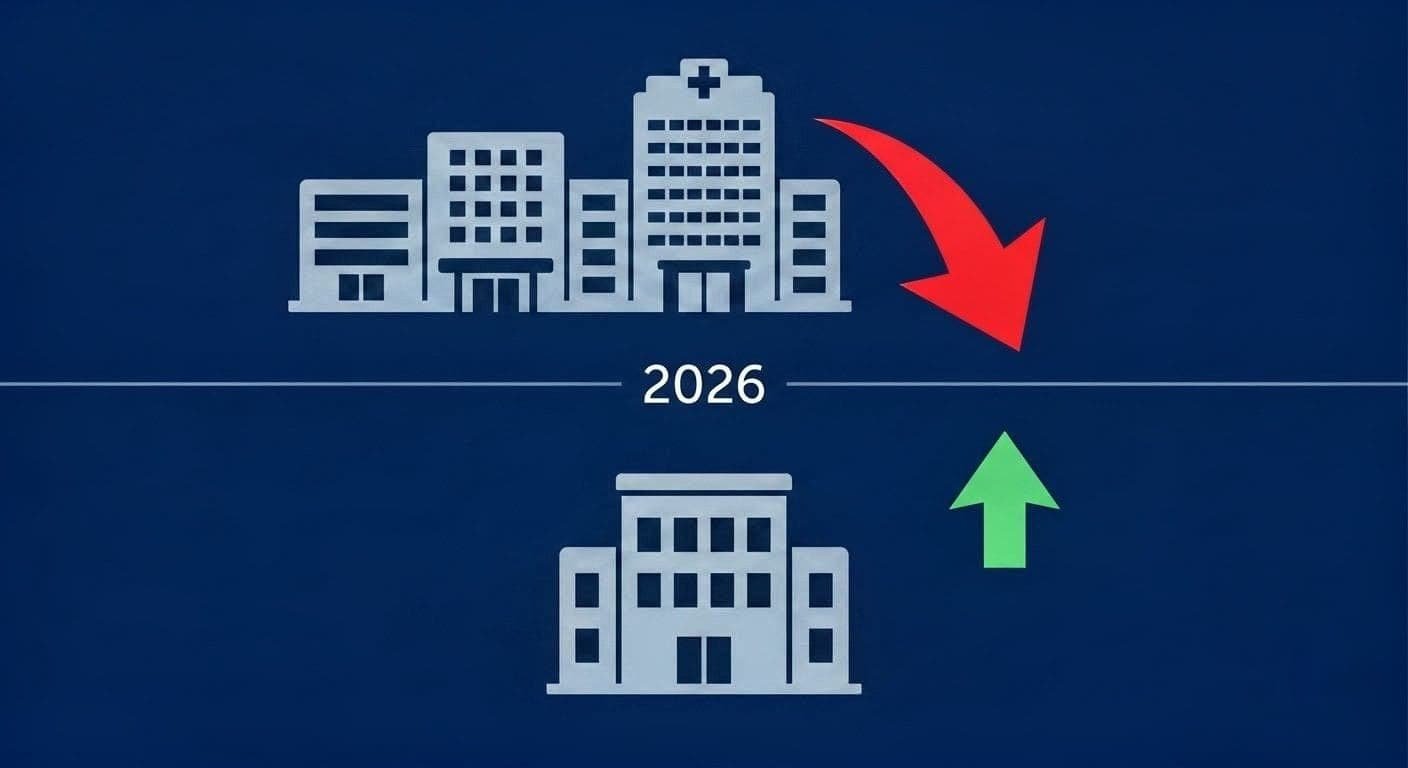


Cardiology just lost its facility-based payment cushion. CMS finalized CMS-1832-F on October 31, 2025, and the rule takes effect January 1, 2026. It rewrites how Medicare allocates indirect practice expense, and cardiology absorbs a disproportionate share of the fallout.
The headline conversion factor looks like good news. Non-qualifying APM participants get a 3.26% bump, to $33.4009. Qualifying APM participants get 3.77%, to $33.5675. Congress drove most of that increase through the One Big Beautiful Bill Act’s temporary 2.5% add-on. But conversion factor math never tells the whole story, and 2026 proves it. Buried inside the same rule sits a practice expense overhaul that erases the raise for anyone billing procedures in a hospital or facility setting.
What does CMS-1832-F actually change for cardiology reimbursement?
CMS-1832-F cuts the indirect practice expense allocated to work RVUs by 50% for services performed in facility settings. Combined with a new -2.5% efficiency adjustment, this produces roughly 10% total RVU reductions for high-volume procedures like TAVR, PCI, ablation, and pacemaker implants. Cardiology facility-based revenue falls even as office-based rates climb.
The mechanism matters more than the headline number. CMS didn’t touch the conversion factor to punish cardiology. It touched the practice expense formula instead. Historically, Medicare paid the same indirect PE rate whether a physician billed from an owned office or a hospital-employed facility. CMS decided that assumption no longer holds. Citing the shift toward hospital employment, the agency now allocates half as much indirect PE to facility claims. The theory: hospitals already absorb overhead costs, so paying physicians the office-equivalent PE rate double-counts the expense. What that leaves per physician hour depends on a practice’s own overhead, which the physician true hourly rate calculator makes explicit.
Cardiology practice managers should treat this as a structural repricing, not a one-year dip. CMS has signaled it will keep recalculating the efficiency adjustment every three years. The site-of-service differential has no expiration date built into the rule.
Why did CMS reject the AMA’s practice expense survey data?
CMS declined to incorporate the AMA’s 2026 Physician Practice Information Survey (PPIS) results into practice expense valuation, citing validity concerns with survey response rates. This decision preserved lower baseline PE inputs. The AMA argues this ignores real cost growth in running a cardiology practice, deepening the gap between Medicare payment and actual overhead.
This rejection is the quiet lever behind the whole rule. Survey-based valuation has driven PE calculations for decades, but CMS now says it wants to move toward empirical time-and-motion data instead of physician-reported estimates. That’s a defensible research goal. It’s also convenient timing, since rejecting updated survey data kept baseline PE inputs lower heading into a year when CMS was already cutting the facility PE allocation. Billing teams should expect this argument — survey validity versus empirical data — to resurface every rulemaking cycle going forward.
How much will facility-based cardiology payments actually drop in 2026?
On the impact estimates published with the CY 2026 Physician Fee Schedule final rule, cardiology facility-based services face roughly a 7% payment decline in 2026 while non-facility office services see about a 5% increase, leaving overall cardiovascular reimbursement up around 1%. Specialty-level impact estimates are modelled averages, so treat them as direction rather than as your practice number. The split means practice setting, not specialty, now drives the biggest swing in a cardiologist’s Medicare revenue.
That 1% overall figure is the number CMS leads with, and it is the number that will mislead anyone who doesn’t check their site-of-service mix. A cardiology group heavy in hospital-based interventional work, TAVR, PCI, structural heart procedures, doesn’t experience a 1% gain. It experiences a real facility cut layered on top of the efficiency adjustment. A group weighted toward office-based diagnostics and follow-up visits sees the opposite: a genuine bump. Two practices reading the same fact sheet will walk away with opposite financial pictures. Billing leadership needs a service-line breakdown, not the topline average, before budgeting for 2026.
What happened to the Left Atrial Appendage Occlusion code, and why does it matter beyond LAAO?
CMS finalized a nearly 27% work RVU cut to LAAO code 33340, from 14.00 to 10.25, based on RUC survey data that cardiology societies call flawed. The American College of Cardiology, Heart Rhythm Society, and Society for Cardiovascular Angiography and Interventions are resurveying the code for a future RUC cycle.
LAAO is the warning shot for every high-value procedural code cardiology bills. The survey instrument CMS relied on produced a value that three major societies immediately disputed as methodologically unsound, yet CMS finalized it anyway. That sets precedent: RUC survey data can swing a code’s valuation by more than a quarter overnight, and disputing it after finalization means waiting for the next survey cycle while billing at the reduced rate. Any practice with concentrated volume in a handful of high-RVU procedures should model what a similar swing would do to their payer mix, because LAAO won’t be the last code this happens to.
What compliance and revenue-integrity risks does this rule create?
The PE cut pushes practices toward two risk vectors: aggressive recoding to recover lost revenue, and underinvestment in denial management as margins tighten. Both raise False Claims Act exposure. OIG and Recovery Audit Contractors typically increase scrutiny on specialties absorbing sudden reimbursement shifts, since utilization anomalies become easier to flag.
This is the part competitor content skips entirely. When facility revenue drops 7%, someone in the practice will suggest recapturing margin through documentation changes, add-on codes, or shifting site-of-service designation on borderline cases. That instinct, even when well-intentioned, is exactly what triggers a RAC audit or a False Claims Act inquiry. Compliance officers should treat 2026 as a year to tighten documentation standards, not loosen them. Denial rates typically spike 90 to 120 days after a major PE change, as claims systems catch up to new code valuations and clearinghouses adjust edits. Build that lag into cash flow projections now, not after the first denial batch arrives.
There’s a second-order risk here too. CMS is layering the mandatory Ambulatory Specialty Model on top of this PE change starting in 2027, targeting cardiologists who manage heart failure patients under two-sided financial risk. Practices that respond to the 2026 PE cut by shifting site-of-service designations to protect margin will walk into ASM enrollment with a coding history that doesn’t hold up under audit. Compliance officers should treat this as one continuous regulatory arc, not two unrelated rules landing in consecutive years.
How should RCM teams prepare before January 1?
Run a site-of-service revenue model using 2025 claims data mapped against the new facility PE allocation. Flag every code with a facility-versus-office rate gap above 5%. Update charge master and coding software before the effective date, and brief compliance staff on why documentation rigor matters more, not less, when reimbursement pressure rises.
Practice managers who wait for the first quarter’s remittance advice to discover their real exposure will already be behind. The CMS fact sheet gives you the efficiency adjustment methodology in enough detail to model your own service mix against it. The full regulatory text, including the site-of-service PE allocation formula, sits in the Federal Register final rule. Pair that with a cardiology-specific breakdown, since general PFS commentary won’t capture procedure-level exposure the way a specialty society analysis will.
Two other pieces belong in your 2026 planning stack. If your patients face higher cost-sharing as facility payments shift, review how patient balance collection strategy needs to adapt to underpayment risk. And if your coding team is already stretched thin, look at how AI-augmented CPT coding workflows can absorb the added denial-prevention burden without adding headcount.
CMS-1832-F rewards practices that model their true site-of-service exposure and penalizes those that rely on the topline 1% figure. The rule isn’t a one-time adjustment. It’s a structural bet on where American cardiology gets practiced, and the billing office that plans for it now protects margin the office that waits will lose.
Leave a Reply