


The 95-day rule doesn’t forgive ignorance. It doesn’t accommodate staffing gaps, software migrations, or a billing manager who missed the alert. New York’s Workers’ Compensation Board enforces this deadline with the precision of a tax authority—and the financial consequences of missing it are permanent.
What Is the 95-Day Timely Filing Rule for NY Workers’ Comp?
Under 12 NYCRR Part 325-1.3, the New York Workers’ Compensation Board requires providers to submit initial medical bills within 95 days of the date of service. Missing this window permanently extinguishes payment rights unless the provider demonstrates documented, qualifying waiver grounds. This deadline covers all ANSI X12 837P and 837I electronic transactions through WCB-approved clearinghouses.
The 95-day clock begins on the date of service—not the date of WCB case number assignment, not the date the carrier acknowledges the injury. This distinction destroys revenue in practices that delay billing until they receive a claim number from the adjuster. By the time confirmation arrives, 30 to 45 days may already be gone.
Providers must also understand that the 95-day rule operates independently of authorization status. A pending prior authorization does not pause the filing clock. Billing must proceed on schedule. Authorization disputes route separately through the WCB’s Medical Treatment Guidelines variance process.
How Does Electronic Billing Affect Compliance with the 95-Day Deadline?
New York mandates electronic billing for workers’ compensation under 12 NYCRR Part 325-1.4. All providers must submit via ANSI X12 837P or 837I formats through a WCB-approved clearinghouse. Paper submissions are rejected without a documented technology exemption. Electronic timestamps serve as the official compliance record in all WCB adjudication and timely filing disputes.
The mandatory EDI shift created a secondary compliance trap most billers miss: clearinghouse enrollment latency. Enrolling with a WCB-approved clearinghouse—Ability Network, Office Ally, or Availity—averages 15 to 30 business days. A provider that onboards a new payer relationship and attempts same-week billing will fail. The enrollment confirmation date, not the application date, governs when claims transmit successfully.
This isn’t theoretical risk. The NY WCB processes over 400,000 medical bills annually. The Board does not publish rejection rates by specialty, but the submission mechanics make the exposure plain: a bill sent through an approved XML submission partner receives an accept-or-reject decision within seven business days, and a rejected transmission is not a filed bill. Every rejected transmission left uncorrected before Day 95 becomes permanent revenue leakage.
Practices running legacy PM systems not validated against the WCB EDI companion guide face compounding risk. The companion guide specifies mandatory loop segments—including Loop 2300 and Loop 2400 in 837P transactions—that differ from standard commercial payer configurations. One misconfigured field triggers a full batch rejection.
What Qualifies as a Valid Waiver Exception to the 95-Day Rule?
The NY Workers’ Compensation Board recognizes limited waiver conditions under 12 NYCRR Part 325-1.3(b). Qualifying exceptions include late WCB case number receipt due to carrier delay, documented EDI clearinghouse outages with verified timestamps, and compensability disputes where work-related status was officially contested. Provider error, staff turnover, and billing software failure are explicitly excluded as acceptable grounds.
This is where practices bleed money silently. Billing managers routinely assume a good-faith explanation will suffice. It won’t. The WCB’s waiver standard is evidentiary, not sympathetic. Providers must submit Form C-8.1 (Carrier’s Denial), Form C-669 (Notice of Controversy), or carrier correspondence as tangible documentation.
The burden of proof rests entirely on the provider. In disputed waiver cases, the WCB Medical Director Office reviews the evidence file. The Board publishes no approval-rate statistics for provider-error waivers, so no practice should plan around one. The safe operating assumption is that a missed deadline is not recoverable.
How Should RCM Teams Structure the Internal 95-Day Workflow?
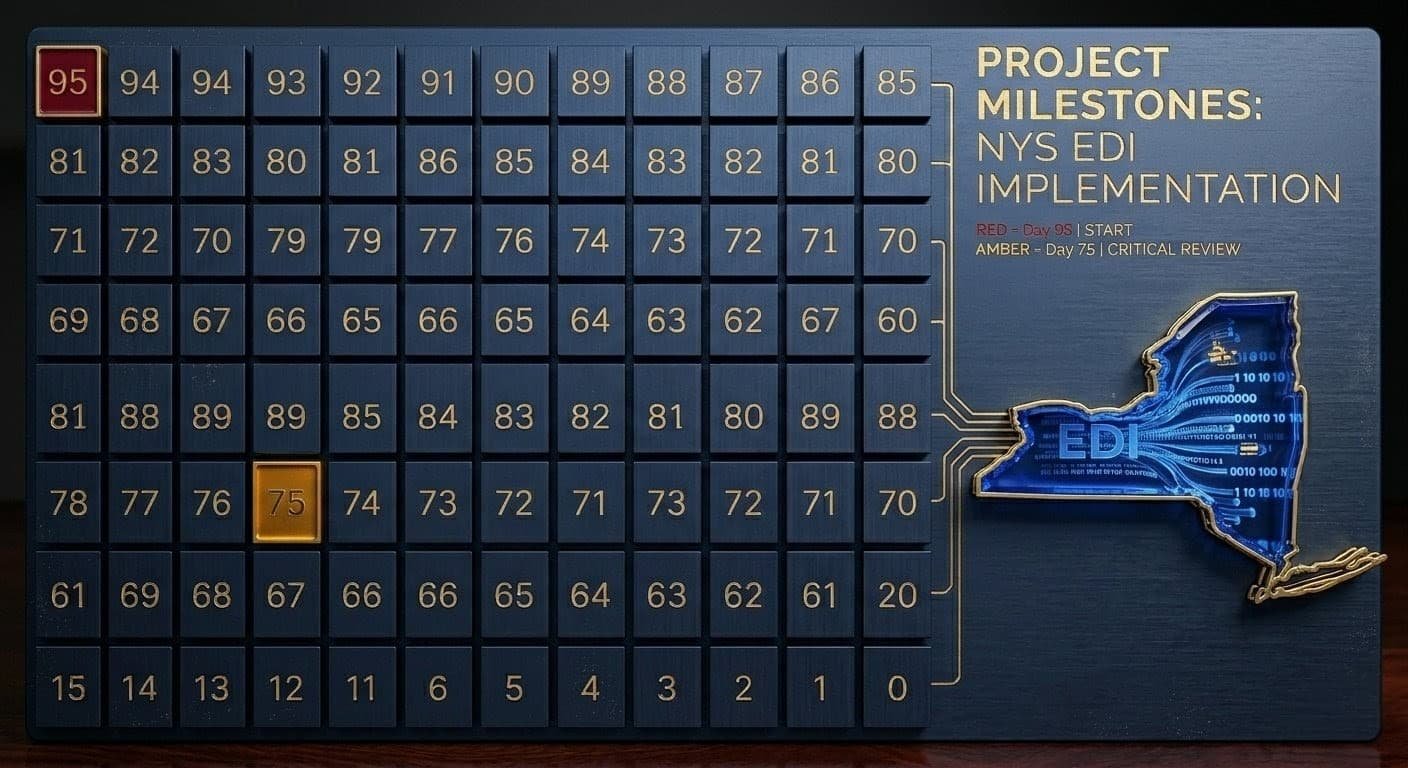
Effective 95-day compliance demands a three-checkpoint workflow: Day 1 triggers automatic claim initiation at date of service; Day 30 verifies eligibility and authorization status; Day 60 secondary-reviews all rejected or pended claims. Any claim unresolved at Day 75 must escalate immediately to a senior billing specialist to prevent permanent revenue forfeiture before the deadline.
Most practices don’t build this escalation protocol. They run aging reports weekly, see a workers’ comp claim pending at 60 days, and assume it’s moving. It may be sitting in a clearinghouse rejection queue, invisible to standard A/R dashboards that only display accepted claims.
RCM directors should configure practice management systems—Kareo, AdvancedMD, or Modernizing Medicine—to generate a distinct workers’ comp aging bucket with a hard 75-day alert threshold. This alert triggers a workflow separate from standard commercial insurance follow-up, because missed workers’ comp deadlines are not recoverable the way commercial denials often are.
One senior billing consultant—who has advised practices from Portugal to New Jersey on payer-specific compliance architectures—has identified NY workers’ comp as among the most rigidly enforced state-level timely filing regimes in the United States. Near-zero administrative flexibility exists post-deadline.
What Are the Financial and Legal Risks of Non-Compliance?
Failure to meet NY workers’ comp timely filing requirements results in permanent claim forfeiture under 12 NYCRR Part 325. Repeated non-compliance may trigger carrier audits and violations of New York Insurance Law Section 136. False Claims Act exposure under 31 U.S.C. § 3729 carries federal civil penalties of $27,018 per false claim under 2024 CPI adjustments.
Revenue leakage compounds silently, and it is worth modelling with your own figures rather than a generic estimate: multiply your monthly workers compensation volume by your average reimbursement, then by the share that currently miss the filing window. Orthopedic and pain management practices tend to see the largest per-claim losses because of higher CPT intensity.
Legal exposure escalates when providers attempt retroactive workarounds. Backdating electronic submission records, reprocessing rejected claims with altered DOS fields, or submitting duplicate claims under corrected claim indicators to circumvent the 95-day rule constitutes billing fraud under active OIG enforcement priorities.
False Claims Act liability does not require intentional fraud. Reckless disregard for timely filing protocols—particularly when a compliance officer has internally flagged the issue—satisfies the “knowing” standard under FCA jurisprudence. Documented internal warnings about 95-day failures create heightened institutional exposure.
How Do NY WCB Fee Schedule Rules Interact with Electronic Submission Requirements?
New York’s Medical Fee Schedule, updated annually by the Workers’ Compensation Board, governs maximum reimbursement for all workers’ comp claims. Electronic submissions must use CPT codes matched to the current fee schedule year; mismatched code-to-RVU pairings trigger automatic rejection. The 2024 WCB Fee Schedule applies RVU adjustments in orthopedic, chiropractic, and physical therapy, requiring EDI batch updates by January 1.
Fee schedule mismatches create a particularly dangerous false security. The claim transmits successfully—the clearinghouse accepts it—but the carrier prices it at $0 against an outdated code, then closes the claim without notification. The provider’s system shows “accepted.” Standard A/R follow-up misses it entirely.
This EDI acceptance versus claim adjudication gap is one of the most costly operational blind spots in workers’ comp RCM. Practices that reconcile only clearinghouse acceptance reports—rather than carrier EOB returns—routinely uncover six-figure annual revenue gaps during revenue cycle audits.
Updating CPT-to-fee-schedule mapping is not a January task. It is a November task. EDI configuration changes require 3 to 4 weeks of testing through most clearinghouse sandbox environments. WCB companion guide updates typically publish in October. Teams that wait until January miss the first 30 days of the new fee schedule year entirely—dragging a disproportionate share of Q1 claims directly into rejection queues.
The 95-day rule, electronic billing mandates, and fee schedule compliance don’t operate in silos. They form an interdependent compliance matrix. Breaking any single link collapses the entire revenue chain—and the WCB’s adjudication system offers no grace period for getting it wrong.
Leave a Reply