


As of January 31, 2026, disputing parties have filed over 5.1 million disputes through the federal IDR portal — fourteen times the annual volume CMS projected at launch. A significant share collapsed before any arbitrator reviewed the merits. They failed eligibility. The 2026 Federal IDR Operations Final Rule, published June 4, 2026 in the Federal Register (Document No. 2026-11140, effective August 3, 2026), directly rewires that architecture. If your RCM team is still operating from a pre-2026 workflow, you are surrendering recoverable revenue.
What Makes a Claim Eligible for the Federal IDR Process in 2026?
A claim qualifies for federal IDR when it involves an out-of-network item or service subject to the No Surprises Act, billed by a nonparticipating provider to a qualifying group health plan or issuer, and when 30 business days of documented open negotiation have concluded without a resolution. State APMA or SSL applicability must first be ruled out before federal IDR is the correct forum.
The No Surprises Act — enacted under §§103–105 of the Consolidated Appropriations Act of 2021 — limits federal IDR access to a defined universe of claims. Emergency services at any facility, non-emergency services furnished at in-network facilities by nonparticipating providers, and air ambulance transports constitute the three primary categories under PHS Act §2799A-1 and ERISA §716.
Many billing departments waste fee dollars on submissions that were never IDR-eligible. A self-funded employer plan regulated solely under state law does not automatically fall within NSA jurisdiction. When a state has an active qualifying All-Payer Model Agreement, federal IDR is pre-empted. CMS publishes a state-by-state applicability chart — the mandatory first stop before any open negotiation notice is generated.
What Did the May 28, 2026 Final Rule Change About IDR Operations?
The 2026 IDR Operations Final Rule — issued jointly by HHS, the Department of Labor, Treasury, and the Office of Personnel Management — finalizes updated standards for open negotiation, dispute initiation, eligibility review timelines, CARC/RARC communication requirements, batching definitions, and a new payer IDR Registry. The rule’s core effective date is August 3, 2026, with phased implementation for portal-dependent provisions.
The rule responds to a systemic backlog crisis. Ineligible disputes flooded the portal after the $115 fee inadvertently discouraged low-value claim withdrawals. Eligibility reviews stretched for months instead of days. The Departments identified three root causes: inadequate pre-dispute communication, unclear batching standards, and no centralized payer identification mechanism. Each failure now has a corresponding regulatory fix.
How Does the New $15 Administrative Fee Reshape IDR Economics?
The IDR administrative fee dropped from $115 to $15 per party per dispute. This reduction of more than 85% applies to disputes initiated on or after June 11, 2026, regardless of claim value. The final rules themselves take effect August 3, 2026, so the fee change reaches disputes ahead of several other provisions in the same rule. IDRE fees charged by certified arbitrators are unchanged and vary by federal contractor.
The economic implications are immediate for high-volume specialty practices. Anesthesiology groups, emergency medicine practices, and independent laboratories routinely absorbed low-balance OON denials because the $115 fee made arbitration uneconomical. At $15, a $400 OON claim now carries a positive expected recovery value.
Revenue cycle directors should audit their current write-off thresholds now. Any claim previously categorized as unviable under the old fee structure requires reclassification.
What CARC and RARC Codes Must Now Appear on Remittance Advice?
Under the 2026 final rule, payers must include standardized Claim Adjustment Reason Codes (CARCs) and Remittance Advice Remark Codes (RARCs) on all paper and electronic remittance advice sent to out-of-network providers. These codes must indicate whether a given claim is or is not subject to NSA surprise billing protections and IDR eligibility. Mandatory payer compliance takes effect within four months of forthcoming CMS implementation guidance.
This requirement resolves a friction point that has plagued provider RCM teams since April 2022. Without standardized codes, providers lacked a reliable mechanism for determining which denied or underpaid claims fell within the federal IDR process. Teams interpreted denial codes inconsistently — initiating IDR for ineligible claims and missing it for eligible ones.
How Do Missing or Incorrect CARC/RARC Codes Create Eligibility Failures Downstream?
When remittance advice lacks the NSA-designated CARC or RARC codes, providers cannot accurately assess IDR eligibility before the open negotiation period begins. Disputes initiated without eligibility confirmation are statistically more likely to be dismissed by the certified IDRE — consuming the $15 fee, the 30-business-day negotiation window, and staff hours, with zero revenue recovery.
The operational fix is upstream. Billing teams need a remittance scrubbing workflow that flags every OON ERA for CARC/RARC presence before the claim enters the dispute queue. EDI clearinghouses that do not yet support NSA-specific code mapping should receive vendor notice now, ahead of mandatory compliance. The CARC/RARC requirements are set out in the Federal IDR Operations final rule (91 FR 33900).
How Does the 2026 Final Rule Redefine Batching Eligibility?
The 2026 rule codifies three permitted batching scenarios: (1) claims for a single patient on the same date or consecutive dates billed on one claim form; (2) items sharing the same service code, or a comparable code across CPT and HCPCS Level II; and (3) specialty-specific batching for anesthesiology, radiology, pathology, and laboratory services within the same Category I CPT section. A hard cap of 50 line items per batched dispute is finalized. These modifications apply to disputes with open negotiation periods beginning 90 days after the Departments issue guidance announcing that the portal functionality supporting them is available.
Prior to this rule, batching errors were among the most common ineligibility triggers. Payers challenged groupings using standards that lacked codified boundaries, and providers had no ceiling on dispute size. The 50-item cap and comparability standard eliminate both ambiguities. What changes operationally is how billing staff construct submissions — same-day encounters must now be grouped deliberately.
What Is the Operational IDR Eligibility Checklist for 2026?
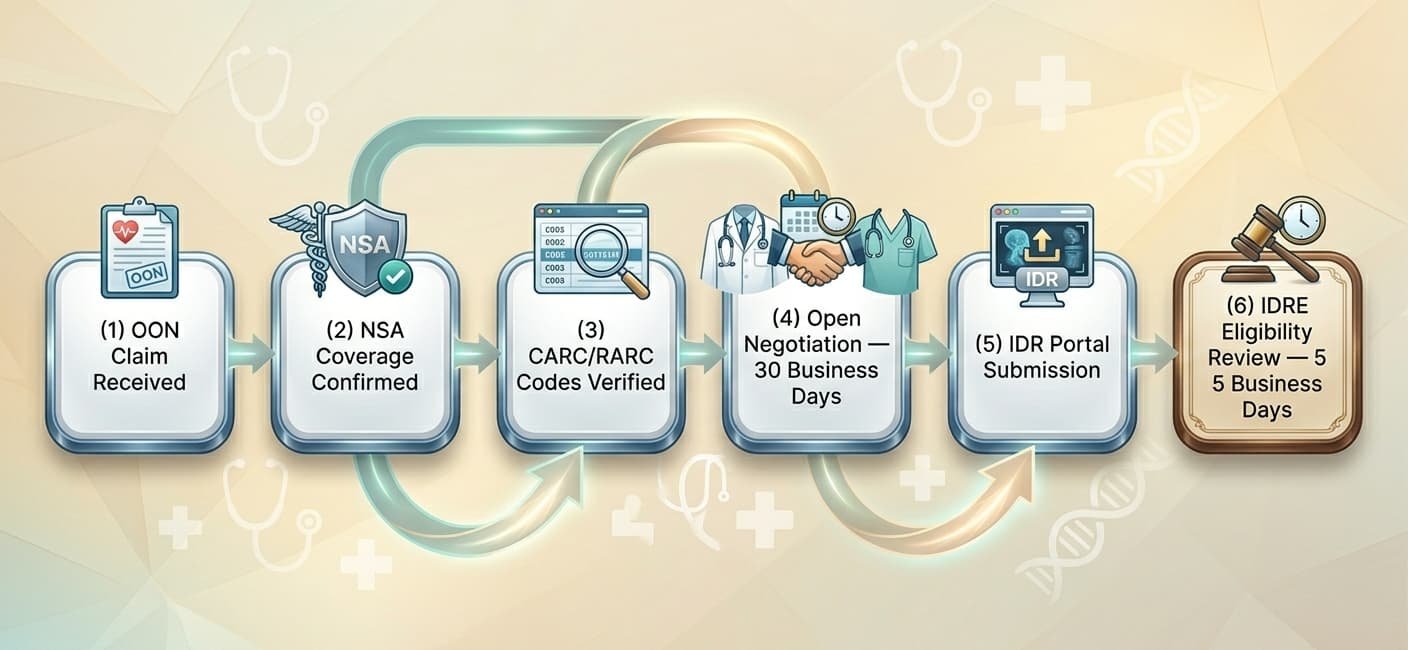
A compliant 2026 IDR submission requires: (1) confirmed NSA coverage and state law pre-emption check; (2) verified OON provider and qualifying payer status; (3) CARC/RARC confirmation of NSA applicability on the remittance; (4) documented 30-business-day open negotiation period initiated through the federal IDR portal with a standardized notice; (5) IDR initiation filed within 4 business days of negotiation close; (6) payer identity verified against the IDR Registry; and (7) batching constructed within the 50-item cap under a permitted category.
Step one is non-negotiable. Even a technically eligible service becomes an ineligible dispute if it was billed under a state-regulated self-funded plan with an APMA in place. Step three became actionable only under the 2026 rule — previously, CARCs and RARCs were not standardized for NSA purposes, and their absence drove a significant share of portal submission errors.
The IDR Registry — new under the 2026 rule — resolves the payer identification problem that caused providers to misdirect open negotiation notices. Certified IDREs may also access the registry to assist eligibility determinations. For hospital-based specialties where the billing entity rarely has a direct payer relationship, this is a material operational improvement.
The initiation window demands strict attention. Providers have exactly 4 business days after open negotiation ends to file through the portal. Missing it forfeits the right to dispute. The responding party — typically the payer — then has 3 business days to submit its own notice under the 2026 rule.
What Financial and Legal Risks Follow an Ineligible IDR Filing?
An ineligible IDR submission results in dismissal after the 5-business-day eligibility review, forfeiture of the $15 fee, and loss of the 30-business-day negotiation window — which cannot be restarted for the same claim. High dismissal rates also attract CMS scrutiny. Systematic submission of ineligible disputes may constitute abusive use of the federal IDR process under the NSA’s enforcement framework.
False Claims Act exposure enters when billing teams use IDR to dispute claims accurately paid at the contracted rate — a scenario common in large multi-payer environments where contract status isn’t updated in real time. Inaccurate OON status flagging creates a paper trail OIG auditors can use to establish a pattern of improper billing conduct.
Revenue leakage operates in both directions. Failing to pursue eligible disputes destroys recoverable revenue. Pursuing ineligible ones creates regulatory exposure. A structured eligibility screening protocol — built around this checklist and updated for CARC/RARC and IDR Registry requirements — is the only rational response to both risks simultaneously.
The 2026 Federal IDR Operations Final Rule is not a procedural update. It is a structural reconfiguration of how payers and providers communicate, dispute, and resolve OON payment conflicts. The $15 fee expands what is worth pursuing. CARC/RARC standardization clarifies what is eligible. The IDR Registry fixes payer identification. The 5-business-day eligibility clock eliminates any margin for an unstructured submission workflow.
Practices that build a rule-compliant eligibility checklist now — before phased portal provisions activate — will capture revenue that unprepared competitors continue to write off.
Primary regulatory source: Federal Register, “Federal Independent Dispute Resolution Operations,” 91 Fed. Reg. 33900, Document No. 2026-11140, June 4, 2026. CMS Fact Sheet: “Federal Independent Dispute Resolution Operations Final Rule,” May 28, 2026.
Leave a Reply