
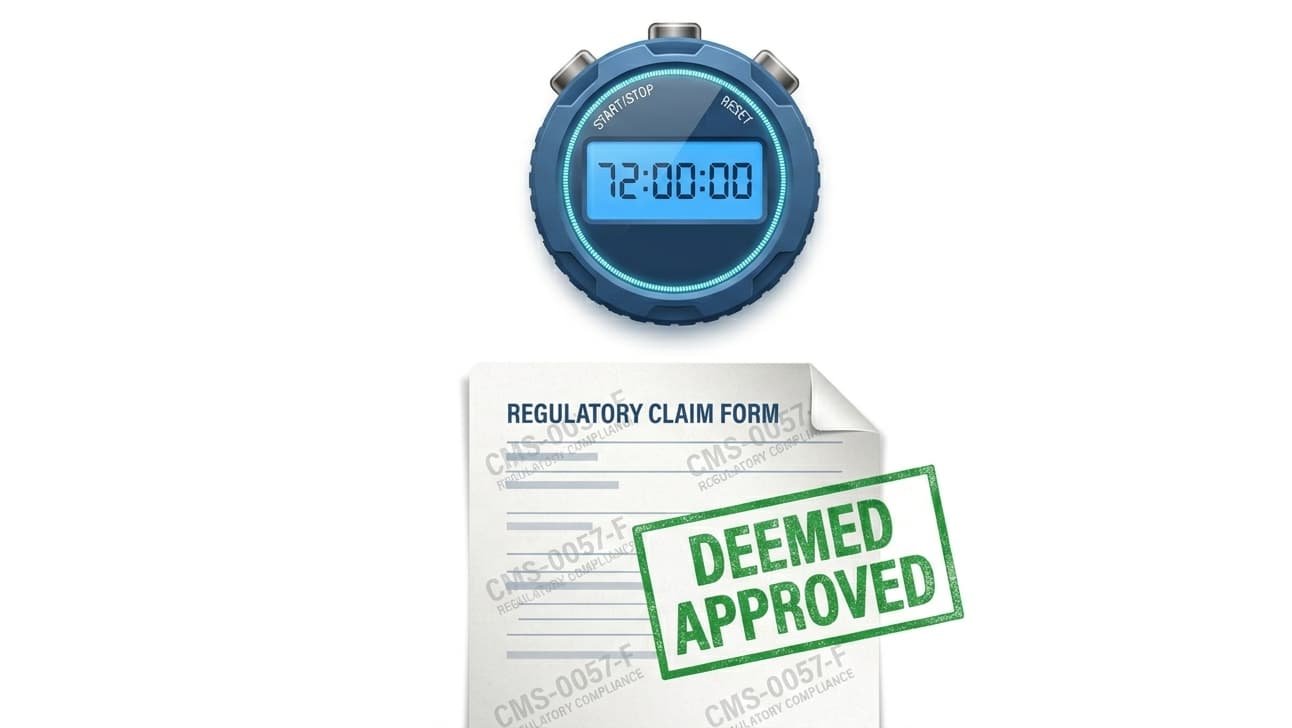


CMS-0057-F is federal law. Starting January 1, 2026, Medicare Advantage organizations must send prior authorization decisions within 72 hours for expedited requests and seven calendar days for standard requests. Miss the window, and the request is deemed approved. CMS fact sheet on the Interoperability and Prior Authorization Final Rule (CMS-0057-F)
That two-word phrase carries more operational weight than any billing update released in the past decade. Most RCM teams haven’t fully operationalized it. That’s a revenue problem and a compliance problem simultaneously.
What Is the “Deemed Approved” Rule Under CMS-0057-F?
Under CMS-0057-F, effective January 1, 2026, Medicare Advantage organizations must issue expedited prior authorization decisions within 72 hours. If a plan misses this deadline, the request is deemed approved by default. The plan cannot retroactively deny the service after missing its window. Standard requests carry a parallel 7-calendar-day federal floor.
This directly tightened what had been a 14-calendar-day window for standard MA prior authorization decisions. Plans exploited that window through administrative extension tactics, generating multi-week delays that cascaded into claim denials and disrupted patient care. KFF analysis of the final prior authorization rules
The “deemed approved” mechanism is not a technicality. It is an enforcement instrument. When a plan fails to respond to an expedited request within 72 hours, the provider holds a de facto authorization the plan is legally barred from retroactively overturning. Documenting and asserting that status is the RCM team’s job — and most aren’t doing it.
Why Did CMS Shorten the MA Prior Authorization Timeline?
CMS shortened MA prior authorization timelines because OIG data consistently showed MA plans issuing inappropriate denials at scale. OIG’s 2022 report (OEI-09-18-00260) found 13% of denied prior authorization requests in its sample met Medicare coverage rules. CMS estimated the CMS-0057-F rulemaking would save approximately $15 billion over a decade. psu
OIG’s earlier 2018 report found “widespread and persistent problems related to denials of care and payment in Medicare Advantage plans,” including that plans overturned 75% of their own denials when beneficiaries appealed, while only 1% of denials were appealed at the first level. Center for Medicare Advocacy
A KFF analysis counted nearly 53 million prior authorization requests submitted to Medicare Advantage insurers in 2024. At even the 12% SNF denial rate OIG documented in its 2024 review, that translates to more than 6 million potential denial events annually. A significant portion of those are clinically unwarranted. The rule requires payers to include specific denial reasons to facilitate resubmission or appeal — a requirement that didn’t exist before 2026. Healthcare Finance Newspsu
The shortened timeline removes the administrative friction weapon. Plans can no longer use deadline extensions to pressure providers into abandoning valid requests.
How Does the 72-Hour Deemed Approval Clock Start and Stop?
The 72-hour clock under CMS-0057-F begins when a Medicare Advantage organization receives a complete expedited prior authorization request. CMS permits a 14-day extension only in specific limited circumstances, as documented at 89 FR 8878. The request qualifies as expedited when a treating provider certifies that the standard timeline would seriously jeopardize patient health.
This is where most RCM departments have a critical operational gap. “Receipt” is defined by the payer’s intake system, not the provider’s submission timestamp. A fax submitted at 11:59 PM may not log in the plan’s system until morning.
Countermeasure: require real-time confirmation for every expedited request. Portal submissions with timestamped confirmation numbers are far superior to fax. For fax-reliant plans, follow every submission with a same-day phone call, log the agent’s name, time, and reference number, and retain that record in the patient’s authorization file.
CMS has acknowledged the possibility of a 14-day extension in certain circumstances (89 FR 8878), but the rule does not authorize extensions based on internal reviewer backlogs. Plans claiming extension authority due to volume cannot use that position to deny a request after day seven. Knowing that distinction is essential when a plan issues a late denial and cites an extension it did not properly invoke. Federal Register
What Are the Financial and Legal Risks of a Missed 72-Hour Deadline?
When an MA organization misses the 72-hour expedited prior authorization deadline, providers gain enforceable deemed-approved status. Filing a claim without documenting this is a revenue cycle error. Ignoring the missed deadline enables plans to deny the claim retroactively. False Claims Act exposure also attaches when a plan’s retroactive denial contradicts a legally implied approval.
The revenue leakage is asymmetric and underreported. Most billing teams default to accepting a late denial without escalating to CMS or pursuing a plan grievance. That passivity costs practices real reimbursement dollars on every occurrence.
In FY 2024, the OIG recovered $2.91 billion in investigative receivables and identified $527 million in expected audit recoveries. The agency’s scrutiny of MA improper denials is intensifying — and it is not confined to large health systems. Small practices and independent billing companies face identical exposure. Bulwark Health
How Does the False Claims Act Connect to Deemed Approval Violations?
The False Claims Act attaches when an entity knowingly submits false claims for federal payment or knowingly withholds money owed to the government. An MA organization that retroactively denies a deemed-approved service — having internally logged its own missed 72-hour deadline — risks FCA liability under the “reverse false claim” theory codified at 31 U.S.C. § 3729(a)(1)(G).
Legal analysts have noted that FCA exposure can arise when a company seeks and receives payments despite being out of compliance with the basic terms for its participation — a framework that applies directly to MA organizations systematically violating coverage obligations under CMS-0057-F. NatLawReview
This is the legal dimension most billing content ignores. When CMS pays a plan capitation rates predicated on lawful coverage obligations, a plan that routinely misses the 72-hour window while collecting full capitation may satisfy the FCA’s “avoiding an obligation” standard. Providers and compliance officers should log every missed-deadline event. These records form the foundation of any CMS complaint, plan grievance, or qui tam investigation.
How Should Revenue Cycle Teams Track the 72-Hour Clock Operationally?
Revenue cycle teams should implement a dedicated prior authorization tracking workflow that timestamps every expedited MA request, logs the plan’s confirmed receipt, and triggers an escalation alert at hour 48. This 24-hour buffer provides time to follow up before the deadline expires and to gather documentation proving the deadline was missed if the plan fails to respond.
The practical workflow begins with a submission receipt protocol. Every expedited request should generate a documented intake confirmation within two hours of submission — portal confirmation screenshots, phone confirmation logs, or EDI acknowledgment records from clearinghouses such as Availity or Change Healthcare.
As MA plans accelerate AI adoption to meet the new timelines, automated clinical review tools are more likely to issue immediate denials on documentation-thin submissions rather than “pending” notices. That changes the upstream equation. Documentation completeness at the point of submission is now the most critical variable in the entire PA workflow — more important than follow-up speed, more important than appeal volume. Humanmedicalbilling
At hour 48, a trained authorization specialist — not an automated system alone — should manually verify the status of every open expedited request. That human checkpoint catches the cases automation misses and creates a dated audit trail that supports a deemed-approval assertion if the plan goes silent.
What Does OIG 2024 Data Reveal About MA Plan Denial Patterns?
OIG’s June 2024 analysis of 19 MA organizations covering 29.3 million Medicare Advantage enrollees found a 12% denial rate for SNF prior authorization requests, ranging from 0.4% to 23% across plans. Of those that were appealed, MA organizations overturned 2,313 of 2,445 denials in favor of the enrollee — a 95% overturn rate. Healthcare Finance News
A separate OIG report found that when patients sought long-term care hospital treatment, denial rates among the three largest MA insurers reached 71% to 80%. When enrollees appealed, MA insurers collectively overturned more than one-third of denials. Star Tribune
Despite this, just 11% of denied prior authorization requests were appealed; of those appealed, 82% resulted in the initial denial being either fully or partially overturned. For a practice submitting 500 MA prior authorization requests monthly at a 12% denial rate, that’s 60 denials — roughly 49 of which would likely be overturned on appeal based on OIG data. Most practices appeal fewer than seven. Center for Medicare Advocacy
The 72-hour deemed-approved rule doesn’t just create a new protection. It raises the operational floor for what competent MA prior authorization management looks like in 2026. Build the timestamp protocol. Train staff to identify missed deadlines. File grievances when plans miss the window. The plan’s procedural failure is your revenue recovery opportunity.
For the binding regulatory text, see the CMS Interoperability and Prior Authorization Final Rule (CMS-0057-F). For OIG denial pattern evidence, see OIG Report OEI-09-18-00260.
Regulatory citations in this article reference 42 CFR Part 422 Subpart M, 89 FR 8878, 31 U.S.C. § 3729(a)(1)(G), and CMS-0057-F. This content is informational and does not constitute legal or compliance advice. Consult qualified healthcare legal counsel for organization-specific guidance.
Leave a Reply