
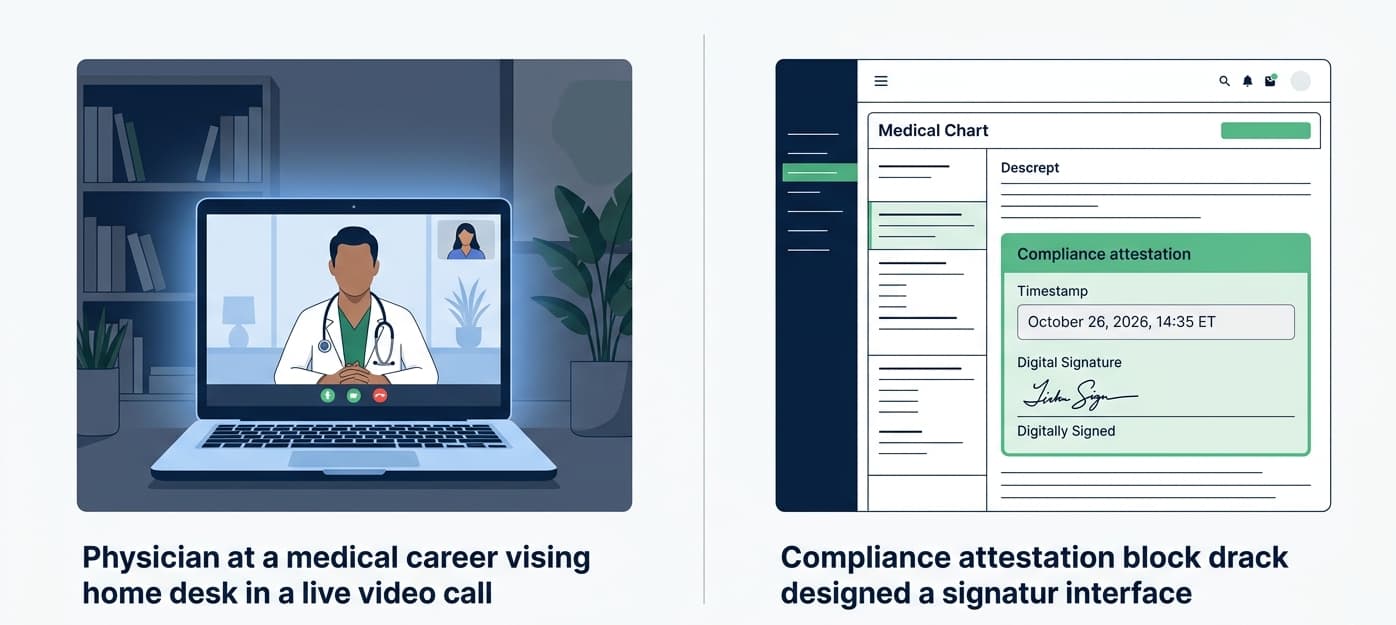

The CY 2026 Medicare Physician Fee Schedule Final Rule became permanent on January 1, 2026, and most billing departments celebrated. Medicare Administrative Contractors did not join the party. They built audit infrastructure targeting precisely the documentation gaps the rule left open.
This article is not about the policy announcement. It is about surviving the review that follows it.
What Did CMS Permanently Change About Direct Supervision in 2026?
CMS permanently revised the definition of “direct supervision” in the CY 2026 Physician Fee Schedule Final Rule (CMS-1807-F), effective January 1, 2026. Supervising physicians and NPPs may now satisfy the “immediately available” requirement via real-time, two-way audio and video technology. This change governs incident-to services under 42 CFR § 410.26, diagnostic tests under 42 CFR § 410.32, and cardiac and pulmonary rehabilitation.
The shift is architecturally significant. For five consecutive years, CMS extended the COVID-era virtual presence waiver annually, keeping compliance teams in perpetual limbo. The CY 2026 MPFS Final Rule ended that cycle and wrote virtual direct supervision into the permanent regulatory text at 90 FR 50007.
The practical consequence: a supervising physician no longer needs to occupy the office suite. A cardiologist at a satellite-location desk, a supervising NPP physician working remotely, or a primary care physician overseeing a nurse practitioner from home—all qualify, provided a live audio-video connection remains active throughout the service encounter. The Consolidated Appropriations Act, 2026 simultaneously extended and made permanent certain broader Medicare telehealth flexibilities, further anchoring the framework.
Which Services Qualify—and Which Are Explicitly Excluded?
Virtual direct supervision applies to incident-to services (42 CFR § 410.26), diagnostic tests (42 CFR § 410.32), and cardiac and pulmonary rehabilitation (42 CFR §§ 410.47–410.49). Services with global surgery indicators 010 or 090 are explicitly excluded and require physical onsite presence. Audio-only connections—telephone calls included—do not satisfy the CMS standard under any eligible service category.
That 010/090 carve-out carries immediate billing implications. A practice performing elective procedures that also runs a physician-extender model for post-operative wound checks within a global surgery period cannot substitute virtual supervision for those services. A MAC that catches this misapplication issues a denial cascade and may apply extrapolation—multiplying a statistically derived error rate across the entire audited claims universe, often years of billing.
The audio-video distinction is equally non-negotiable. Several commercial payers permit telephone-only availability for direct supervision. CMS does not. A Microsoft Teams audio-only channel, a standard phone bridge, or a FaceTime call with video disabled fails the standard. The platform must transmit simultaneous, live audio and visual signals. For practices operating Independent Diagnostic Testing Facilities (IDTFs), an additional layer applies: CMS requires that the remote supervising physician demonstrate documented proficiency in performing and interpreting the specific supervised test. Generic supervisory credentials are insufficient in that setting.
What Does Proper EHR Documentation for Virtual Supervision Actually Require?
CMS does not prescribe a mandatory attestation template, but MACs require documentation demonstrating: the supervising practitioner’s identity and credentials, the specific technology platform used, timestamp confirmation of real-time availability throughout service delivery, and the supervising physician’s readiness to intervene immediately. Generic phrases such as “physician was available” are insufficient and have been cited as deficient in post-payment reviews.
Here is where most practices are exposed. Competitors covering this rule celebrated its permanence. None published the specific language required to survive MAC scrutiny. The gap is operational, not regulatory—CMS intentionally declined to mandate a note format, which means each practice must construct its own and confirm it contains every element an auditor will check against.
Stating “I was available” in an encounter note does not document a virtual direct supervision event. It documents nothing auditors cannot immediately challenge.
What Virtual Supervision Attestation Language Survives a MAC Audit?
An audit-proof virtual supervision attestation must specify the supervisor’s name and NPI, confirm real-time two-way audio and video technology was active, name the specific platform, include start and end timestamps, and state the supervisor’s immediate availability to intervene. Missing any element converts a compliant claim into a presumptive denial and triggers potential overpayment extrapolation by a MAC.
Below is a copy-paste-ready attestation template built against the MAC documentation criteria in the CY 2026 MPFS Final Rule [Federal Register, Vol. 90, p. 50007] and active post-payment review checklists. Embed this in your EHR’s encounter note template and require completion at every virtual supervision event.
VIRTUAL DIRECT SUPERVISION ATTESTATION — EHR Template (Copy-Paste Ready)
“I, [Supervising Physician/NPP Full Name], NPI [XXXXXXXXXX], provided direct supervision for the service performed by [Auxiliary Staff Name, Credential] on [Date of Service] for patient [Patient Name / MRN]. Supervision was furnished via real-time, two-way audio and video technology using [Platform Name: e.g., Microsoft Teams for Healthcare / Zoom for Healthcare / Epic Video]. I was not physically present in the office suite at the time of service. Both audio and video were active and uninterrupted from [Start Time] to [End Time] [Time Zone]. I was continuously and immediately available to provide assistance and direction throughout the encounter and able to intervene at any moment had clinical need arisen.
Supervising Practitioner Signature: ___________ Date and Time of Attestation: ___________”
Store the platform’s session connection log as a secondary document attached to the claim record. HIPAA-compliant platforms—Microsoft Teams for Healthcare, Zoom for Healthcare, and Epic’s embedded video module—generate timestamped connection logs that serve as objective corroboration independent of the physician’s note. If a MAC auditor requests proof of the live connection, the platform log is the only forensic evidence available.
Why Are Medicare MACs Escalating Post-Payment Audits on Virtual Supervision Claims?
Medicare MACs are intensifying post-payment audits on incident-to and virtual supervision claims because OIG identified these service categories as top audit priorities [OIG Work Plan, Active]. CMS’s permanent adoption of virtual supervision—without prescribing specific documentation formats—created documentation inconsistency patterns that MAC algorithms flag for review. Extrapolated overpayment calculations on incident-to claims have produced six- to seven-figure recoupment demands for mid-sized practices.
The enforcement math is unambiguous. The DOJ recovered a record $6.8 billion in False Claims Act settlements in fiscal 2025, with healthcare representing the dominant share. In 2026, AI-driven audit tools at both MAC and OIG levels flag outlier telehealth and supervision billing patterns at machine speed—no whistleblower required to initiate scrutiny.
Incident-to billing has appeared on the OIG Work Plan continuously since 2019. Permanent adoption of virtual supervision does not reduce that scrutiny. It may have sharpened it. A MAC can request claims where the supervising physician’s physical location is unconfirmed, and the burden of proof sits entirely with the provider.
One underappreciated compliance fault line: the Bass Berry & Sims analysis of the CY 2026 Final Rule identified a potential ambiguity regarding whether independent contractors of the billing practitioner—as opposed to employed staff—are fully covered under the permanent virtual supervision provision. The 42 CFR § 410.26(a)(1) definition of “auxiliary personnel” explicitly encompasses employees, leased employees, and independent contractors, but CMS’s final rule language used the narrower term “employed” in one passage, creating interpretive gray space. Practices billing incident-to services performed by contracted—not employed—staff should seek formal MAC guidance before deploying virtual supervision for those encounters.
What Are the Financial and Legal Risks of Documentation Deficiencies?
Documentation deficiencies in virtual supervision claims generate three risks: post-payment denial with recoupment demand, extrapolated overpayment liability under MAC statistical sampling, and False Claims Act exposure if documentation gaps reveal a pattern of inadequate supervision. The federal 60-day repayment rule accelerates liability—failure to refund within 60 days of identifying an overpayment independently creates FCA liability.
The False Claims Act operates on a “knew or should have known” standard. A practice that deployed virtual supervision after January 1, 2026, without updating its EHR note templates cannot credibly claim ignorance when an auditor finds encounter notes reading “physician available by phone.” That phrase fails on two counts: the standard requires audio-video, and the specificity required to prove it was never documented.
Overpayment extrapolation compounds the exposure exponentially. A MAC reviewing 30 sampled claims can apply the identified error rate to the entire audited claims population—potentially years of incident-to billing—and issue a demand that exceeds a mid-sized practice’s entire annual revenue from those service codes. Legal defense alone routinely reaches six figures before a settlement is reached.
How Should Practices Operationalize Virtual Supervision Workflows Right Now?
Practices must immediately update EHR templates to include platform-specific attestation language, configure timestamped supervision logs as mandatory encounter fields, conduct retroactive audits of 2026 incident-to claims, verify accurate Medicare Provider Enrollment for all service locations, and confirm state scope-of-practice permits the virtual supervision model—CMS authorization does not override state licensure law.
State law is the most underappreciated friction point in this model. CMS’s federal framework is permissive, but multiple states maintain active statutes or board regulations requiring physical physician presence for specific clinical delegations. A multi-state group practice that uniformly deploys virtual supervision based solely on the 2026 MPFS rule—without auditing each state’s scope-of-practice requirements—faces simultaneous payer recoupment and state medical board exposure.
The Medicare Provider Enrollment check is not optional. A supervising physician providing virtual oversight from a home office must confirm that location is registered as an enrolled service location in PECOS, CMS’s Provider Enrollment, Chain and Ownership System. MACs have flagged enrollment-location mismatches as a discrete denial trigger in post-payment reviews. The home office is a new supervision site. It requires enrollment as such.
Conduct a retroactive review of every incident-to claim billed since January 1, 2026. The OIG’s own General Compliance Program Guidance explicitly advises proactive self-disclosure over reactive response. Identifying documentation deficiencies before a MAC does eliminates the FCA dimension of the liability entirely—and the 60-day clock does not start until an overpayment is “identified,” making proactive review strategically valuable, not merely defensive.
Virtual direct supervision is a genuine operational advancement for understaffed and geographically dispersed practices. CMS built a permanent framework. MACs built the audit infrastructure to match it. The practices that will sustain this model are those that treated documentation architecture as mission-critical on day one—not as a compliance afterthought triggered by a demand letter.
Regulatory citations: CMS CY 2026 Physician Fee Schedule Final Rule, CMS-1807-F [Federal Register, Vol. 90, p. 50007, Nov. 5, 2025]; 42 CFR §§ 410.26, 410.32, 410.47, 410.49 as amended through 91 FR 12079 (Mar. 12, 2026). For full regulatory text, consult the eCFR at (42 CFR 410.26, incident-to services). For active OIG audit priorities, consult the HHS OIG Work Plan at (OIG Work Plan).
Leave a Reply