
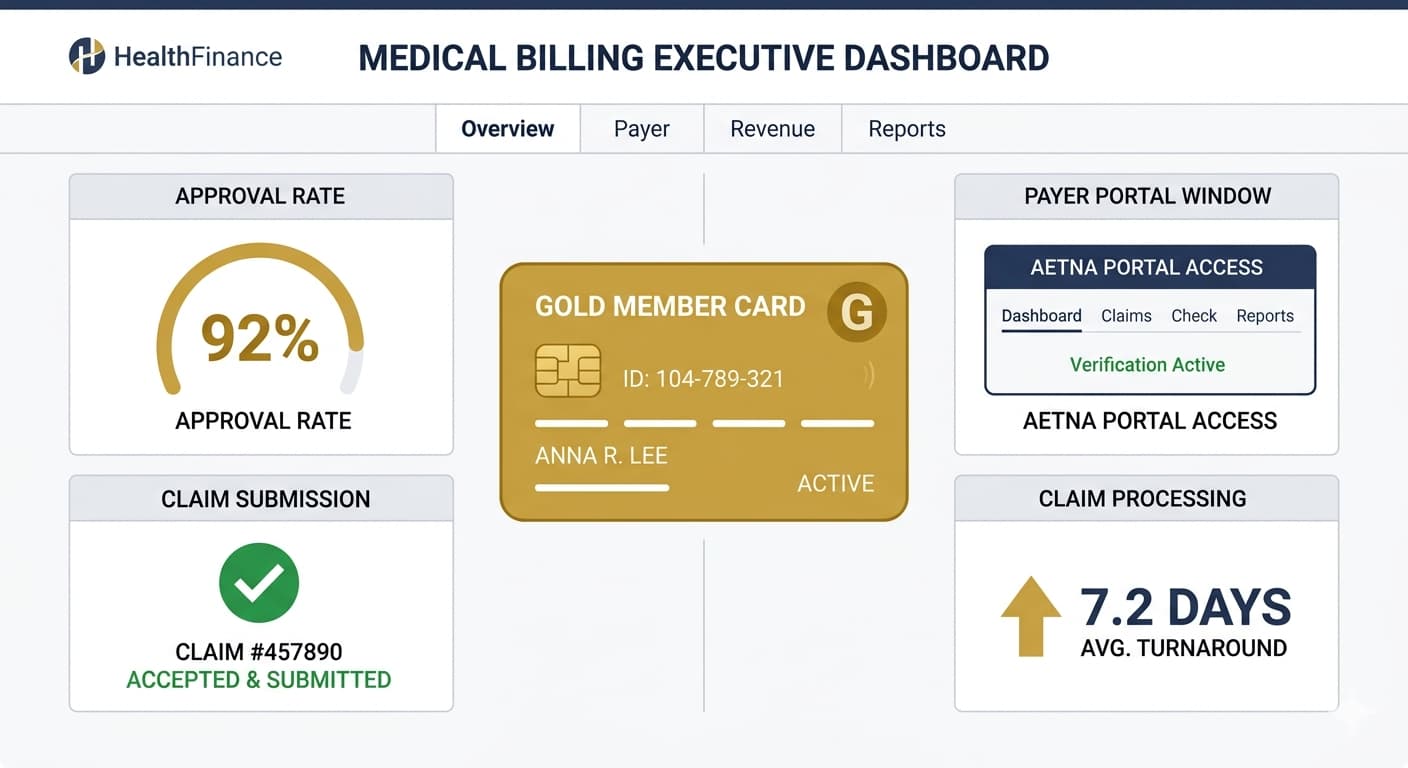


What Exactly Does Gold Card Status Mean for Your Billing Operations?
Gold card status is a prior authorization exemption granted by a payer to physician practices that consistently demonstrate high approval rates for specific procedures. Qualified providers replace full clinical documentation review with a simple advance notification, eliminating routine PA delays on eligible CPT codes while remaining subject to retrospective audits and periodic re-evaluation by the insurer.
This is not a loyalty reward. It is a performance contract enforced by data. Payers track every prior authorization submission your TIN generates, calculate your rolling approval rate, and use that number — not your reputation — to determine whether you keep or lose this operational advantage.
The administrative stakes are immediate. A 2024 AMA survey found physicians and their staff spend an average of 13 hours per week completing prior authorizations. Gold card exemption eliminates that burden for designated CPT codes, compressing scheduling timelines and cutting the revenue cycle friction that drains practice cash flow.
How Do Payers Determine Who Qualifies for Gold Card Exemption?
Payers evaluate gold card eligibility by reviewing a provider’s prior authorization approval rate over a defined look-back period — typically six to 24 months — against a minimum volume threshold. Approval rates must generally reach 90% to 92% or higher on eligible codes. In national programs, eligibility ties to a Tax Identification Number, not an individual provider’s NPI.
The thresholds are not uniform, and that variability is the first risk vector most practices fail to account for. UnitedHealthcare’s national program, launched October 1, 2024, requires a 92% or greater PA approval rate across at least 10 eligible prior authorizations per year for two consecutive years. Texas state law sets the floor at 90% approval across at least five PA requests per specialty service during a six-month evaluation window.
The operational gap is where practices bleed. Qualification is far rarer than the programs suggest: the Texas Department of Insurance reported that only 3% of Texas providers had qualified for the state gold card by December 2024, and UnitedHealthcare national protocol requires a 92% approval rate in each of two consecutive qualification years on top of a minimum volume. Those numbers point to a systemic documentation failure rather than a performance failure. Most denials originate from submission deficiencies — missing clinical criteria, incomplete medical necessity narratives, or CPT-to-diagnosis code mismatches — all correctable upstream.
What Is UnitedHealthcare’s 92% Approval Rate Threshold and Why Does It Matter?
UnitedHealthcare’s 92% approval rate threshold means that for every 100 prior authorization requests submitted on gold card–eligible CPT codes, at least 92 must receive final approval — including approvals after appeal — over a two-year evaluation period. Practices failing to reach this threshold after meeting volume requirements remain ineligible and must continue submitting full prior authorization documentation for those codes.
What catches practices off-guard is UnitedHealthcare’s inclusion of appeals in the final rate calculation. A PA initially denied but approved on appeal counts in your favor. That makes a structured, disciplined appeals workflow an active contributor to gold card eligibility — not an administrative afterthought.
UHC also ties gold card status to the TIN rather than the individual NPI. Once qualified, every provider billing under that TIN gains the exemption on designated codes. That architecture amplifies both the benefit and the risk: a single outlier physician within the group who consistently submits under-documented PAs erodes the entire TIN’s approval rate without triggering any individual-level alert.
How Do You Monitor and Protect Your Prior Authorization Approval Rate?
To protect your gold card approval rate, implement a continuous PA performance dashboard segmented by payer, CPT code, and denial reason code. Track initial denial rates, appeal overturn rates, and final approval percentages monthly. Identify the procedure codes and documentation gaps driving denials, then remediate at the point of order — before submission, not after denial.
The mechanics require your RCM platform to capture denial reason codes at the 835 transaction level and map them back to individual CPT codes submitted for PA. Authorization management tools from Waystar, Availity, or Change Healthcare support this segmentation. Without payer-specific reporting by code, you are managing your approval rate blind.
Your clinical documentation specialist should conduct pre-submission audits on every PA request for gold card–eligible services. The checklist must verify that ICD-10-CM codes in the clinical record align precisely with the codes on the submission, that medical necessity language mirrors the payer’s Local Coverage Determination or medical policy criteria, and that the ordering provider’s credentials match current payer enrollment data.
One frequently overlooked protection: PA submissions pending appeal at the time of a payer’s evaluation review may be excluded from the denominator under the federal GOLD CARD Act’s procedural safeguards. [External Citation: AMA GOLD CARD Act Legislative Summary — ama-assn.org] A disputed denial left un-appealed becomes a clean negative data point against your rate. Appealing every defensible denial is not optional strategy — it is rate protection.
What Documentation Practices Prevent Gold Card Rescission?
To prevent gold card rescission, maintain medical records that explicitly demonstrate clinical guideline adherence for every service rendered under the exemption. Payers conduct retrospective audits of five to 20 randomly sampled claims per 12-month review cycle. Records must contain evidence-based justification, physician attestation, and ICD-10-CM coding aligned to the payer’s current coverage determination policies.
Texas law codifies this requirement directly. Under TDI’s gold card rule, effective September 1, 2022, an exemption may be rescinded “in the absence of adequate records during an evaluation or appeal.” The documentation that qualifies you for the exemption is the same documentation that defends you when the auditor arrives. They are operationally inseparable.
Structure your medical record for audit readiness on every gold-carded service. This means a clinician-authored narrative explicitly connecting the patient’s presenting condition to the applicable evidence-based guideline, a clear statement of why alternatives were considered or excluded, and a signed ordering provider attestation. Generic note templates do not satisfy this requirement under any payer’s retrospective review standard.
What Happens If Your Practice Loses Gold Card Status?
If a practice loses gold card status, it immediately reverts to submitting full prior authorization documentation for all previously exempted CPT codes. The financial impact includes authorization processing delays of one to 14 days per case, increased administrative labor costs, and elevated claim denial risk during the transition period. Payer-specific appeal processes exist to contest rescission decisions.
The revenue impact compounds quickly. A dermatology practice that held gold card exemption for CPT 17311 — Mohs surgery — must now clear full PA on every scheduled case. Delayed authorizations mean rescheduled procedures and deferred revenue that rarely fully recovers within the same fiscal quarter.
Under the AMA-supported GOLD CARD Act, Medicare Advantage plans must demonstrate that fewer than 90% of claims during a 90-day look-back period would not have received prior authorization before revoking an exemption. Plans must also accumulate at least 10 claims in that window before rescission is valid. This federal framework creates a procedural firewall against arbitrary revocation — but only for practices that know it exists and actively contest non-compliant rescissions.
How Do State Laws Shape Your Gold Card Maintenance Strategy?
State gold card laws determine minimum approval rate thresholds, evaluation period lengths, volume requirements, and payer obligations. Texas requires 90% approval on at least five PAs per service per six months. West Virginia mandates 90% approval across an average of 30 procedures per year. Arkansas extended gold card privileges to group practices and added prescription drug coverage beginning in 2025.
The regulatory landscape is fragmenting by state, and that fragmentation demands payer-by-payer compliance matrices from your RCM leadership. As of late 2024, at least eight states had enacted gold card legislation, with additional states advancing bills through 2025 and 2026 sessions. [External Citation: CMS Interoperability and Prior Authorization Final Rule (CMS-0057-F) — cms.gov] Each jurisdiction may cover different service categories and embed different rescission rights.
Practice managers operating across multiple states must maintain separate compliance matrices for each payer and jurisdiction. A 90% threshold in Texas and a 92% threshold under UHC’s national program can apply simultaneously to the same provider. Conflating them is a compliance error with direct revenue consequences.
How Should Your Revenue Cycle Team Structure Its Gold Card Compliance Workflow?
Revenue cycle teams should designate a gold card program coordinator who tracks approval rate performance monthly by payer and CPT code, manages advance notification requirements for exempted services, monitors retrospective audit correspondence, and conducts quarterly documentation audits. This role bridges clinical documentation and billing functions, acting as an early-warning system against approval rate erosion before an evaluation window closes.
The coordination gap is real. Most practices have billing staff who understand PA workflows and clinical staff who document care — but no single accountable owner at the intersection. When UHC’s program explicitly states that claims for exempted services submitted without advance notification will not be paid, the failure to notify is a billing error, entirely preventable, and it directly generates revenue leakage.
Build a monthly reporting cadence surfacing three metrics: your rolling 12-month approval rate by payer and code, the volume of pending appeals that could affect your denominator, and any retrospective audit correspondence received. Review these against each payer’s evaluation period calendar so you know exactly when your performance window opens and closes.
The False Claims Act exposure is real when gold card exemptions are misapplied. Billing for a service with an expired or rescinded exemption, or failing to maintain the documentation required during retrospective review, creates audit liability that extends far beyond the gold card program itself. OIG Work Plans increasingly treat prior authorization compliance as a proxy for medical necessity documentation integrity. Treat gold card status as a compliance asset — one that demands the same rigor as any credentialing or coding program your practice operates.
Leave a Reply