


163,940 Claims Reviewed, and What Went Wrong
The Comprehensive Error Rate Testing program pulls a sample of Medicare fee-for-service claims each year, requests the records, and has them reviewed. It is the mechanism behind the published improper payment rate, and unusually for an audit program, CMS publishes the claim-level results.
The current file holds 163,940 reviewed claims with the Medicare part, the procedure code, the provider type, the review decision and, where the reviewer found a problem, an error category. Almost nobody outside CMS reads it, and it answers a question every compliance officer has guessed at: when a Medicare claim fails review, what actually failed?
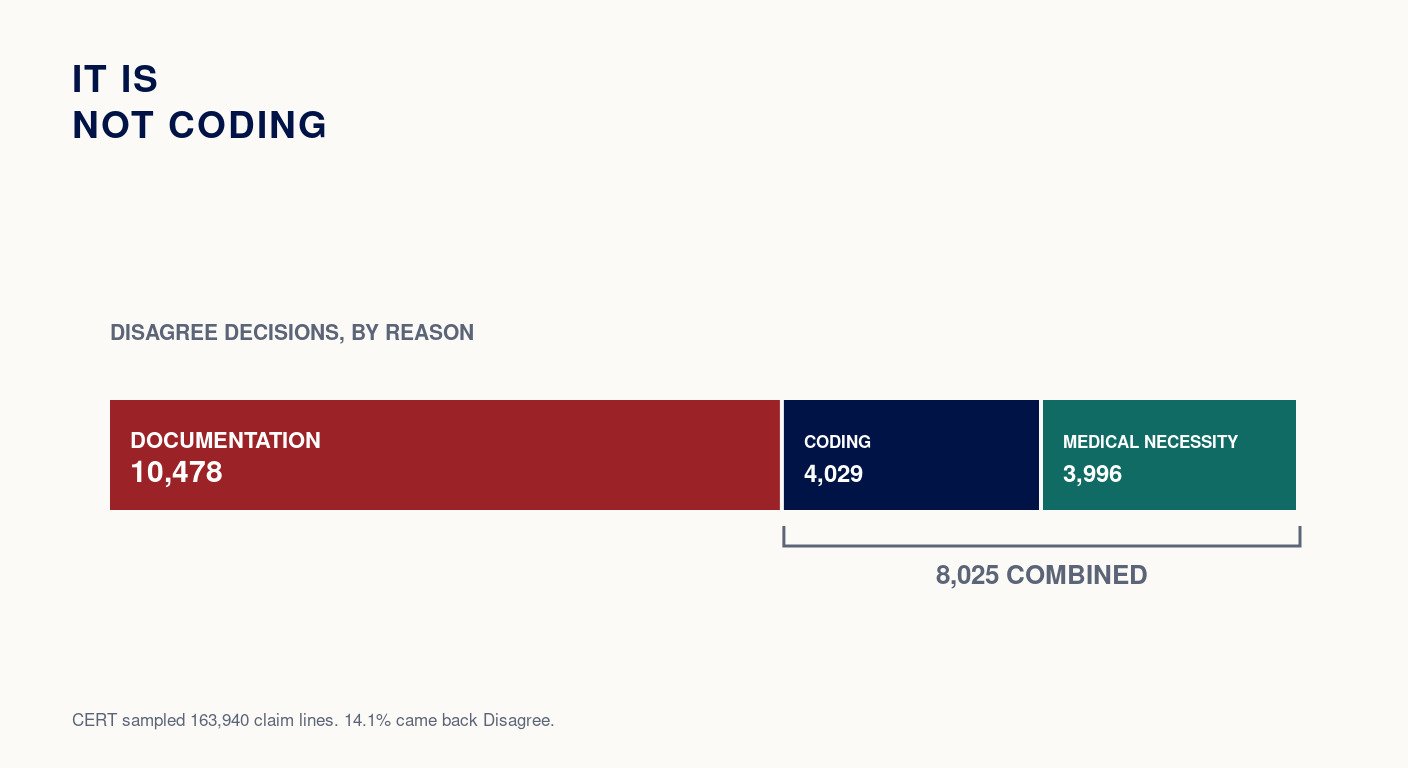
It is not coding.
Documentation Beats Coding and Medical Necessity Combined
| Error category | Claims | Share of all reviews |
|---|---|---|
| Insufficient documentation | 8,813 | 5.38% |
| Other | 4,616 | 2.82% |
| Incorrect coding | 4,029 | 2.46% |
| Medical necessity | 3,996 | 2.44% |
| Overturned | 3,362 | 2.05% |
| No documentation | 1,665 | 1.02% |
| No error code recorded | 137,459 | 83.85% |
Put the two documentation categories together and the picture is stark. Insufficient documentation plus no documentation is 10,478 claims. Incorrect coding plus medical necessity is 8,025.
The single largest reason a Medicare claim fails CERT review is that the record supporting it was incomplete or was never produced. Not that the code was wrong. Not that the service was unnecessary. That the paperwork did not carry the claim.
The 1,665 no-documentation claims deserve their own moment. Those are claims where the records were requested and nothing usable came back. The service may have been perfectly appropriate and perfectly coded; from the reviewer’s side it is indistinguishable from a service that never happened.
Overall: 85.9 Percent Agree
| Review decision | Claims | Share |
|---|---|---|
| Agree | 140,821 | 85.9% |
| Disagree | 23,119 | 14.1% |
Roughly one claim in seven drew a disagreement. That is a sampled review program, not a census, so this is the rate within the reviewed sample rather than a statement about all Medicare claims.
DME Carries the Highest Error Rate
| Part | Claims reviewed | With an error | Error rate |
|---|---|---|---|
| DME MAC | 19,346 | 4,134 | 21.37% |
| Part A, inpatient hospital | 8,750 | 1,762 | 20.14% |
| Part B | 24,912 | 4,630 | 18.59% |
| Part A, excluding inpatient | 110,932 | 15,955 | 14.38% |
DME leads, which will surprise nobody who has assembled a DMEPOS documentation package. Note also that Part A excluding inpatient carries two thirds of all reviews and the lowest error rate, so the aggregate figure is heavily weighted by it.
Provider Types: Where the Errors Concentrate
| Provider type | Errors | Reviewed | Rate |
|---|---|---|---|
| Skilled nursing facility | 4,676 | 14,522 | 32.2% |
| Clinical laboratory, billing independently | 1,319 | 4,757 | 27.7% |
| Inpatient rehabilitation hospital | 1,019 | 4,193 | 24.3% |
| Medical supply company | 1,790 | 8,767 | 20.4% |
| Home health agency | 2,307 | 14,394 | 16.0% |
| DRG short term | 1,474 | 8,541 | 17.3% |
| Pharmacy | 849 | 6,104 | 13.9% |
| Hospice | 1,707 | 16,070 | 10.6% |
| Outpatient, laboratory, ambulatory | 1,813 | 21,875 | 8.3% |
| ESRD | 1,073 | 27,930 | 3.8% |
Nearly a third of reviewed skilled nursing facility claims carried an error. At the other end, ESRD facilities were reviewed more heavily than anyone else, 27,930 claims, and carried the lowest rate at 3.8 percent.
The Codes That Fail Most Often
Two lists, because they answer different questions. First, by volume of errors.
| Code | What it is | Errors | Reviewed | Rate |
|---|---|---|---|---|
| G0299 | Direct skilled nursing services of an RN, home health or hospice setting | 891 | 6,921 | 12.9% |
| G0156 | Services of a home health or hospice aide | 762 | 5,975 | 12.8% |
| G0300 | Direct skilled nursing services of an LPN, home health or hospice setting | 524 | 2,750 | 19.1% |
| 90945 | CPT code | 343 | 436 | 78.7% |
| Q5001 | Hospice or home health care provided in the patient’s home or residence | 245 | 2,091 | 11.7% |
| G0151 | Services of a qualified physical therapist, home health or hospice setting | 202 | 1,745 | 11.6% |
| A4352 | Intermittent urinary catheter, coude (curved) tip | 194 | 471 | 41.2% |
Home health dominates the volume list. G0299, G0156, G0300, G0151 and Q5001 are all home-based services, and together they account for more than 2,600 errors.
Second, by rate, among codes reviewed at least 300 times:
| Code | Error rate | Errors of reviews |
|---|---|---|
| 90945 | 78.7% | 343 of 436 |
| 99233 | 41.4% | 203 of 490 |
| A4352 | 41.2% | 194 of 471 |
| J1644 | 23.9% | 84 of 352 |
| G0300 | 19.1% | 524 of 2,750 |
| G0496 | 19.0% | 85 of 448 |
| 81479 | 18.6% | 70 of 377 |
A code failing review nearly four times in five is worth knowing about if you bill it. That is not a coding difficulty; at that rate it points at a documentation requirement that is routinely not being met.
What This Changes About Where You Spend Effort
Most compliance attention goes to code selection, because that is what coders control and what audits are imagined to be about. The data says the exposure is elsewhere.
- Test whether you can actually produce records. 1,665 claims failed because nothing usable came back. Pick ten paid claims at random and try to assemble the complete package within the response window.
- Find out what the requirement is for your worst codes. If you bill something with a national error rate above 20 percent, the elements reviewers expect are the thing to go and read.
- Home health and SNF deserve disproportionate attention. Home-based service codes dominate error volume and SNF carries the highest provider type rate.
- Signatures, orders and certifications are the usual gaps. Insufficient documentation is rarely an absent note; it is a note missing a required element.
- Do not read your own rate off this file. It is a national sample and says nothing about any individual provider.
What This Dataset Cannot Tell You
- It does not identify providers. There is no NPI or facility name.
- It does not define its error categories. The file gives the label and nothing more.
- Overturned is ambiguous. It appears alongside the error categories but does not describe a claim defect, so it is excluded from the per-code and per-provider error counts above and shown separately in the category table.
- It is a sample. CERT reviews a sample designed to estimate a national rate, so a code reviewed 436 times is not a census of that code.
- It carries no dollars. Improper payment amounts are not in this file.
Common Questions
What is the most common CERT error?
Insufficient documentation, on 8,813 of 163,940 reviewed claims. With no documentation added, documentation problems total 10,478, more than incorrect coding and medical necessity combined at 8,025.
Which Medicare part has the highest error rate?
DME at 21.37 percent of reviewed claims, followed by Part A inpatient at 20.14 percent.
Which provider type fails most often?
Skilled nursing facilities, at 32.2 percent of reviewed claims.
Does CERT tell me my own error rate?
No. It is an anonymised national sample with no provider identifiers.
What does Overturned mean?
The file does not say. It is reported alongside the error categories, and because it does not describe a defect it is excluded from the error counts in this analysis.
Sources and Methodology
Every figure was produced by downloading the complete CMS Medicare Fee-for-Service Comprehensive Error Rate Testing public data file from data.cms.gov and counting all 163,940 records. A claim was treated as carrying an error where the error code field held a value other than the placeholder or Overturned. Rate figures are errors divided by reviews within the same group. Code-level tables apply a minimum review threshold, stated beneath each, so that a handful of reviews cannot produce a misleading rate. HCPCS Level II descriptions are quoted from the CMS HCPCS file, which is published free. CPT codes are identified by number only, because CPT descriptors are copyrighted by the American Medical Association and are not licensed for reproduction here. The CERT dataset itself is free and carries no license restriction.
Leave a Reply