
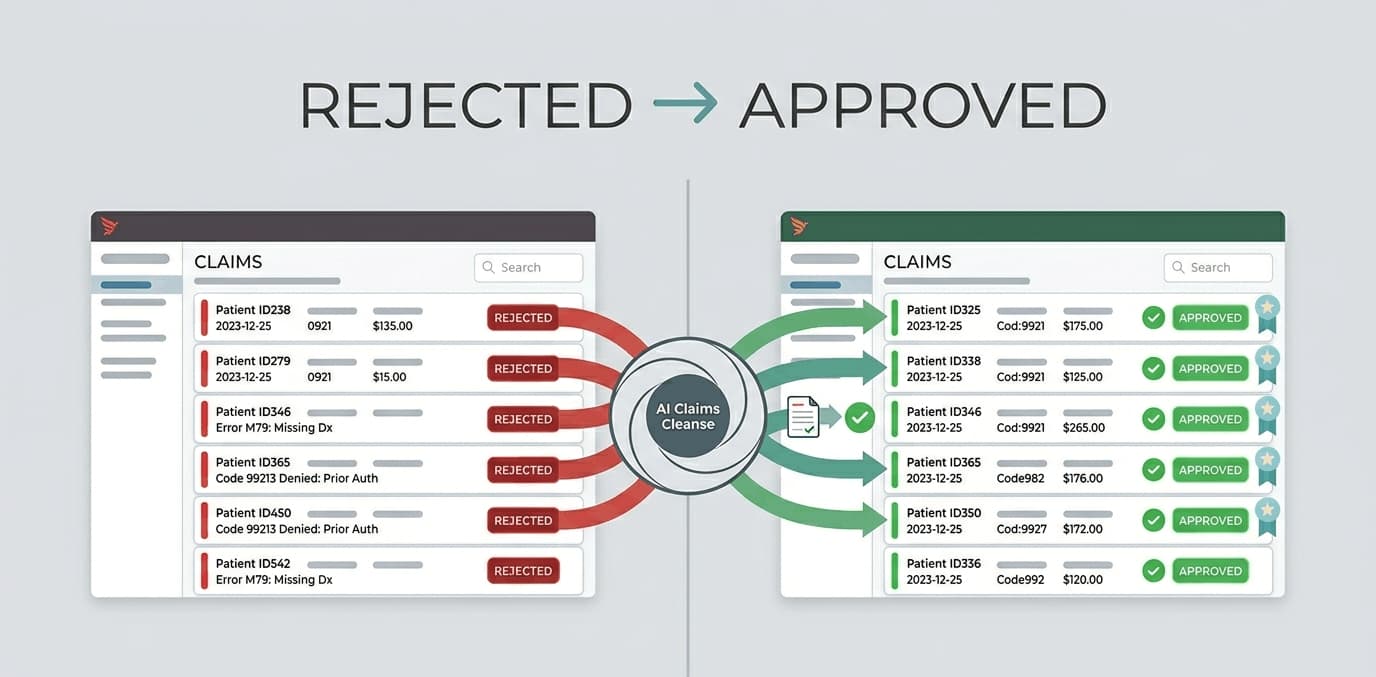


A claim that never reaches a payer earns nothing. Yet thousands of independent practices running AdvancedMD watch their rejection rates climb month after month, unsure whether the fault lies in their workflow, their staff, or the platform itself.
The answer is almost always all three.
A rejected claim has not been accepted for processing, so payment waits until the claim is corrected and resubmitted. Identifying where AdvancedMD rejections originate is the only path to eliminating them for good.
What causes a high AdvancedMD claim rejection rate?
A high AdvancedMD claim rejection rate is most commonly caused by inaccurate patient demographic data, invalid or outdated CPT and ICD-10-CM codes, missing prior authorization numbers, and eligibility verification failures. Coding errors and incomplete documentation are the leading denial drivers, and both are preventable upstream.
Every rejection traces back to a discrete failure point somewhere along the revenue cycle. In AdvancedMD, that failure almost always starts before the claim is ever submitted.
The platform’s integrated workflow connects scheduling, insurance eligibility, coding, and claim submission. When any one node breaks — a misspelled subscriber ID, a lapsed insurance plan, a mismatched rendering provider NPI — the claim never clears the clearinghouse. It returns as a rejection, not a denial. That distinction matters enormously, and we’ll address it directly below.
Practices with high staff turnover or undertrained billers are especially exposed. They miss payer-specific nuances: modifier requirements, coordination-of-benefits sequencing, and place-of-service codes. Each error seems trivial individually. Collectively, they produce a rejection rate that bleeds cash flow every day. The Advisory Board estimated that 90% of denied claims are preventable. Rejections are even easier to intercept — they don’t require an appeal. They require a corrected field and a resubmission.
How does AdvancedMD’s claims scrubbing feature actually work?
AdvancedMD’s Claims Scrubbing tool automatically reviews submitted claims against a database of over 119 million government and third-party edits — including CCI, HIPAA, and LCD edits — before clearinghouse transmission. Integrated with Optum’s rules engine, it guarantees a minimum 95% first-pass clean claim acceptance rate and generates prioritized worklists so billing staff can resolve flagged errors immediately within the same workflow screen.
AdvancedMD built its scrubbing engine directly into the practice management platform — no separate login, no manual file exports. When a biller finalizes a claim, the Claim Inspector runs automatically, flagging everything from invalid diagnosis codes to incomplete facility addresses.
The Optum integration is the platform’s most significant structural advantage. Most practice management systems maintain an internal rules engine that operates independently of the clearinghouse. AdvancedMD’s scrubber syncs directly with Optum — the clearinghouse that processes its claims — applying the same payer-rule logic used in clearinghouse validation. That alignment dramatically reduces structural rejections.
The breakdown occurs when practices under-configure those settings. Custom payer rules must be actively set and maintained. Annual CPT and ICD-10-CM updates must be applied on schedule. Neglect either, and the scrubber operates on stale data — producing the false confidence of a “reviewed” claim that still fails at transmission.
What is the difference between a claim rejection and a claim denial in AdvancedMD?
A claim rejection in AdvancedMD occurs before payer adjudication — the claim returns due to a structural or data error such as an invalid NPI, missing field, or formatting failure. A denial occurs after the payer adjudicates the claim and refuses payment. Rejections can be corrected and resubmitted immediately; denials require formal appeals and clinical documentation support.
This is the distinction most billing teams blur — and it costs them in strategy, not just money.
Rejections live on the clearinghouse side. They signal a technical failure: the claim never entered the payer’s adjudication queue. Correcting a rejection is fast — fix the error, resubmit, reset the clock. Data from BillingParadise indicates claims corrected and resubmitted within 48 hours carry a 98% payment success rate.
Denials are a different category entirely. The payer received the claim, processed it, and refused payment — citing medical necessity, a missing authorization, or coverage restrictions. Denials demand documentation packages, appeal letters, and clinical justification. They cost far more in staff time.
Confusing the two leads practices to manage rejections like denials, burning hours on problems requiring only a one-line data correction.
Why do clearinghouse rejection rates in AdvancedMD spike suddenly?
Clearinghouse rejection spikes in AdvancedMD typically result from three systemic triggers: payer rule updates not reflected in the practice’s custom edit configuration, January CPT and ICD-10 code set changes applied inconsistently across providers, and NPI or taxonomy mismatches introduced during provider roster changes. Secondary claim formatting failures and coordination-of-benefits sequencing errors also produce rapid, broad-based rejection waves.
Sudden spikes are the most alarming — and most diagnostic — events in a billing cycle.
When rejection rates jump sharply in a compressed window, the cause is systemic, not random. A payer silently updates its edits. A new provider joins the practice with an incorrectly entered taxonomy code. The January code update rolls out and no one patches AdvancedMD’s custom edit rules. Any of these triggers produces a wave of rejections across dozens or hundreds of claims at once.
The diagnostic is straightforward: pull a rejection summary report from AdvancedMD’s reporting module, filter by rejection reason code, and sort by payer. Patterns surface within minutes. A single reason code across 40 claims from the same payer points to a configuration gap — not a coder error. Treat it as a system problem, not a personnel issue.
How can practices fix a high AdvancedMD claim rejection rate?
To fix a high AdvancedMD claim rejection rate, practices should fully configure the Claims Scrubbing feature with payer-specific custom edits, enforce real-time eligibility verification at the scheduling stage, audit NPI and taxonomy entries for all providers, apply CPT and ICD-10 updates annually, and review clearinghouse rejection reason-code reports weekly to identify and resolve payer-specific error patterns before they compound.
The solution is rarely a single fix. It is a recalibrated workflow that closes failure points upstream before a claim leaves the practice.
Start with eligibility. AdvancedMD’s real-time insurance verification tool checks coverage at scheduling, not on the day of service. Running verification too late means billing against a lapsed or inaccurate plan. That one adjustment alone eliminates a significant share of demographic and coverage rejections.
Next, audit the Claims Scrubbing configuration. AdvancedMD allows practices to create custom payer edit rules within the system. Most practices use default settings and never revisit them. Default settings do not account for payer-specific modifier requirements or specialty-specific billing logic. Configuring those rules transforms the scrubber from a generic filter into a precision instrument.
Finally, build a weekly rejection review into the billing calendar. AdvancedMD’s standard reporting package delivers rejection trend data by payer, by provider, and by reason code. Weekly review — not quarterly — catches emerging problems before they mature into large AR backlogs.
Should AdvancedMD users outsource billing or fix claims internally?
Whether to outsource AdvancedMD billing depends on staff capacity, specialty complexity, and the severity and duration of the current rejection rate problem. Practices sustaining rejection rates above 10% for more than two consecutive billing cycles should seek external RCM support. The Healthcare Financial Management Association puts the industry average denial rate at 5% to 10%, with under 5% considered optimal. AdvancedMD-specialized billing firms close configuration gaps faster than internal retraining alone typically allows.
There is no universal answer — but there is a useful threshold.
When internal teams cannot drive the rejection rate below 5% despite process corrections, the problem usually lies in platform expertise, not effort. AdvancedMD rewards deep configuration knowledge. A biller unfamiliar with payer-specific edit rules or the clearinghouse reporting module loses ground steadily, regardless of hours invested.
For smaller practices, outsourced teams with AdvancedMD-specific credentials can implement denial management workflows, configure the rules engine correctly, and manage daily worklists — tasks that exceed a lean staff’s realistic bandwidth. For mid-size practices with dedicated billing departments, the right move is targeted AdvancedMD training investment. The platform’s learning curve is real. So are the productivity gains that follow from mastering it.
What KPIs should you track to keep your AdvancedMD rejection rate in check?
Practices using AdvancedMD should actively monitor five revenue cycle metrics: first-pass claim acceptance rate (target: 95% or higher), clean claim rate, rejection rate segmented by payer and reason code, days in accounts receivable (target: under 40 days), and denial-to-appeal success rate. AdvancedMD’s standard reporting package delivers all five in configurable reports schedulable on daily, weekly, or monthly intervals.
Metrics without a review cadence are inert data. Practices that sustain low rejection rates treat these five KPIs as operational signals, not accounting summaries reviewed at year-end.
First-pass acceptance rate is the most immediate diagnostic. AdvancedMD guarantees a minimum 95% first-pass rate when the scrubbing feature is properly configured. When that number drops, the system is flagging problems before the payer ever sees the claim.
Days in AR tells a separate story — it reflects what happens after submission, how long earned revenue sits uncollected. AdvancedMD’s own benchmark for managed billing clients is 40 days or fewer from submission to payment. Track rejection rate by payer independently. One consistently difficult payer can distort aggregate data and mask strong performance across the rest of the portfolio. Payer-level isolation enables surgical corrections rather than broad workflow overhauls that disrupt what’s already working.
A high AdvancedMD claim rejection rate is not a billing department failure. It is a system configuration gap that compounds over time.
The platform provides every tool a practice needs: a scrubber synchronized with Optum, real-time eligibility verification, customizable payer edit rules, and granular rejection reporting. Practices that deploy all of it — configured correctly, reviewed consistently — operate at the 95%-plus first-pass rate the platform was engineered to deliver.
Practices that don’t leave revenue at the clearinghouse every single day.
Leave a Reply