
 By Eman Zahra

What Is the Texas Medicaid Behavioral Health System Providers Must Navigate in 2026?
Texas Medicaid’s behavioral health system is administered by the Health and Human Services Commission (HHSC) through four managed care programs — STAR, STAR+PLUS, STAR Kids, and STAR Health — each contracting with private MCOs to process claims. Behavioral health providers do not bill a single payer. They bill plan-specific organizations governed by TMHP‘s overarching fee-for-service rules.
That structural reality is where most billing errors begin. A psychiatrist in Houston billing a STAR member through Superior HealthPlan operates under different authorization thresholds than the same psychiatrist billing a STAR+PLUS member through Molina Healthcare. The managed care layer isn’t cosmetic — it’s operationally decisive.
Texas Medicaid distinguishes between medical and behavioral health subcontractors, meaning that even within a single plan, behavioral claims may route to a third-party vendor for processing. This routing difference directly affects timely filing windows, denial logic, and appeal pathways. Providers who treat it as a minor technicality lose revenue. Medisysdata
Check the current Texas Medicaid Provider Procedures Manual (TMPPM) before relying on a billing rule, because TMHP updates the manual to incorporate policy changes. Because Medicaid billing guidance can change, providers should verify applicable requirements against the current TMPPM before submitting claims. Texas Medicaid Providers
What CPT Codes Does Texas Medicaid Reimburse for Behavioral Health in 2026?
Texas Medicaid covers core behavioral health CPT codes including 90791 and 90792 for psychiatric diagnostic evaluations, 90832 through 90837 for individual psychotherapy, 90846 and 90847 for family psychotherapy, 96130 (with add-on 96131) for psychological testing evaluation, and 96132 (with add-on 96133) for neuropsychological testing evaluation, with test administration and scoring (96136, add-on 96137) reported separately where applicable. Intensive outpatient programs bill under H0015; partial hospitalization programs use H0035. All codes require ICD-10-CM diagnosis alignment and appropriate provider taxonomy on the claim.
Texas Medicaid allows independently practicing LCSWs, LPCs, LMFTs, psychologists, and psychiatrists to bill directly for covered behavioral health services. The current TMPPM does not identify a Texas Medicaid fee-for-service billing pathway for LPC Associates or an ‘LMSW Associate’ category. The manual separately describes supervised billing, under the supervising psychologist’s NPI or the NPI of the entity employing that psychologist, for licensed psychological associates, provisionally licensed psychologists, post-doctoral psychology fellows, and pre-doctoral psychology interns. Verify Medicaid managed care requirements separately.
Billing eligibility, supervision requirements, and the provider’s NPI reported on each claim should be verified against the current TMPPM and applicable payer rules before submitting claims. Texas Medicaid conducts retrospective reviews, and missing required documentation can result in recoupment.
Add-on codes like 90833, 90836, and 90838 for psychotherapy combined with evaluation and management services require careful documentation of both the medical decision-making component and the psychotherapy time. TMHP and most Texas MCOs apply NCCI (National Correct Coding Initiative) edits to these claims. A code combination that a commercial payer accepts can still fail a TMHP claims edit.
How Does Prior Authorization Work for Texas Medicaid Behavioral Health Services in 2026?
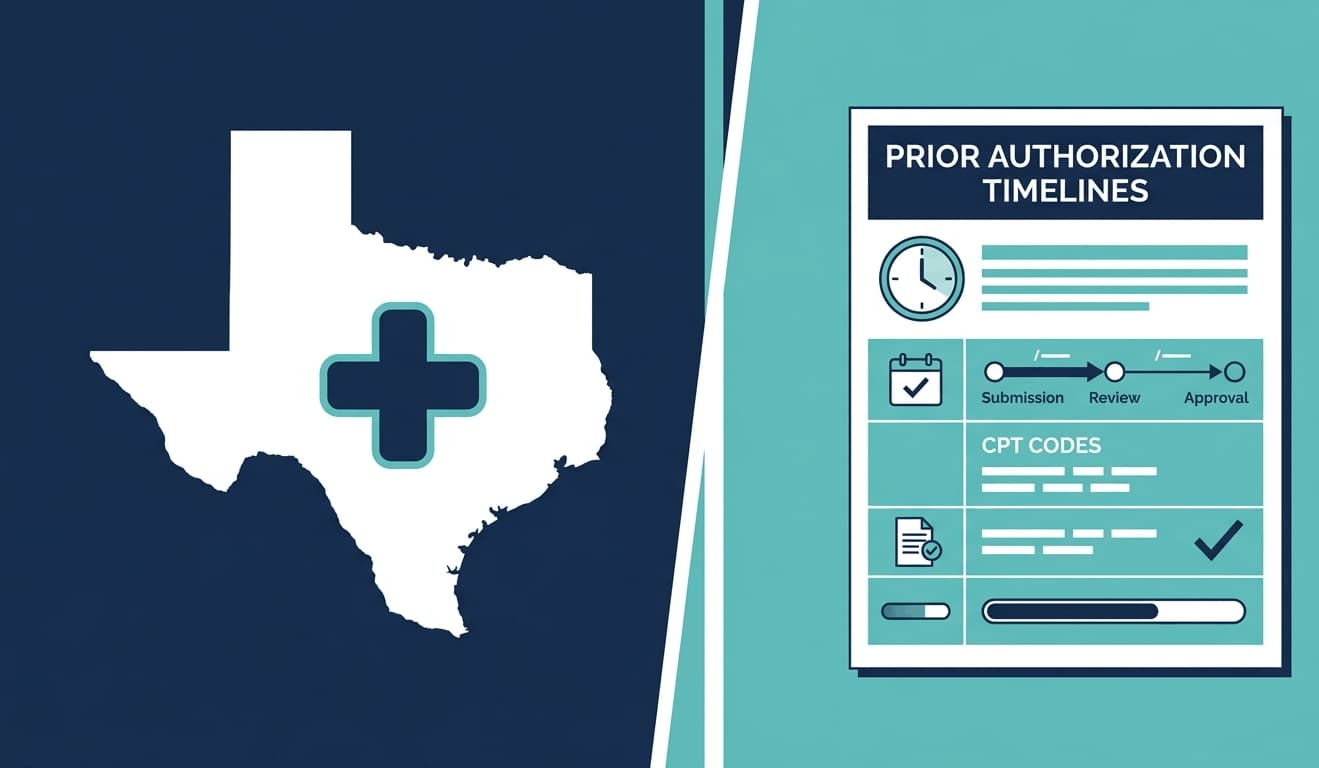
Under the federal CMS Interoperability and Prior Authorization Final Rule (CMS-0057-F), which applies to Medicaid managed care plans and state Medicaid fee-for-service programs beginning January 1, 2026, standard prior authorization decisions must be issued within 7 calendar days. Expedited requests — those where delay poses a serious risk to patient health, such as active suicidal ideation or acute psychosis — require a decision within 72 hours. These timeframes do not apply to prior authorization requests for drugs. Each MCO operates its own PA portal; providers must submit through the correct plan’s system using the Texas Standard Prior Authorization Request Form.
This 7-day standard and 72-hour expedited mandate represents a tightened compliance floor. If a delay might lead to serious harm, providers should label the request expedited and make the urgency explicit with clinical notes or risk assessments. The language in the request itself matters. State the clinical risk plainly and support it with documented evidence.
Texas Medicaid MCOs including Superior Health Plan, BCBS of Texas, and WellPoint each maintain their own prior authorization online portal. Filing in the wrong portal can delay the review process, and with it care, at a point where the patient may already be in crisis. The Medicators
Attach the treatment plan and the most recent progress note to the authorization request. When a payer or program requires a clinical severity measure, such as the PHQ-9 for depression, include the applicable measure and supporting documentation with the authorization request.
BCBSTX released prior authorization code updates for Medicaid effective April 1, 2026. Providers contracting with BCBSTX should audit their PA checklists immediately against the updated code set. Submitting under a code that no longer requires authorization wastes administrative time; submitting under a newly covered code without the required authorization can result in a claim denial. Blue Cross and Blue Shield of Texas
What Documentation Do Texas Medicaid Behavioral Health Claims Require?
Texas Medicaid behavioral health claims require a signed treatment plan, session-level progress notes documenting the presenting problem, interventions used, and the patient’s response, a valid ICD-10-CM diagnosis code matching the billed service, and evidence of medical necessity. Quantified severity measures such as PHQ-9 scores, or other measures the applicable payer and program require, strengthen medical necessity arguments and reduce audit risk.
BCBSTX announced behavioral health documentation reviews for Medicaid members in early 2026. Providers who cannot produce audit-ready documentation when requested may face recoupment. Blue Cross and Blue Shield of Texas
The HHSC’s Clinical Management for Behavioral Health Services (CMBHS) system maintains patient-level data for providers delivering certain state-funded behavioral health services. Aligning your clinical documentation with CMBHS reporting requirements is not optional for providers in those programs. CMBHS documentation may be relevant to audit and record-review requirements where applicable.
How Do Telehealth Rules Affect Texas Medicaid Behavioral Health Billing in 2026?
Texas Medicaid covers behavioral health telehealth services via synchronous video for most covered CPT codes. For fee-for-service claims, TMHP requires modifier 95 for outpatient mental health services delivered by synchronous audiovisual technology; MCOs may publish additional requirements. Under the Texas Medicaid Provider Procedures Manual behavioral health handbook, the listed psychological and neuropsychological testing codes (96130, 96131, 96132, 96133, 96136, and 96137) may be delivered by synchronous audiovisual technology when the manual’s conditions are met, including real-time observation of the person for the duration of the test and delivery in accordance with the provider’s licensing board and professional guidelines. Group psychotherapy (90853) is also on that synchronous audiovisual list. ABA evaluation and treatment services may be delivered by telehealth only through synchronous audiovisual technology, in accordance with the Medicaid Autism Services requirements; one-on-one direct services by behavior technicians or licensed assistant behavior analysts must be delivered in person.
For fee-for-service claims, covered behavioral health services delivered by synchronous telephone (audio-only) technology are billed with modifier FQ. Only the services the TMPPM lists for audio-only delivery qualify: psychiatric diagnostic evaluations (90791 and 90792), psychotherapy (90832, 90833, 90834, 90836, 90837, 90838, 90846, 90847, and 90853), and pharmacological management for psychiatric care. The person must have an existing clinical relationship with the billing provider, the reason for audio-only delivery must be documented in the medical record, and the billing provider must deliver at least one in-person or synchronous audiovisual service every rolling 12 months unless a TMPPM exception applies and is documented. MCOs may have additional requirements.
Which Billing Modifiers Apply to Texas Medicaid Telebehavioral Health Claims?
For Texas Medicaid behavioral health telehealth claims, modifier 95 signals synchronous telemedicine; modifier FQ signals synchronous telephone (audio-only) delivery of covered behavioral health services. Modifier HE is the HCPCS Level II modifier for mental health programs. Modifier U2 is a state-defined modifier that the Texas Medicaid Provider Procedures Manual specifies for Case Management for Children and Pregnant Women visits, paired with U5 — not as a general behavioral health telehealth modifier. Under the national place-of-service code set, POS 02 indicates telehealth when the patient is not at home, while POS 10 indicates telehealth when the patient is at home; confirm the POS code expected for the claim with the applicable Texas Medicaid or MCO billing guidance. Omitting or misapplying any of these modifiers can lead to preventable telehealth denials.
Modifier and POS errors can cause preventable telehealth denials. The fix isn’t complicated. Build a modifier matrix by payer — a simple spreadsheet mapping each MCO’s required modifier combinations for each CPT code. Update it quarterly. Modifier 95 is required by TMHP for synchronous audiovisual telehealth; requirements for HE, U2, and other state-defined modifiers vary by payer and program, so verify each MCO’s published requirements rather than assuming a common set. SiriussolutionsglobalMedStates
Texas Medicaid’s fee-for-service rules require an existing clinical relationship before covered audio-only behavioral health services. Check each MCO’s current telehealth policy for additional requirements before scheduling a patient’s first telehealth appointment.
What Causes the Most Claim Denials in Texas Medicaid Behavioral Health Billing?
The most common Texas Medicaid behavioral health claim denials in 2026 stem from incorrect or missing billing modifiers, submitting outside the timely filing window, insufficient medical necessity documentation, prior authorization not obtained or submitted through the wrong MCO portal, and billing under an NPI that does not meet the applicable provider enrollment and billing requirements.
Texas Medicaid claims must be received within 95 days of the date of service; the separate 120-day deadline applies to appeals and adjustment requests, measured from the disposition date on the R&S Report. MCO deadlines are set by contract, so confirm each plan’s published limit. That window sounds generous until a credentialing delay, a system transition, or a staffing gap compresses it. Track every claim’s original date of service, not the date of submission. The claim filing deadline runs from the service date.
How Should Behavioral Health Practices Protect Revenue Under 2026 Texas Medicaid Rules?
The operational answer is system-based, not effort-based. Build payer-specific PA tracking spreadsheets covering required forms, portal destinations, and average turnaround time for each MCO. Implement a denial categorization log that identifies patterns — not isolated incidents. Review provider enrollment, billing eligibility, and required documentation periodically against the current TMPPM and applicable payer rules. Verify modifier requirements directly with each MCO when billing new CPT codes.
The providers succeeding in this environment treat the TMPPM not as background compliance reading but as a living operational document. TMHP updates the manual monthly, and each release cycle can adjust billing rules, covered codes, or documentation standards. Subscribe to TMHP bulletins and HHSC managed care communications. The update that changes your reimbursement rate rarely arrives with a warning. Texas Medicaid Providers
For authoritative current requirements, consult the Texas Medicaid Provider Procedures Manual directly at TMHP.com — Texas Medicaid Provider Procedures Manual, the primary official source for all fee-for-service billing rules, behavioral health handbook chapters, and monthly policy updates administered by HHSC.
Texas Medicaid behavioral health billing in 2026 rewards practices that build systems, verify constantly, and treat every MCO as a distinct operational entity. The reimbursement is there. The documentation burden is high. Procedural requirements should be verified carefully before submission.
FAQs
HHSC is the single state Medicaid agency. TMHP (Texas Medicaid & Healthcare Partnership) administers fee-for-service claims. For managed care members, claims route through contracted MCOs — Superior HealthPlan, BCBSTX, Molina Healthcare, WellPoint, and UnitedHealthcare Community Plan — each with their own behavioral health subcontractors and portals.
The current TMPPM does not identify a fee-for-service billing pathway for LPC Associates or an ‘LMSW Associate’ category. It separately describes supervised billing, under a supervising psychologist’s NPI or the employing entity’s NPI, for licensed psychological associates, provisionally licensed psychologists, post-doctoral psychology fellows, and pre-doctoral psychology interns. Verify applicable Medicaid managed-care requirements separately before billing.
For Medicaid managed care plans and state Medicaid fee-for-service programs subject to CMS-0057-F, the rule establishes a 72-hour timeframe for expedited requests and 7 calendar days for standard requests beginning January 1, 2026. Drug prior authorizations are excluded from these specific CMS-0057-F requirements. Check the applicable program and payer guidance for the request being submitted.
Core covered codes include 90791–90792 (psychiatric diagnostic evaluations), 90832–90837 (individual psychotherapy), 90846–90847 (family psychotherapy), 96130 with add-on 96131 (psychological testing evaluation), 96132 with add-on 96133 (neuropsychological testing evaluation), 96136 with add-on 96137 (test administration and scoring), H0015 (IOP), and H0035 (PHP). Add-on codes 90833, 90836, and 90838 are covered when properly paired with E/M services and supported by documentation.
You need a signed treatment plan, session-level progress notes documenting the presenting problem, interventions, and patient response, and a valid ICD-10-CM diagnosis. When a payer or program requires a clinical severity measure, such as the PHQ-9, include the applicable measure and supporting documentation with the prior authorization request.
Leave a Reply