
 By Eman Zahra
Telehealth billing was supposed to get easier. After the pandemic-era regulatory flexibilities normalized virtual care, the industry expected a cleanup — standardized rules, consistent payer policies, predictable reimbursement. In 2026, that hasn’t happened.
Instead, telehealth billing remains one of the most error-prone and payer-inconsistent categories in all of medical billing. The providers who get it right are capturing significant revenue. The ones who get it wrong are generating denials, underpayments, and compliance risk — often without realizing it.
Why Is Telehealth Billing So Complicated in 2026?
Telehealth billing is complicated in 2026 because reimbursement rules vary significantly by payer, service type, patient location, provider location, and originating site — with no universal standard across Medicare, Medicaid, and commercial insurance, creating a matrix of requirements that even experienced billers struggle to navigate.
What Are the Most Common Telehealth Billing Mistakes?
The most common telehealth billing mistakes are using the wrong place-of-service code, omitting required modifiers (particularly GT, 95, or FQ/FR), billing non-covered telehealth services, and failing to document patient location at the time of service.
Place-of-service codes
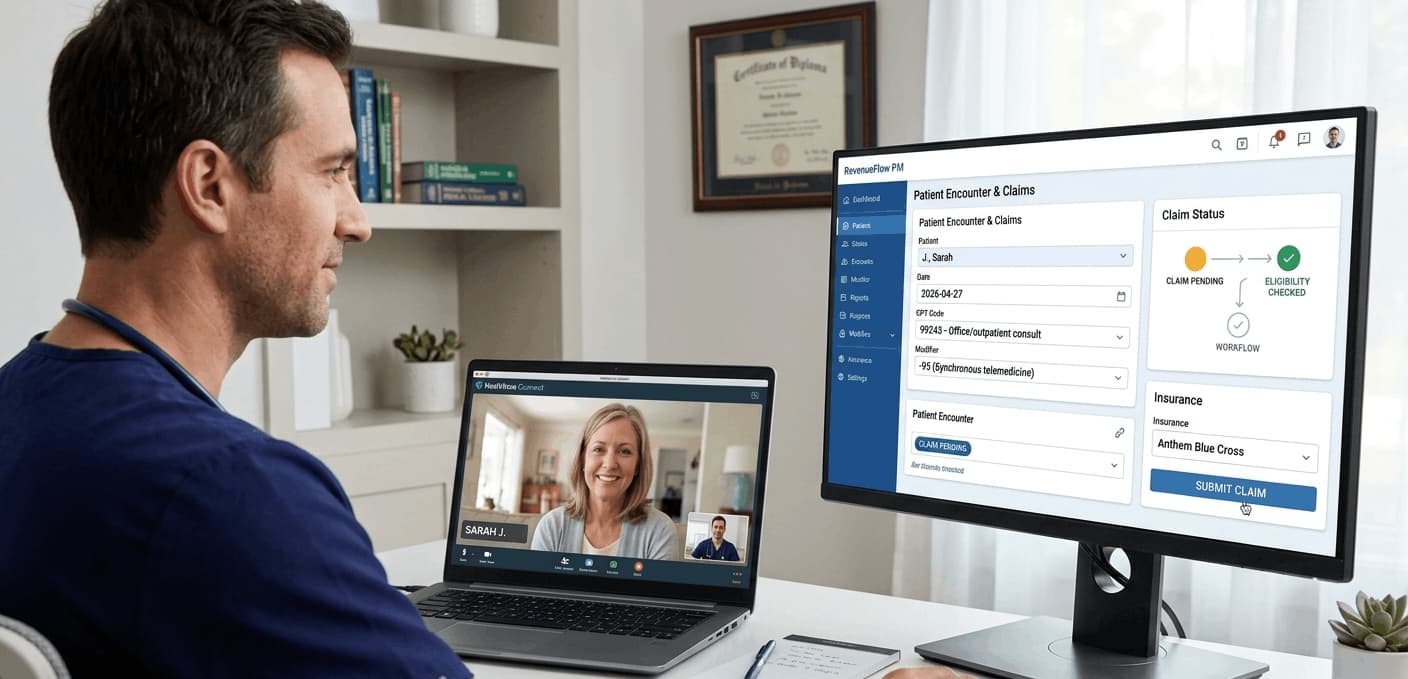
The most frequent single error. Billing POS 11 (office) for audio-video requires modifier 95. Audio-only visits require POS 02 with modifier FQ. Errors result in systematic, across-the-board underpayment — because the wrong POS changes the reimbursement rate, not just approval status.
Documentation of patient location
A payer audit trigger. Providers must document where the patient was physically located at the time of the virtual visit. For Medicare, patients must still be in an eligible geographic area for many services — catching practices off guard when patients cross state lines.
How Does Medicare Reimburse Telehealth Services in 2026?
Medicare in 2026 continues to reimburse a broad set of telehealth services following Consolidated Appropriations Act extensions, with most pandemic-era flexibilities now permanently incorporated — but specific modifier and place-of-service requirements still apply and vary by service type.
For mental health services, an in-person visit within six months of the first telehealth visit is still required — a rule that catches behavioral health practices regularly. Congress has extended the ability for Medicare beneficiaries to receive telehealth from their homes without geographic restriction.
Do Commercial Payers Reimburse Telehealth the Same as Medicare?
No — commercial payers reimburse telehealth with significant variation, including different covered service lists, different modifier requirements, different audio-only policies, and in some cases, different reimbursement rates for the same service.
Parity laws requiring commercial payers to reimburse telehealth at the same rate as in-person care now exist in 43 states — but their enforcement and scope vary. Knowing your state’s specific parity law is essential before billing telehealth services to commercial payers.
What Documentation Is Required for Telehealth Claims?
Telehealth claims require documentation of the patient’s consent to receive telehealth services, the patient’s location at the time of the visit, the technology platform used, and a clinical note that meets the same medical necessity standards as an equivalent in-person visit.
This documentation isn’t just a billing requirement — it’s an audit defense. Payers auditing telehealth claims specifically look for patient location and consent documentation. Missing either is grounds for recoupment, even if the service was medically appropriate and clinically well-documented.
Frequently Asked Questions
Q: Can I bill telehealth services using modifier 25 for a separate E/M?
A: Yes, but the same documentation rules apply as for in-person visits. If a separately identifiable E/M service was provided during a telehealth visit that also included a procedure, modifier 25 is appropriate with complete supporting documentation.
Q: What is the difference between synchronous and asynchronous telehealth billing?
A: Synchronous telehealth is real-time audio-video interaction — the standard for most billing. Asynchronous (store-and-forward) involves transmitting recorded information for later review and is reimbursable only by a limited number of payers.
Q: Are audio-only visits reimbursable by Medicare?
A: Yes — Medicare reimburses certain audio-only visits under specific CPT codes with modifier FQ appended. Not all services are eligible, and documentation must clearly note that audio-video was not available to the patient.Sources: CMS Telehealth Policy 2026, Consolidated Appropriations Act, AAA Medical Billing, AMA Telehealth Resources.
Leave a Reply