
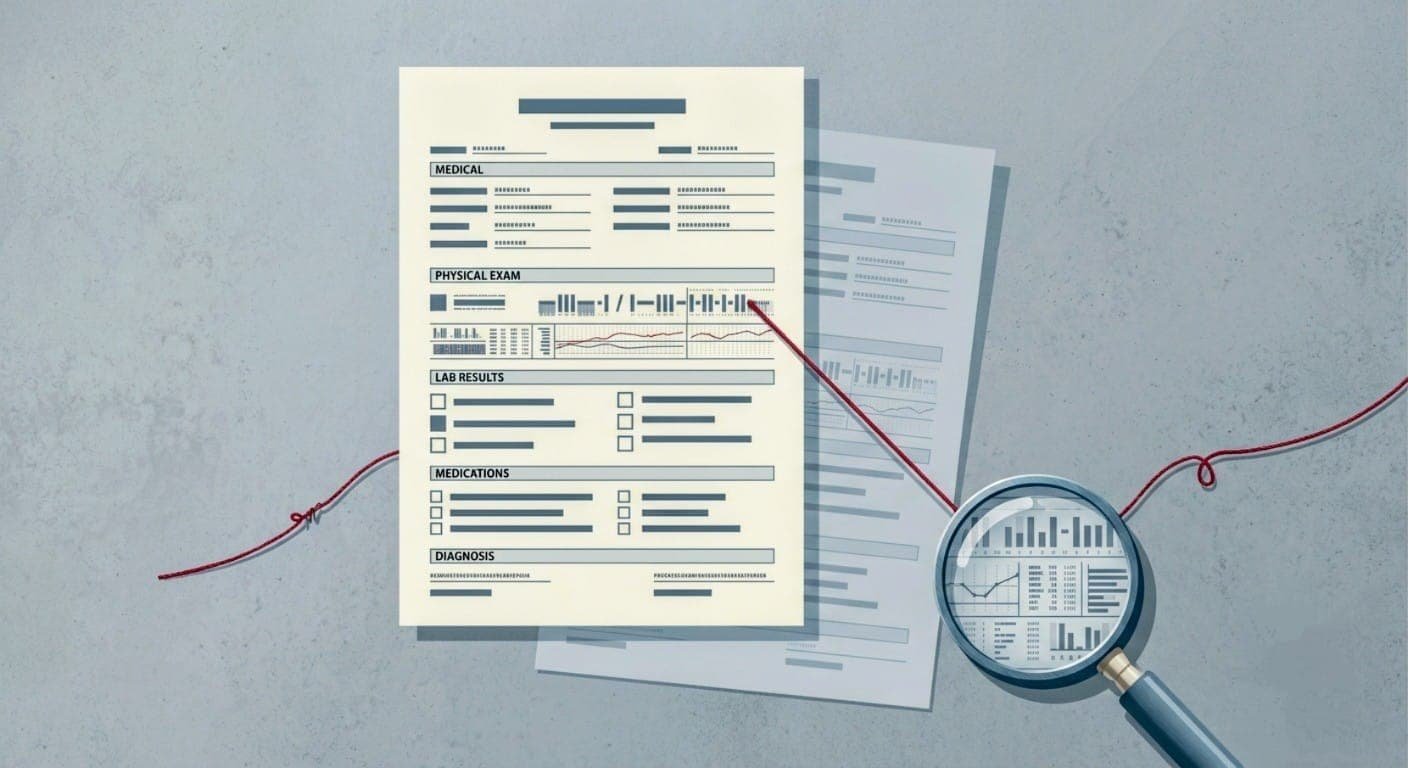


Cloned notes used to mean one physician cutting and pasting a paragraph. In 2026, it means something bigger: templates, macros, and AI scribes all producing text that looks complete but proves nothing. Auditors know the difference. Most practices still don’t.
What Counts as a Cloned Note Under CMS Rules?
CMS defines cloned documentation as multiple entries in a patient’s record that are identical or nearly identical to other entries in that record or another patient’s record. The term covers copy-forward text, saved templates, and auto-populated fields. Intent doesn’t matter. Structure does.
That definition matters because it’s broad by design. A note doesn’t need to be word-for-word stolen from another patient to qualify. It only needs to repeat prior content without reflecting what actually happened at this visit. A physician who copies yesterday’s assessment and changes one lab value has technically cloned the record, even if nothing was falsified on purpose.
This is where most compliance training falls short. Staff hear “don’t copy and paste” as a blanket rule, but the real standard is narrower and more useful: information can be reused, but every section must be updated to reflect the current encounter. CMS’s own fact sheet on EHR documentation integrity walks through exactly which features create risk and which don’t.
Why Do Cloned Notes Trigger a False Claims Act Investigation?
A cloned note undermines medical necessity, the core requirement for any billed service. When two encounters show identical documentation, the claim can’t prove that unique, patient-specific care occurred at each visit. That gap is what turns a documentation habit into a federal fraud exposure.
The False Claims Act doesn’t require proof of intentional fraud. Reckless disregard for accuracy is enough to create liability, and prosecutors have used prior enforcement actions as evidence of materiality in later cases. A cardiology group’s 2022 voluntary self-disclosure over cloned progress notes and inflated E/M coding remains a frequently cited example in healthcare fraud litigation analysis, because it shows how quickly a documentation shortcut becomes a whistleblower case.
Self-disclosure carries real financial consequences, but it’s often cheaper than what follows a government-initiated investigation. Practices that catch cloning internally and correct it, rather than waiting for a payer to flag it, generally fare better in penalty negotiations.
How Common Is Copy-Paste Documentation Really?
Copy-paste isn’t a fringe practice. Research on inpatient and outpatient progress notes has found that more than half the text in a typical note is duplicated from prior entries, and one widely cited study found only 18 percent of note content was newly authored by the clinician at the time of the visit.
Those numbers explain why auditors no longer treat cloning as an isolated red flag. It’s the default behavior of most EHR systems unless a practice actively fights it. Templates reward speed. Auditors reward specificity. Those two incentives point in opposite directions, and most practices haven’t resolved the tension. The free Audit Guard risk checker covers the documentation signals auditors weigh most heavily.
An older but still-relevant OIG review of hospital EHR practices found that only about one-quarter of surveyed hospitals had a written policy governing copy-and-paste use at all. Roughly half reported they couldn’t even restrict or disable the copy-paste function in their own software. If a hospital system doesn’t know how its own EHR behaves, an auditor is happy to find out for them.
The same review found that a majority of hospitals simply pushed accuracy responsibility onto the individual clinician entering the note, with no system-level check behind that expectation. That gap between policy and practice is exactly what surfaces during a CERT or RAC review. An auditor doesn’t need to prove intent to falsify a record. Finding the same paragraph repeated across six visits, with no updated vitals or interval findings, is often enough to open a broader sample pull. AAPC’s coding guidance on cloned documentation notes that payers actively scan for these contradictions rather than waiting for a complaint to trigger review.
What Makes AI Scribe Notes a New Version of the Same Problem?
Ambient AI scribes generate documentation from a recorded conversation, but the output often reads like a template: exhaustive, uniform, and generic across patients. Auditors increasingly flag this pattern the same way they flag manual cloning, because uniform language across encounters still fails to prove individualized care.
For a deeper look at how this plays out in practice, see our companion piece on ambient AI scribes and the new cloning problem.
The efficiency gains are smaller than marketed, too. A large multi-center study found ambient AI scribes saved clinicians roughly 16 minutes of documentation time across an eight-hour shift, a modest return given the new review burden they create. Physicians remain legally responsible for every word an AI tool generates under their signature, which means the “captain of the ship” standard now applies to machine-authored text as much as human-typed text.
CMS finalized new rules on AI-assisted documentation in 2026, and several states have layered on additional consent and privacy requirements for ambient listening tools. A practice that adopts an AI scribe without updating its documentation policy hasn’t reduced cloning risk. It’s just changed who wrote the boilerplate.
Courts and defense attorneys are also raising the bar on what counts as proof of physician review. A single “I reviewed this note” attestation click, with no record of which sections were checked or when, increasingly reads as insufficient in liability proceedings. Practices relying on AI scribes should push vendors for section-level audit trails, not just a document-level sign-off, because that granularity is what separates a defensible record from a note nobody can vouch for after the fact.
What Should a Practice Do to Reduce Cloned-Note Exposure?
The fix isn’t banning copy-paste. It’s requiring that every carried-forward section be reviewed, dated, and updated to reflect the current visit, with the EHR’s audit log configured to record how each entry was created. A written policy, consistently enforced, is the single control auditors ask for first.
Our copy-paste documentation policy guide walks through the template and audit-log settings in more detail.
Three actions matter most in practice. First, require a new assessment and interval history at every visit, even when the underlying condition hasn’t changed. Second, enable audit-log tracking that distinguishes typed entries from copied or AI-generated ones, so a reviewer can reconstruct exactly what happened. Third, run internal mock audits against real payer and CERT criteria before a federal or commercial auditor does it first.
None of this requires slower documentation. It requires documentation that can stand on its own outside the practice, in front of a reviewer who has never met the patient. That’s the actual test auditors apply, and it’s a different test than “did the note get finished.”
What Does This Mean for Practices Heading Into 2026 Audits?
Cloned documentation sits at the intersection of three enforcement priorities right now: traditional Medicare E/M audits, the new OIG Medicare Advantage compliance guidance issued in February 2026, and emerging scrutiny of AI-generated notes. A practice that only addresses one of these fronts is still exposed on the other two.
See how this connects to current enforcement targets in our Modifier 25 audit guide.
Revenue cycle teams should treat documentation review as a continuous function, not a pre-audit scramble. The practices that come through an audit clean aren’t the ones with the most documentation. They’re the ones whose documentation actually reflects what happened, visit by visit, without shortcuts that flatten every encounter into the same note.
Compliance officers who wait for a payer letter to start this work are already behind. Building the review cadence now, before an ADR or CERT sample lands on a desk, is what turns cloned-note exposure from a live liability into a closed finding. The documentation itself rarely needs to get longer. It needs to prove, encounter by encounter, that someone was actually paying attention.
Leave a Reply