


What Is the QPA in 2026 Physician Billing?
The Qualifying Payment Amount is a health plan’s median contracted rate for a given service, frozen at 2019 levels and adjusted annually for inflation. For 2026, the IRS indexing factor is 1.0265311701, applied to prior-year contracted rates under Notice 2025-65.
Every out-of-network claim that falls under the No Surprises Act now runs through this single number. It sets the patient’s cost-sharing floor. It anchors the opening offer in arbitration. And in 2026, it does both jobs while sitting at the center of a legal fight that still isn’t resolved.
Practice managers who treat the QPA as a fixed data point are already behind. It’s a moving benchmark, recalculated every plan year, and every recalculation carries downstream billing consequences your front desk feels before your CFO does.
What Does the QPA Actually Represent on a Claim?
Strip away the acronym and the Qualifying Payment Amount is a stand-in. When a patient is treated by a provider their health plan has no contract with, there is no negotiated rate to work from, so federal law supplies a substitute. CMS describes it as the plan’s median contracted rate for the same or similar service in that geographic area on January 31, 2019, indexed for inflation. It is, in effect, an estimate of what the service would have been worth had the provider been in network in 2019, carried forward to the current year.
That framing explains how the number behaves once it reaches your billing team. It is not the billed charge. It is not an allowed amount in the usual sense, because no contract produced it. And it is not a promise of payment — it is the reference point the plan, the provider and the arbitrator all argue from.
It also reaches a narrower slice of claims than most billing staff assume. The No Surprises Act protections cover emergency care, non-emergency care delivered by out-of-network providers at in-network facilities, and air ambulance services furnished by out-of-network providers. A routine out-of-network office visit the patient chose to schedule falls outside that boundary, and no QPA attaches to it.
One qualifier is worth holding onto before you explain a balance to a patient. The QPA is not automatically the basis for what that patient owes. CMS sets an order of precedence: cost sharing is calculated from a state All-Payer Model Agreement, or from specified state law, and only if neither of those applies does the QPA govern. Practices operating in states with their own surprise-billing statutes should confirm which rule controls before quoting a figure.
How Does CMS Calculate the QPA Benchmark Each Year?
CMS requires plans to start with contracted rates in effect on January 31, 2019, then apply the annual CPI-U adjustment. A plan needs at least three contracted rates for the same or similar service in the same geographic market to produce a statistically valid median.
That geographic market matters more than most billing teams realize. Primary rules split each state into MSA-based regions plus one catch-all region for everything outside an MSA. A practice in a rural catch-all region can see a materially different QPA than a practice thirty miles away inside a metro boundary, for the identical CPT code.
Plans must also exclude bonuses, incentive payments, and other non-fee-for-service adjustments from the contracted rate before calculating the median. That exclusion rule didn’t exist in the original 2021 methodology. It exists now because litigation forced it.
For bundled or partially capitated arrangements, CMS applies a separate conversion methodology rather than a straight median, since there’s no clean per-service contracted rate to sample. Anesthesia and air ambulance services carry their own special rules too. A billing team that applies the standard median methodology to any of these three categories will produce a QPA that doesn’t match what the payer’s own actuarial file says, and that mismatch is exactly what a well-prepared open negotiation letter should surface.
Why Are TMA Lawsuits Still Reshaping QPA Methodology?
The Texas Medical Association has challenged QPA calculation methodology through four separate federal lawsuits. The Fifth Circuit granted an en banc rehearing in TMA III on May 30, 2025, so the district court’s August 2023 ruling still binds federal agencies today.
Because the en banc decision hasn’t landed, the Departments of Labor, Treasury, and HHS have kept extending enforcement discretion in six-month increments since October 2023. Plans may still rely on QPAs calculated under a good-faith, reasonable reading of the current rules, even where the underlying methodology remains legally contested.
That discretion window is not indefinite. The Departments stated they don’t currently expect relief to extend past August 1, 2026, though they’ve said the same thing before and then extended it again. Billing teams tracking QPA disputes need to watch for a revised FAQ release, not just a court date.
This uncertainty has a direct revenue cycle cost. A QPA calculated under a methodology later found noncompliant can trigger retroactive recalculation, and retroactive recalculation means reworking every affected cost-share determination and IDR filing tied to that rate.
What Changed Under the May 2026 Federal IDR Operations Final Rule?
CMS finalized CMS-9897-F on May 28, 2026, effective August 3, 2026. The rule cuts the federal IDR administrative fee from $115 to $15 per party for disputes filed on or after June 11, 2026, and requires payers to communicate using standardized CARCs and RARCs under the ASC X12 835 transaction standard.
The volume problem driving this rule is staggering. Disputing parties filed 489,000 cases in the program’s first year against an expected volume CMS never anticipated, and cumulative filings passed 5.1 million by January 31, 2026. Emergency department claims account for 88.4% of disputes reaching arbitration, concentrated among a small number of staffing-company billing entities.
The final rule requires payers to disclose more detail about how a QPA was calculated at the same moment they issue an initial payment or denial. It formalizes the 30-business-day open negotiation period inside a new IDR portal, with a mandatory response from the receiving party by day 15. It also raises the batching cap to 50 line items per dispute, up from the 25-item limit CMS originally proposed.
What the rule does not do matters just as much. It leaves the underlying QPA calculation methodology untouched. Payer identification and communication got faster. The number at the center of every dispute is still governed by the same contested formula.
How Does the QPA Affect Patient Cost-Sharing on Surprise Bills?
Under the No Surprises Act, patient cost-sharing for a covered out-of-network claim is based on the lesser of billed charges or the QPA, and that figure locks in before the plan finalizes payment. A $200 QPA with 20% coinsurance caps the patient’s exposure at $40, regardless of what the provider eventually collects through negotiation or arbitration.
That structure creates an information gap your billing staff has to close manually. Plans must supply the QPA and a compliance certification with the initial payment or denial, but front-desk teams rarely see that documentation before the patient asks why their bill looks smaller than the visit felt.
Practices that build a standing QPA-disclosure request into their initial claim workflow catch discrepancies before they become collection headaches. Waiting for the patient to raise the question means you’re reconciling after the account is already past due.
What Financial and Compliance Risks Come From an Inaccurate QPA?
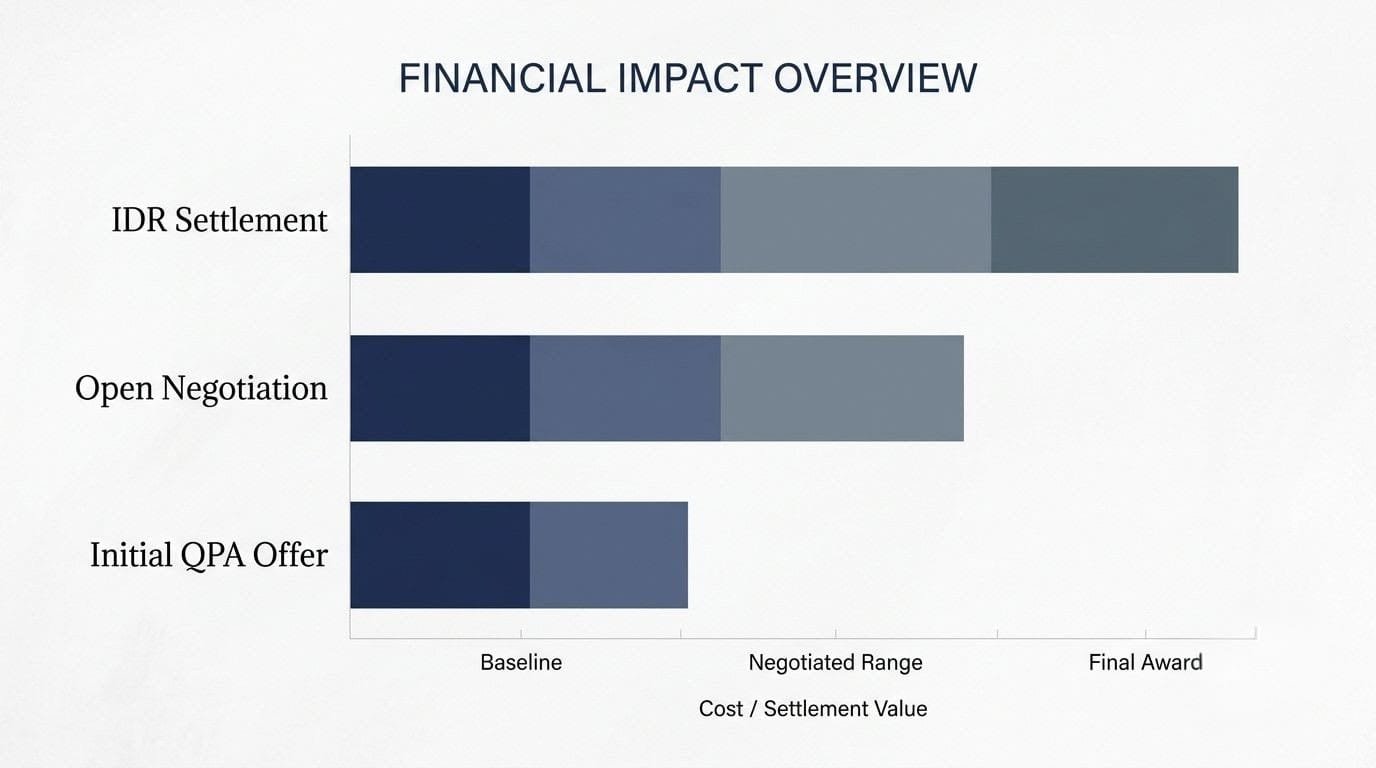
Peer-reviewed arbitration outcomes data analyzing Elevance Health disputes found providers won 80.1% of arbitrated cases, with settlements averaging two to three times the QPA and four to six times Medicare fee-for-service rates. That gap is the clearest evidence yet that initial QPA-based payments often undershoot fair market value.
Accepting an artificially low QPA as final payment, without contesting it through open negotiation, is quiet revenue leakage. Multiply a modest per-claim shortfall across a full emergency medicine or anesthesia panel and the annual gap becomes a budget line, not a rounding error.
There’s a compliance dimension too. A practice that routinely bills patients based on a QPA it never verified, while payer audit obligations under the No Surprises Act require CMS to review QPA methodology, is trusting a number it hasn’t tested. That’s a thin foundation for defending a cost-sharing determination if a state regulator or the OIG comes asking.
The staffing-company concentration data cuts both ways for compliance teams. Six billing entities account for more than half of all federal IDR disputes, which tells you arbitration favors organizations with dedicated dispute-management infrastructure. A solo practice or small group without that infrastructure is more likely to accept a low initial QPA simply because pursuing IDR looks costlier than it actually is under the new $15 fee structure.
How Should Practices Prepare for the August 2026 IDR Rule Changes?
Start by auditing every out-of-network claim workflow against the new CARC/RARC disclosure requirement before the August 3, 2026 effective date. Your clearinghouse mapping needs to recognize the new codes on day one, not after the first batch of rejected eligibility determinations.
Second, build a QPA-verification checkpoint into every surprise-billing claim, not just the ones that look disputable on their face. Given that settlements average two to three times the initial QPA, the disputes worth pursuing are frequently the ones nobody flagged as unusual.
Third, register early for the IDR Gateway as it rolls out through 2026, and route batching decisions through someone who understands the new 50-item cap. Practices that treat this rule as an administrative footnote will spend 2027 relearning it the hard way, one denied dispute at a time.
Leave a Reply