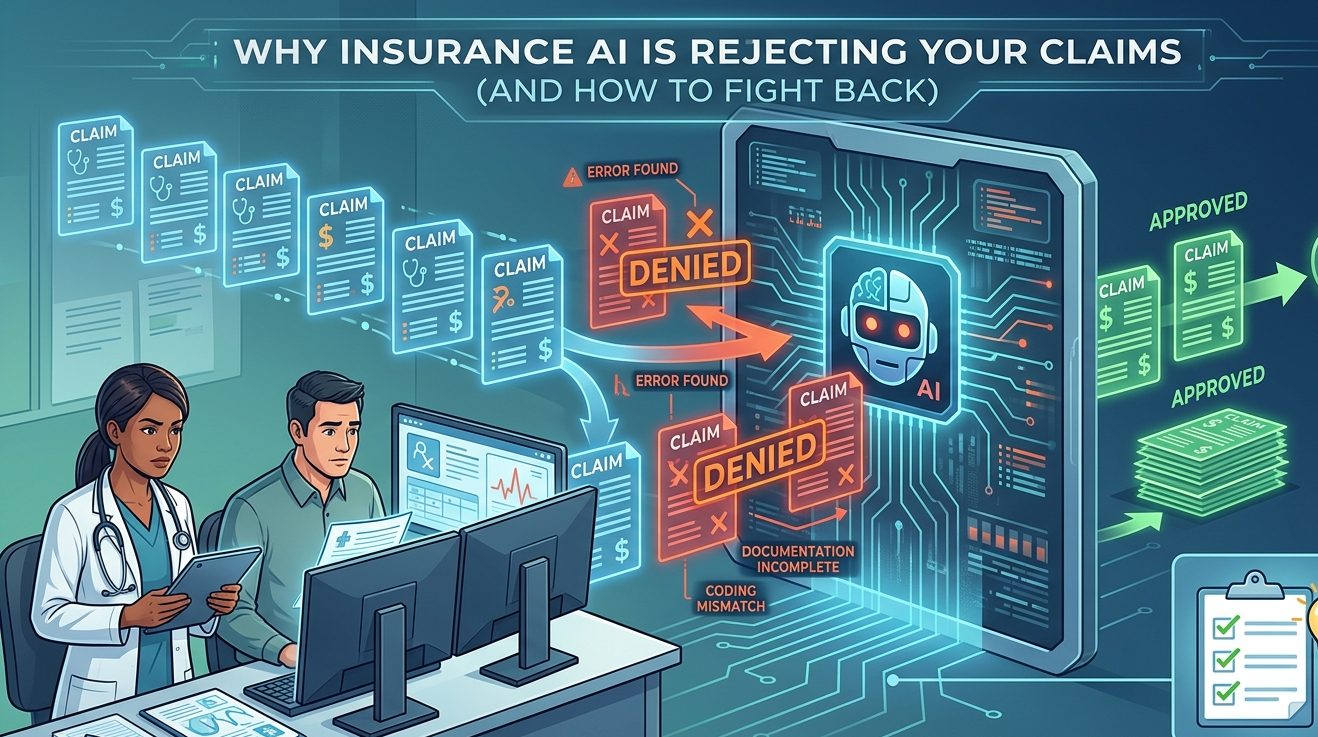
I’ve spent years inside the medical billing world. I’ve watched payers evolve from slow, paper-heavy adjudicators into sophisticated algorithmic machines — and in 2026, that shift has reached a breaking point that every practice, biller, and patient needs to understand.
Insurance companies are no longer staffing claims departments the way they once did. They’re deploying AI.
And that AI is denying claims at a scale that would have seemed impossible five years ago.
What Is AI-Driven Claim Denial — and Why Should You Care?
AI-driven claim denial is when an automated algorithm — not a human reviewer — evaluates and rejects a medical claim, often within seconds and without clinical context.
According to a 2024–2025 NAIC survey, 84% of U.S. health insurers now use AI for sensitive processes including prior authorization and fraud detection. UnitedHealthcare currently carries a 33% claim denial rate. Cigna, Aetna, and Anthem follow closely, with denial rates between 17% and 30% depending on region and plan type. These aren’t rounding errors. They represent millions of patients and billions in revenue being withheld.
How Does Insurance AI Actually Decide to Deny a Claim?
Insurance AI denies claims by scanning for pattern mismatches — coding errors, documentation gaps, or statistical outliers — and rejecting anything that falls outside its training data, regardless of clinical merit.
These systems don’t read. They match. The AI looks at your CPT codes, ICD-10 diagnoses, date of service, provider NPI, and modifier sequence, then compares them against a model built on historical approval/denial patterns. If your claim doesn’t fit the pattern, it gets flagged — or outright rejected — before a single human sees it.
Common AI denial triggers include:
- Missing or mismatched modifiers
- Diagnosis codes that don’t “link” to the billed procedure in the algorithm’s model
- Prior authorization numbers entered incorrectly or missing entirely
- Documentation that doesn’t match the clinical language the AI is trained to recognize
- Bundling flags — where separately billed codes are collapsed and denied
The deeper problem, as Stanford researchers warned in a January 2026 Health Affairs study, is that many insurers lack strong governance processes to catch when their AI makes mistakes. There is virtually no public data on whether AI-driven denials produce better or worse patient outcomes than human review.
Which Insurance Companies Use AI Most Aggressively for Denials?
The major commercial payers — UnitedHealthcare, Cigna, and Aetna — lead AI deployment in claims adjudication, with UnitedHealthcare reporting the highest overall denial rate at 33%.
Tenet Healthcare publicly alleged that Cigna was denying claims without human review in a 2025 contract dispute — the first time AI denial practices became a direct point of contention between a major health system and a large insurer. Cigna disputed the claim, but the lawsuit brought national attention to how opaque these systems are.
Medicare Advantage plans processed 53 million prior authorization requests in 2024, resulting in 4.1 million denials, according to KFF. Traditional Medicare, by contrast, generated only 143,705 denials from 625,000 reviews during the same period.
What Are the Most Common Reasons AI Rejects Medical Claims?
The most common AI-driven denial reasons are medical necessity flags, prior authorization failures, coding mismatches, and documentation gaps — each addressable with the right preparation.
Here’s what billers see most often on the front line:
Medical necessity denials — The AI determines the procedure isn’t clinically justified based on the submitted diagnosis. This often happens when documentation uses general or non-specific ICD-10 codes instead of granular, condition-specific codes that the algorithm’s training data associates with the billed service.
Prior authorization failures — Either the auth wasn’t obtained, the auth number wasn’t attached, or the service billed doesn’t exactly match what was authorized. AI systems cross-reference these with zero tolerance for variance.
Bundling and unbundling errors — AI adjudication engines apply NCCI edits automatically. Separately billing services that the payer’s algorithm considers inclusive to another code triggers an immediate denial.
Timely filing — Automated systems enforce filing windows strictly. A claim submitted one day late is denied. There’s no human to call.
Coordination of benefits (COB) issues — When primary/secondary payer data is incomplete or outdated, AI flags it as a billing error rather than requesting clarification.
How Does AI Denial Affect Medical Billing Revenue Cycles?
AI-powered denials create compounding revenue cycle damage — delayed reimbursement, increased A/R days, staff overtime on appeals, and in some cases, permanent write-offs.
According to the American Hospital Association, claim denials have risen more than 20% over the last five years. A 2022 MGMA survey found that 69% of medical groups reported increased denials as their top revenue cycle challenge. For practices without a dedicated denial management workflow, the fallout is severe.
The hidden cost is administrative. Billers spend hours re-working denied claims — pulling records, drafting appeal letters, navigating payer portals — instead of processing new revenue. That time compounds across every denial.
Can You Successfully Appeal an AI-Generated Insurance Denial?
Yes — and the data is strongly in your favor. Studies show that 40% to 82% of appealed denials are overturned, yet fewer than 1% of patients and providers ever file an appeal.
Federal administrative law judges overturn approximately 90% of AI-generated claim denials brought before them. In Medicare Advantage plans, nearly 81% of appealed denials in 2024 were reversed. The AMA reports that 82% of prior authorization denials were overturned on appeal — even before AI was widely deployed.
The appeals process works. The problem isn’t the system. The problem is that almost nobody uses it.
What Is the Step-by-Step Process to Fight an AI Claim Denial?
To fight an AI insurance denial, request the denial reason in writing, gather complete clinical documentation, cite the payer’s own medical necessity criteria, and submit a structured appeal within the filing window.
Here’s a proven framework billing professionals use:
Step 1: Read the denial letter completely. By law, it must state the specific reason for denial, the clinical criteria applied, and the appeals instructions. The stated reason tells you exactly what the AI flagged.
Step 2: Pull the Explanation of Benefits (EOB). Check the CARC and RARC codes. These remark codes identify whether the denial is administrative (fixable with a corrected claim) or clinical (requires a full appeal).
Step 3: Gather supporting documentation. Match your clinical notes, physician orders, lab results, and prior authorization records directly to the payer’s own coverage criteria — not just general medical literature.
Step 4: Write a structured appeal letter. Address the specific denial reason. Use the payer’s language. Cite clinical guidelines (AMA, CMS, specialty societies). Avoid emotional framing — AI adjudication systems and human reviewers respond to evidence and policy citations, not frustration.
Step 5: Request physician involvement. A Letter of Medical Necessity from the treating physician, written specifically to address the denial rationale, dramatically increases overturn rates.
Step 6: Track your deadlines. Most payers allow 30–180 days for internal appeals. If the internal appeal fails, escalate to external review — an independent third party with no incentive to uphold the AI’s decision.
For patients, tools like Fight Health Insurance allow you to upload a denial letter and generate a structured appeal in minutes — lowering the barrier for those without billing support.
What Are Providers Doing to Prevent AI Denials Before They Happen?
Proactive practices are using predictive denial analytics, pre-submission claim scrubbing, and real-time eligibility verification to stop AI denials before they occur.
Prevention is more profitable than appeals. Billing teams that track denial patterns by payer, procedure, and provider can identify which claims are high-risk before submission. Predictive tools flag potential coding mismatches, missing documentation, and authorization gaps in real time — giving billers the chance to correct issues before the AI ever sees the claim.
The shift from reactive denial management to proactive claim integrity is the single biggest differentiator between high-performing and average-performing revenue cycles in 2026.
What Regulations Govern AI Insurance Denials in 2026?
Federal rules require a qualified clinician — not an AI alone — to make the final adverse decision on prior authorization and claims, but enforcement and transparency remain inconsistent across payers and states.
The NAIC launched its AI Systems Evaluation Tool across 12 pilot states in 2026, requiring insurers to disclose the data inputs feeding their AI models and prove human oversight in denial decisions. A nationwide rollout is expected by November 2026. Meanwhile, CMS permits AI to assist in coverage determinations but explicitly states that decisions must be individualized — a rule that multiple ongoing lawsuits allege major payers are violating.
As of January 1, 2026, the WISeR pilot program tests AI-driven prior authorization for select Medicare services across six states, representing the first formal federal expansion of AI into original Medicare claim review.
Frequently Asked Questions
Can insurance companies legally use AI to deny claims without human review? Federal CMS rules require that adverse coverage decisions involve a qualified clinician. However, transparency is inconsistent — some denial letters have explicitly named AI programs as the reviewer, and multiple lawsuits are currently challenging whether payers are complying. The legal landscape is actively evolving.
How long do I have to appeal an insurance claim denial? Internal appeal windows vary by plan — typically 30 to 180 days from the denial date. Always check your denial letter for the specific deadline. Missing it forfeits your right to appeal entirely.
What is the success rate of appealing AI-generated denials? Overturn rates range from 40% for internal appeals to 82% in Medicare Advantage and 90% before federal administrative law judges. The data consistently shows that appealing is worth the effort — the barrier is not the outcome, it’s the process.
What is prior authorization AI, and how does it differ from claims AI? Prior authorization AI evaluates requests for service approval before care is delivered. Claims AI adjudicates bills for care already provided. Both use pattern-matching algorithms, but prior authorization AI acts as a gatekeeper to treatment — making its errors more immediately harmful to patient outcomes.
Should small practices invest in denial management software? Yes — especially in 2026. With denial rates climbing above 20% at major payers, manual denial management is no longer cost-effective at any practice size. Even entry-level RCM platforms now include denial tracking, CARC/RARC code libraries, and appeal template generation that reduce turnaround time significantly.
Sources: National Association of Insurance Commissioners (NAIC), American Medical Association (AMA), KFF (Kaiser Family Foundation), Stanford Health Affairs 2026, American Hospital Association (AHA), MGMA 2022 Survey, CMS WISeR Model documentation.